
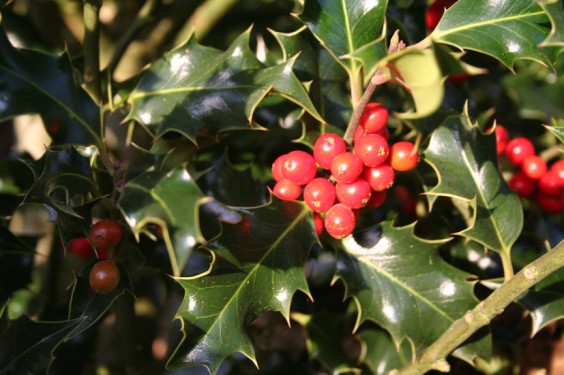
Hannah Genders explores the ancient folklore surrounding two of our favourite Christmas plants . . .
Most of us know the Christmas carol: “The holly and the ivy/When they are both full grown/Of all the trees that are in the wood/The holly bears the crown.”
The author and composer of this old carol seems to be unknown, but many of us associate holly and ivy images strongly with Christmas, and the idea of bringing greenery into the house in the dark days of winter goes back way beyond our present Christmas festival.
I had a vague idea as to where these rituals came from but decided to investigate further and find out how much I could discover about the folklore of these two common plants.
First of all we need to imagine the landscape of Britain several hundred years ago where the only evergreen plants would have been holly, ivy, yew and mistletoe, with no conifers or evergreen shrubs. The few native evergreens would have really stood out in the winter months.
The holly tree seems to have played an important part in the winter solstice festivals, and folklore stated that the holly was king during the winter months, and the oak was king during the summer months when it became dominant again.
It is easy to understand how these myths came about when you look at the changes we see through the seasons; the oak trees are dominant visually in our woods and fields during the summer and the holly trees seem to be swallowed up. However, when the oaks lose their leaves, the hollies and other evergreens stand out again.
Holly was also believed to have protective properties from evil spirits and to be able to protect your home from lightning – it was therefore considered bad luck to cut down a holly tree, but it was OK to coppice the holly branches.
Coppicing is when the outer branches are cut to allow new growth to come through the following year. Amazingly I also found out that this new growth was considered important animal feed in areas of the country where hay became scarce in the winter months.
There are records showing the buying and selling of holly for animal feed in Wales and Cumbria.
As well as animal feed, larger branches were used for tool handles and, as holly was thought to be good for training wild horses, many whips were made from it too.
Holly was thought of as a male plant in pre-Christian times and ivy was thought to be female – one of the winter celebrations involved a boy dressing up in holly leaves (there’s a painful thought) and a girl dressing in ivy. They would then parade through the village streets to bring good luck and rebirth in the middle of winter.
Holly also had a role in medicine; in medieval times the crushed leaves were used as a cure for hangovers and an infusion for catarrh and smallpox.
For the Romans, ivy played as important a role as holly in their winter celebrations. December 17 was the key date in worshipping the god of Saturn and on this date they gave holly wreaths and partook in lots of eating and drinking. It seems that the modern tradition of giving presents on Christmas Day could well have come from this practice.
Ivy was associated with Bacchus, the god of wine, and garlands were made which the Romans wore at their feasts. Ivy clinging to your house was thought to bring good luck and again ward off evil. Its black berries are a very valuable winter food source for birds, which is an excellent reason to grow it.
The original Christmas tree would have been holly – today’s practice of decorating a pine tree originated in Germany and was popularised in Victorian times.
Tree dressing has always been associated with pagan festivals, as was bringing greenery into the home to celebrate rebirth and ward off evil; so much so that many Christians in the 17th century thought it inappropriate for true Christian households and advised against it.
Whatever else you may believe about holly and ivy, they certainly do brighten up our Christmas festival and give us a promise that the winter will pass and we’ll have the chance to get out in the garden again soon.
Happy Christmas!
