

Hannah Genders looks ahead to a garden full of colours.
One of the best things about gardening is the fact that you are always planning ahead, and I think this is why it lifts our spirits so much to have our own garden and the opportunity to plan for a future season.
The excitement of choosing which flowers you would like to give early colour to an existing border or to add some interest under trees is great. I am often revisiting gardens myself at this time of the year to plant bulbs as the finishing touch to a project, which is very satisfying when I have been involved right from the start – from putting a design on paper to seeing it landscaped and planted.
So, this month I thought it might be helpful to give some ideas on planting bulbs in different situations.
One of my rules is to ‘keep it simple’, so when you are browsing through the latest bulb catalogue with the myriad of colours and cultivars, try to keep in mind the colour scheme of the border you are putting the bulbs in.
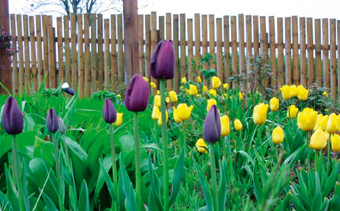
You can use a good drift of bulbs to contrast the colours in the border, but make sure you do this on a scale that will give good impact. For example, if you have a blue border you could sweep through a drift of Tulipa ‘Golden Melody’, a lovely buttercup yellow bulb that flowers in late April. For a good contrast try adding Tulipa ‘Queen of the Night’, with its luxurious purple flowers that look just like satin.
I have also planted Tulipa ‘Queen of the Night’ with deep red flowers and alongside purple foliage in other planting schemes and the effect has been stunning. When planning this sort of display as well as keeping the variety simple, it must be carried out with a good number of bulbs of each type. The effect is totally lost if either the species is changed too often or the numbers are too few.
In a small border of about 3 x 5m I would use ten to15 tulip bulbs of one type, so a total of about 30 bulbs. Plant them in a drift to pick out a central feature, like a tree, shrub or statue used as a focal point. To plant in a drift simply means having more bulbs in the middle and trailing off towards the edges and therefore trying to create more natural shapes.
The other great ability of bulb planting is to ‘extend the season’, as we say in the design world, simply meaning that bulbs can give you colour in the garden long before other plants are awake!
This is a particularly useful tool in a cottage garden planting where much of the colour is between April and July with few perennials coming into flower early or late, although there are some exceptions. Bulbs can do a great job of filling that gap. Choose from Anemone blanda, Cyclamineus ‘February Gold’ and Iris reticulata, to do this really well.
Other than planting bulbs in a border, I love to use them to naturalise new woodland. You don’t need lots of room to plant a drift of bulbs under a few trees and again create variety and interest.
The rules are the same: keep the colour and variety simple and as near to the native woodland species as possible. Anemone blanda would do well along with Eranthus hyemalis (Winter Aconite) or the lovely Cyclamen hederifolium, an ivy-leaved cyclamen for autumn flowering.
Again, plant plenty of the same variety, in drifts under the trees. The easiest way to do this in an open space is to throw the bulbs onto the ground in the area and plant them just where they land.
This should avoid any straight rows or lines – basically, what we are trying to do in this situation is to emulate what nature does so well in a native woodland! The bulbs should then come up each year and naturalise happily into their environment.
Happy planting.
