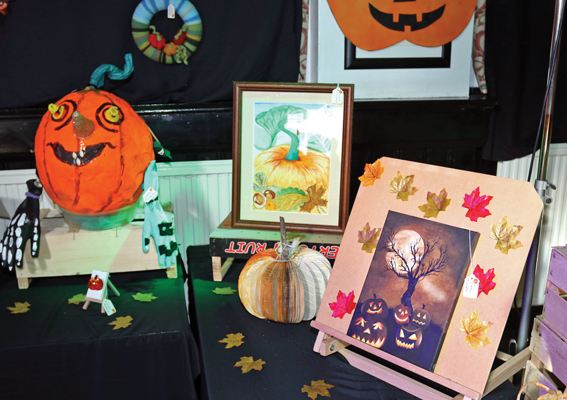
The second Alvechurch Pumpkin Festival will take place on Saturday October 27 in the Village Hall.
The public are invited to view the display between 11am-4pm, with pumpkin-related refreshments available in the downstairs café. Organisers hope to have as many, if not more, exhibits than at last year’s successful family event.
The festival is not a competition, and anyone can exhibit just for the fun of it. You may have grown a pumpkin yourself and carved it, or wish to carve a shop-bought one.
Pumpkin craft is also welcome – so try your hand at knitting or crochet, painting, baking, or crafting anything pumpkin-related.
All exhibitors will receive a badge featuring this year’s logo, designed by Sophie Rose, a Year 8 pupil at Alvechurch Middle School.
Entry forms can be downloaded from www.alvechurchvillagehall.co.uk or collected from The Lounge or the library in Alvechurch. There is a £1 entry fee for each exhibit and proceeds will go towards Village Hall maintenance and Papyrus (a charity for young suicide prevention).
This year there’s also a “best window” competition for village shops, with the displays judged by The Village magazine! A number of shops have already signed up, so look out for pumpkins appearing in the windows in the run-up to the event.
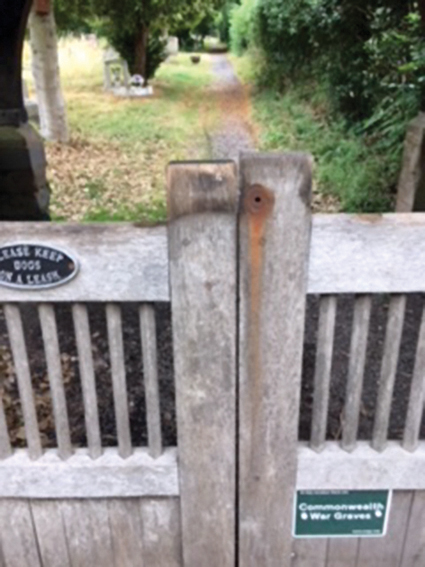
Churchwardens in Lickey are baffled by the disappearance and return of the latch on the gate to the cemetery extension.
When it was discovered to be missing, a replacement was ordered at a cost of £100 – but a few days later the original reappeared, with new nuts holding it in place.
“We thought the latch had been stolen, but why would anybody want an insignificant piece of metal?” said churchwarden Nick Forknell.
“Perhaps it just fell off when somebody used it, and they took it away in order to fix it? Either way, we are very grateful it’s been put back.”
Villagers are being asked to come up with ideas that could solve the growing parking problems across Alvechurch.
It is hoped a solution will also help to reduce traffic volume and speeds through the village centre.
Streets are becoming clogged as the number of cars per household increases, with driveways only having room for one vehicle. Sometimes there are whole streets with no driveways but two or three cars per household.
The problems is particularly acute near the station as better train services attract more commuters, but the station car park cannot cope, pushing the problem on to the surrounding streets.
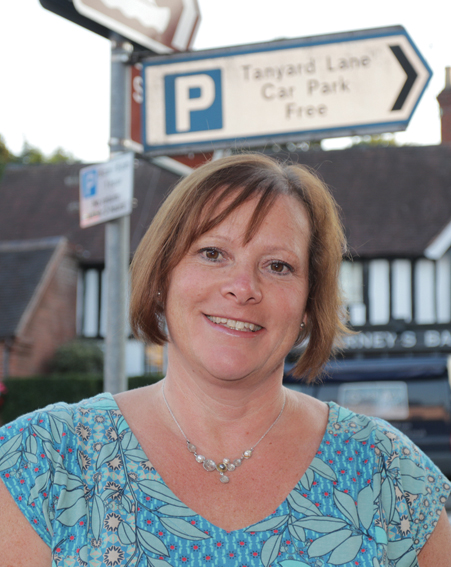
District councillor Kate Van Der Plank has launched an urgent call for ideas. “Rather than looking at this piecemeal, on a street-by-street basis, we need to look across the whole village, otherwise we’ll just push the problem from one road to the next,” said Coun Van Der Plank.
“I would be in favour of much more street parking in the village centre by removing double yellow lines and thinking about traffic flow, parking bays, and direction of parking.
“I think this would have the added benefit of slowing traffic down through the village centre and encouraging through traffic to use the bypass rather than choosing ‘the scenic route’ through the village.”
The search for ideas is backed by county councillor Charlie Hotham and Alvechurch Parish Council. A meeting is being held this month between the councillors and representatives of Worcestershire Highways to consider ways forward.
Ideas received so far by Coun Van Der Plank include having “horizontal” parking, similar to outside the Village Hall, on some wider village roads, such as along Swan Street. This would create a large number of parking spaces and, by narrowing the road, act as a traffic calming measure.
It has also been pointed out that any residential parking permits, such as those investigated for Bear Hill, would have to be introduced across the whole village so the problem would not just be pushed to the next street.
Anyone with any suggestions can email: kate.vanderplank@bromsgroveand redditch.gov.uk
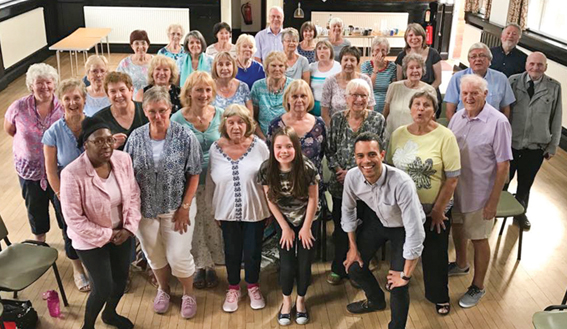
Alvechurch Community Choir enjoyed an afternoon of song with a workshop led by professional opera and choral singer Themba Mvula.
Themba, who studied at Birmingham Conservatoire and currently leads Lichfield Gospel Choir as well as performing in operas across the UK, was one of the Alvechurch choir’s early leaders, and the members were delighted to welcome him back.
The workshop ended with a mini-performance of the new material, including songs in Zulu and Xhosa!
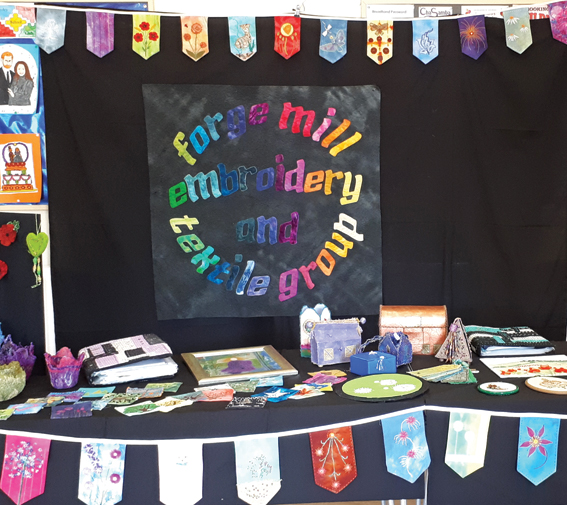
Forge Mill Creative Textile Group attracted plenty of visitors to their Open Morning at Beoley Village Hall.
The group placed various working tables throughout the hall where visitors could see different creative activities taking place and have a go themselves, including stencil work, dying, fabric painting, soldering and organza.
Visitors commented on the lovely atmosphere and a thoroughly enjoyable morning, which was all the better for the free coffee and cake on offer!
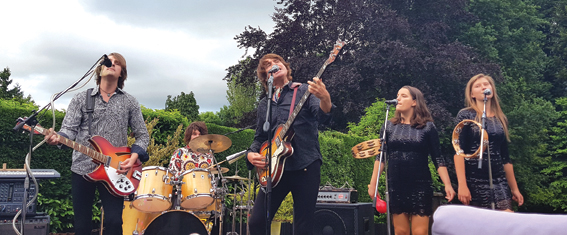
A group of villagers enjoyed a garden party with a difference: featuring a private performance from American rock band Lucky Tongue.
The band were staying in Alvechurch with Pat and Ron Ashworth, who met them while on holiday in California. Pat is a member of Alvechurch Community Choir and invited fellow members to join the party.
Lucky Tongue, made up of Blaine Ward, his sons Blade and Dylan and daughters Ireland and Gillian, played a mix of covers and original material. They were off to Kent the next day for another stop on their UK tour.
A charity garden party held in Bordesley attracted a host of visitors and raised money for three charities.
Penny Disbury has been opening her garden, The Piggery, to the public for the past five years, supporting Cancer Research UK (Breast Cancer), Dementia UK and Help For Heroes.
“We thought the extremely high temperatures this year would put lots of people off, but on the contrary, they came in their droves,” said Penny. “It was a record-breaking weekend; we served around 300 cream teas over four days!”
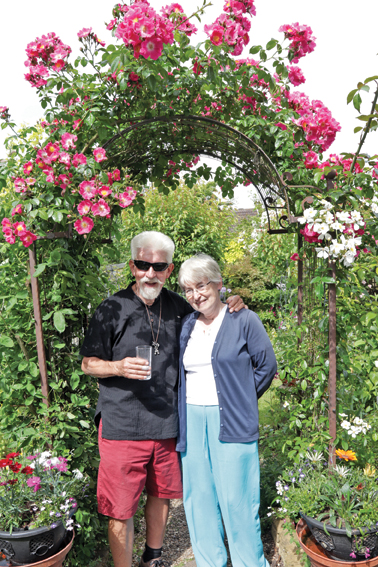
Although during most of the year Penny (pictured below) takes care of the sprawling gardens alone, a week before and during the annual event she enlists the help of family and friends.
The garden is spread over three acres and includes deep herbaceous borders, a huge vegetable garden, a wood, an ivy-clad Anderson shelter and lots of nooks and crannies scattered with unusual planters.
Within the price of the entrance fee, each visitor is served with a substantial cream tea, all home-made by Penny and her friends.
Martin and Janet Wright in their Callow Hill Road garden
The sun shone on Alvechurch’s bi-annual Open Gardens event, with ten different gardens welcoming visitors and raising a record £5,115 for charity under the National Garden Scheme.
SpaceX and Boeing spacecraft (Image courtesy of NASA)
Amateur astronomer Brian Watkiss peers into the Village night sky.
August, an exciting month anyway with warm weather, holidays and lovely long evenings. Oh well, two out of three isn’t bad. This year, August is even more exciting because we have news of developments in manned spaceflight and all the bright planets to see, as well as one of the best meteor showers.
So, to the USA, and since the last flight of space shuttle Atlantis seven years ago, American astronauts have relied exclusively on Russian Soyuz vehicles to get into orbit. This year may see that change, starting this month with a launch of an unmanned Crew Dragon spacecraft by SpaceX.
Then Boeing hope to launch their version, also unmanned, later in the month. Of course, the timescale could slip, and they are unlikely to be visible from Alvechurch, but if they are successful, it will pave the way for launches to the ISS later this year and then they could, occasionally, be seen.
Now for the plethora of planets. For the past couple of months, Venus has been clearly visible in the glow of the sunset, which is getting a little earlier, at about half past nine. Look for a very thin crescent Moon close by on the 14th.
As ever, Venus has defied the westward drift of the skies while Jupiter has complied. So, just a short distance to the left we can see the giant of our Solar System, looking brighter because it’s further from the Sun’s glare.
As the Moon trundles round Earth, it visits each of the planets in turn, getting close to Jupiter on the 17th.
Moving to the left again, the same distance as before, following the line of the Ecliptic, we find Saturn, rising at a much more reasonable time now. This planet is quite distinctive too, being as bright as Jupiter but a little more yellow in colour.
As the skies begin to properly darken and Venus sets, the two largest planets really stand out even though they are relatively low in the sky. The Moon, continuing its trundle, visits Saturn on the 20th/21st.
Now, Mars is sitting well below the Ecliptic at the moment. They do that, you know, these planets: wobble up and down above and below that mysterious line that marks the path of the Sun across our sky, and it’s the Red Planet’s turn to be a bit coy.
So we have to wait until ten thirty or so before we get chance to see it and even then it’s not very high above the horizon. The Moon helps or hinders on the 23rd, because it’s close to full, which is actually on the 26th.
The first half of the month is the time to go meteor spotting as the Perseid shower occurs while the Moon is out of the way.
So, after a hard day’s holidaying, what better way of spending the evening than sitting in a comfy chair, with, perhaps, a little something to quench the thirst, staring skywards and looking for shooting stars.
Mary Green continues her series on trees in the Celtic calendar.
Summer so far is warm and dry, but there is lots of sun, so all the plants grew and flowered well, and birds and mammals thrived. One thing the hot weather showed up was the way natural vegetation looks after itself in the dry whereas mowed grass just dies into a brown desert.
For some reason verges were left unmown for quite a while in June and the wild flowers flourished by the roadside, though there was a mowing later on dry ground which made everything very dead-looking.
There was a delay in mowing the churchyard too, reminding us that a beautiful variety of ancient plants like pignut grow there and are routinely mown to nothing in the interests of tidiness.
It has been a lovely classic English summer so far, but the dry weather will begin to take its toll if this weather continues as forecast. Wild life is pretty resilient but there are signs of a much reduced fruit crop: fruit trees want water. Some things that have benefited are the wonderful butterflies which love the sun, and the dragonflies and damselflies wherever there is water.
Hazel is the Celtic calendar tree for August. It is a tree I love, because it is so common and appears everywhere, adds great beauty at times of year when you need it, and has all kinds of uses. The hazel in mythology is a tree of magic and divination. Its use in divination is not entirely mythological, however.
It is traditionally used for water divining. A forked hazel twig held loosely in the hands will suddenly bend and twist as you carry it. This is believed to happen when crossing a source of water. I believe it, as my cynical old farmer father used a diviner to find the source of springs on the farm.
Hazel is the tree of the fairies, and a hazel wand can perform all kinds of magic! One Celtic legend tells of nuts falling from a beautiful hazel into a stream and being eaten by salmon, causing the orange spots on their skin. Hazel nuts represent a concentration of wisdom and insight. The medieval nun Julian of Norwich meditated on a hazel nut.
We know hazel as a hedgerow shrub, but in open places it can grow into a large tree. It likes poor soil and grows near streams in wild places, so you can find it all over the British Isles.
One of the reasons we think of it as a small tree is that is was often coppiced – cut down and allowed to regrow. Hazel takes particularly well to coppicing, partly because it naturally coppices itself!
There is often not a main trunk on a hazel, but lots of small trunks growing from one root. Even if it has a main trunk, it will often have side shoots. These often grow nice and straight and when cut can easily be made into bean poles, walking sticks, Morris men’s sticks, line props or the framework for furniture and buildings.
Hazel can be split and bent, so it made “wattles” for fencing, and rods to peg down thatch. So, hazels were really useful and encouraged to grow.
In January and February, hazel has gradually lengthening catkins – the familiar ones known as lambs’ tails. These are often the first flowers you see at that time of year. What you may not realise is that these are only the male flowers. There are little female flowers too, which usually come in February.
They are tiny red spray-shaped flowers growing from a bud. These receive the wind-blown pollen from the male catkins and become hazel nuts. Flowering this early in the year, the tree cannot rely on insect pollination, so it is wind-pollinated.
The nuts used to be a major food source for country people, gathered in August or September before the squirrels get them all! Squirrels love them of course, as do some birds, especially the nuthatch.
This little bird will take the nut to a crevice in a tree, wedge it there and bang away with its hard beak until it gets into the sweet flesh of the nut.
Squirrels take them away and store them, thus helping them to grow and spread when the squirrels forget where they are! For humans, they were eaten raw or roasted, or ground to make a flour, and they are very delicious.
They were bred to produce bigger and better nuts, the various kind of cobnuts that used to be in orchards throughout the country, and which are still sold in autumn at some local farmers’ markets.
The nuts could be eaten green but were more often stored until October/ November. Sometimes there were celebrations around Samhain (Halloween) at which the new season’s nuts were eaten.
From September onwards the leaves of hazel turn a beautiful golden yellow. They are quite rounded, and when they fall look like those gold chocolate coins we used to have at Christmas! At this stage you can already see the tiny catkins getting ready to grow for the next year.
A coppiced hedge will grow rapidly, and within a few years will be ready for laying. Hazel takes well to laying, along with hawthorn. It’s the best way to get a thick hedge, as hazel naturally grows quite thinly.
It’s quite unusual to find a hedge of pure hazel like the one we have had coppiced at the Lime Kilns site at Tardebigge. More usually they are interspersed with other trees like elder, ash, maple and oak.
These crafts, coppicing, laying and using hazel, have been revived a lot recently, and we have a local hazel coppicer, Dave Ward, in Alvechurch, as well as local farmers like Adrian Bytom who coppice and lay hedges in the proper fashion. Good managing of hedges is so important for the ecology of the area.
One of the other Celtic “trees” connected to this time of year is heather. It may seem odd to us to think of heather as a tree, but of course there is really no technical definition of a tree – it’s just a big woody plant.
Heather can grow quite big and woody, and in some places abroad is used for hedging. It is uncommon around here as it likes acid soil, not our Midland clay.
However, it can be found elsewhere in Worcestershire – near Kidderminster, around Hartlebury and Bewdley, where there are old heathlands, and a little on the Lickeys. It’s not too far to Kinver Edge which has glorious heather.
Of course, it covers vast acres of moorland and mountain in the north and west of the UK. It’s a sign of “poor soil”, which is not suitable for much agriculture, but not poor for the things that like growing on it!
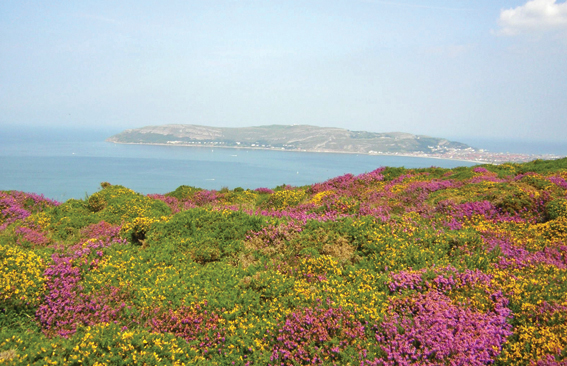
August is the time for heather to flower, and it makes the whole hillside purple. Occasionally it comes white, which is considered lucky. There are several different kinds of heather. The commonest is ling, but cross-leaved heath and purple or bell heather are also common.
There are other rarer local types, and I have found St Dabeoc’s heath in Connemara. They are in the same family as the bilberries and blueberries which grow in similar locations.
Heather was used for bedding and brooms and anywhere you needed something long-lasting, springy and shock-absorbing. When it’s young, animals can feed on it, and bees love the flowers – in fact it’s one of the most-used nectar producers for bees, and the honey is much-liked.
On grouse-shooting moors the heather is often burnt, which is not very good for the environment or health. Burning or “swaling” used to be quite common to get a fresh growth of young plants for animals to feed on, but it damages the habitat and releases polluting particles. Recent wildfires on the Pennines show how much damage fire on a moorland can do.
Heathland, which takes its name from heather (or perhaps vice versa) is becoming a rare habitat in central and southern England. In some places conservation groups are trying to re-establish it, and you can see this in the nature reserve near Bewdley called the Devil’s Spittleful.
This kind of restoration is contentious as it often means removing native trees which have grown there as the soil has become more fertile.
Naturally-occurring woodland (somewhat disparagingly called “scrub”) is also a rare habitat these days, and trees are better for the general environment than heathland. On the other hand, heathland supports some really important species, especially of butterflies but also mammals, lizards and adders.
Meanwhile, enjoy the scented purple heather when you see it!
I wrote this poem a couple of years ago to celebrate people in my life.
Courage
There are people who put courage in you.
My first, maybe, one teacher, who showed me
The power of words and the need to think free
When the others were trimming and tidying me.
Then someone who gave me faith in my body
That it could love and be loved in laughter
Next someone who trusted me in my work
Taught me to do the near impossible
Brave because of a belief in other people.
And I went on the back of a motorbike
With someone who made me see
I was safe with a touch if I trusted.
I went in a hot air balloon, flew a plane,
Never fearing flying again, a bird woman.
I learned that I could make music, stand up
In front of the world and sing aloud
When others sang with me, making harmony.
Now I am learning not to be old, to walk
The gunwales, the early morning streets
And the late-night towpath, feet without fear.