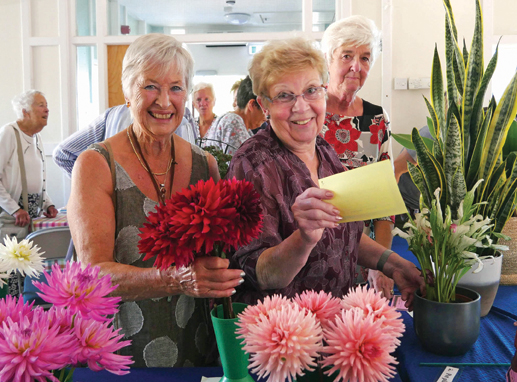
Rosehill Flower Arrangement Society (RFAS) has enjoyed a great history of successful flower arrangement demonstration programmes – having celebrated its 50th Golden Anniversary last year.
The annual programme includes beautiful and entertaining flower arrangement demonstrations by well-known National Registered flower arrangers, together with social fun events, raffles, outings and opportunities to meet new friends.
In July a great summer luncheon was enjoyed at the Trinity Centre in Lickey by a large number of members and visitors, followed by a “Magic Moments” floral demonstration.
At the recent National Association of Flower Arranging Societies’ Area meeting in Evesham, Rosehill FAS was delighted when one of its members, Elaine Edgar, was congratulated upon her imaginative floral arrangement, winning second prize in the Novice Category “Midsummer Night’s Dream” and simultaneously picking up the award for “Best use of Garden Plant Material” in the show.
Rosehill FAS meets on the second Monday of the month (except January) at 2pm at the Trinity Centre, Lickey. New visitors are warmly welcome to go along. For more info, contact Belinda on 0121 447 7477 or Diana on 01527 870549.
Exploring Shostakovich, presented by Festive Classics, is a weekend of music
and talks at Artrix in Bromsgrove, celebrating the composer’s life and work.
Between Fri Oct 26 to Sun Oct 28, the Dante Quartet will play all fifteen quartets, with each performance introduced by BBC music broadcaster Stephen Johnson. There are also talks from a friend of the composer and experts in Russian music, plus a masterclass with cellist Robin Ireland. For the full programme, see https://www.festiveclassics.co.uk
Saver Tickets for the whole weekend can be bought from 2 College Walk, Bromsgrove B60 2ND or on 01527 874136, or buy single tickets from Artrix via 01527 577330, boxoffice@artrix.co.uk or https://www.artrix.co.uk
Bromsgrove artist Richard McIlwraith is thrilled by the talent of local embroiderers.
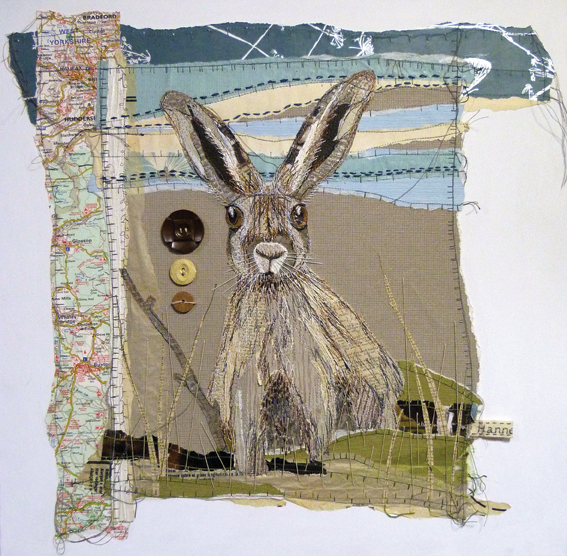
You simply must visit Artrix in October and see the staggering textile artistry on the art centre’s white walls in this touring exhibition by the Embroiderers’ Guild. Each of the 120+ pieces take a book as inspiration.
The display is named “Page 17” and may just leave you speechless. Viewing the combination of painstaking work and rich imagination is an intense experience, heightened by the knowledge that the creators range from experts to gifted novices.
Curators Amanda Smith and Alex Messenger created this overwhelming display to raise the profile of textile and stitched art. Traditional hand stitching and contemporary machine work intertwine and dance as you move through the exhibition.
Amanda and Alex asked me to stress that this is the final opportunity to experience the exhibition; following a remarkable year, the tour of the UK comes sadly to an end.
Words to artistry and back to words: A review in prose seems inadequate. Having spent the best half-hour of my week soaking in this exhibition, something deeper, more elemental, more creative is the only response that feels appropriate. Here goes…
Jane Austen’s Persuasion, Domesday Book of 1086, Watership Down by Richard Adams, Prehistoric rock art, Sketchbooks, poetry, British flora – Scores and scores of stimulating books –
Explosions of imagination. Enigmatic art in thread and cloth.
Textured gesso, gauze, Remnants, velvet, wax and silk, Wire and foil, fabric stain. Pause. Step back. Admire.
A library of toil; white walls filled. Full, unchained applause.
Visit https://www.embroiderersguild.com to find out more about the Guild and your nearest branch. The Artrix exhibition runs until Sunday November 4 at the following times: weekdays 9am to 2pm; Saturdays 10am to 2pm; and on performance evenings. Don’t forget there is a café too! Artrix is located on Slideslow Drive, Bromsgrove, B60 1GN.
Please get in touch if you would like me to write about an art event near you: richard@galleryart61.com
Judy Lawrance, flower photographer, shares ideas for the next growing season.
As we head towards the end of the growing season and just before it’s time to plant next season’s bulbs, we have a breather to take stock, to sit and enjoy the last of the roses and plan the garden for next year.
If you live in parts of Bordesley and Alvechurch, you probably have to work with heavy clay soil – two days of sunshine and it’s like digging concrete; a few days of rain and the earth “glugs” when you try to dig a hole.
Clay is OK to grow shrubs and trees, for making pots and for the kids to use as Play Doh! That’s not to say it isn’t fertile for roses and a few other plants, but to try and create an herbaceous border or to grow bedding plants isn’t much fun.
If you don’t mind rolling up your sleeves and getting down to a bit of hard digging, then one solution is to replace the whole of the soil with topsoil – a mammoth task – but if you don’t quite have the energy or inclination to do that, then another obvious way to add colour to the garden is to use planters: any size, shape, colour or style. The more unconventional, the more interesting!
Penny Disbury, featured in the August issue of The Village, is the “queen” of planters. A prolific gardener, Penny grows all her bedding plants in containers. Calibrachia growing in teacups made from old car tyres; geraniums planted in a discarded porcelain washbasin, including taps; petunias smothering an old iron bedstead, and trailing this and that from hanging watering cans and wall planters contained in picture frames.
If it’s big enough to hold soil and easy enough to drill drainage holes, then Penny will use it! So really anything goes if you’re brave enough to try.
Salvage yards and junk shops are great places to pick up chimney pots, old tin baths, dolly tubs and stone troughs, all at reasonable cost. Place them in a border, among dull coloured shrubs, a dark corner where there’s not much sun, or on a patio to add interest and a talking point.
The latest trend, rusted metal rings, can be purchased from some garden centres. They are simply lengths of mild steel, bent into tube shapes and welded together. They don’t have a bottom as they just sit on top of the soil.
The bought kind are already rusted, but if you are able to get someone to make them for you, you can choose the diameter and height to suit your garden.
A good winter will see them change from a dull grey smooth metal to a beautiful subtle, textured, rusty orange colour. For a minimalist look, try placing them in a bare border or on a flattened piece of ground then filling the gaps with shingle or tree bark.
Layering bulbs when filling them will give a colourful show in the spring and planting on top with bee-friendly long-lasting perennials will give months of continuous colour throughout the year.
For the less adventurous, terracotta and enamelled pots are always a good choice (the frost-proof kind). Small pots can be arranged along a border or grouped together in a larger container. Even broken pots can be used imaginatively.
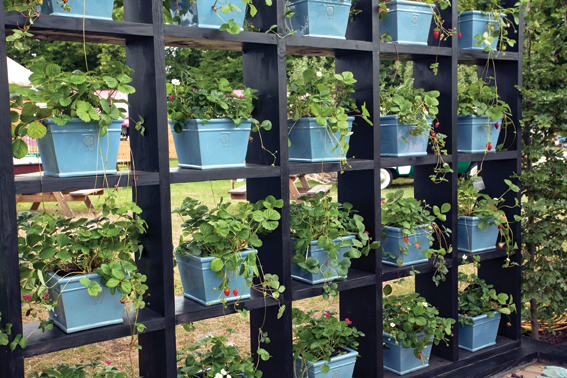
The large wooden structure (above), exhibited at the RHS Hampton Court Flower Show, is an imaginative way to display enamelled pots. The pots could all be the same style or a mixture of different sizes and shapes. Easily adaptable to smaller gardens for use as a screen or simply stood up against a plain wall or fence. A good autumn project!
Long, thin gardens can sometimes create wasted space at the bottom end. Two generations ago, this would have been a valuable area to grow the family’s vegetables and cutting flowers.
But sadly, without the necessity to grow vegetables nowadays, “the bit at the bottom” is sometimes neglected, left to grow wild, fenced off or used to house a shed. Not the place to be growing decorative vegetables or delicate delphiniums – or is it? In an area such as this, if you want to take on a bigger project, then railway sleepers could be the answer.
We had one such area at the bottom of our garden – solid clay, uneven, full of roots and generally an eyesore. So my husband Mike and I came up with a plan to reclaim it. Armed with a few railway sleepers, a drill and some long bolts, Mike set about making some raised planters.
The sleepers were simply laid on the ground and bolted together through their ends, then between us we levelled them off, propping them up at one end with broken bricks and then digging the earth away at the other.
We didn’t need to worry about the poor soil or the roots just below the surface, or the ground between them being uneven. The roots would be covered with weed suppressant and the gaps between the planters would be filled with gravel, taking care of any dips.
Once built, we squared them up, lined them and then filled with a mixture of topsoil purchased from a garden centre; a few bags of well-rotted manure; a small amount of finely chopped clay and finally soil from an old vegetable plot belonging to a friend. Once finished, I looked upon them proudly – all that beautiful loamy soil!
There are so many growing choices for large planters such as these. They don’t have to be too high – a shallow planter painted black looks neat. Fill it with ornamental vegetables and you have a very contemporary look for a modern garden. A two-sleeper high planter would work well as a cutting garden: every square inch could be used and the flowers deadheaded, tied up and cut without bending down too far.
A rose garden would be the choice for some with blooms at eye level and easy pruning. A nursery bed would do well, especially if you like rescuing “poorly” plants from garden centres or you like to grow from plugs. Maybe a wild flower patch to fill the space easily and quickly – a box of seeds, sown in spring, will give colour right through to the end of summer. This would be an ideal introduction to gardening for small children as everything grows so fast. Not forgetting the bees, the ladybirds and butterflies they’ll attract.
But for me, I chose mainly bee-friendly cutting-type flowers because I’d always found it so difficult to grow them in my borders. The first year was impressive, the second was beyond my expectations.
But the bonus for me is that I’m able to use this area as an outdoor photography studio, to capture those perfect blooms any time of day, any day of the week and in any kind of light and weather conditions. And being indecisive, I can move the plants around as and when the mood takes me!
Amateur astronomer Brian Watkiss peers into the Village night sky.
October, and our summer-long parade of the planets is over. Venus has disappeared round the Sun and Jupiter is only just visible in the glow of the sunset. Look for it as soon as the Sun has gone and don’t hang about; it too will set at around eight. A thin crescent Moon is just above it on the 11th.
NASA launched a probe to this giant planet seven years ago, called Juno, and it has been sending amazing pictures back since it arrived there in June.
We still have Saturn in the south, in the same position that Jupiter was a month or so ago but, being further away, not as bright. It is, however, a little higher because the Earth is now starting to tip its head away from the Sun, lifting the night sky as it does so.
Look out for Saturn as soon as the sky is properly dark, it’s alone in this part of the sky, there being no bright stars nearby. The Moon visits it on the 14th. Saturn had its own probe until a year ago, Cassini, and it also sent wonderful pictures back, especially of the extraordinary ring system for which this planet is famous, and the effect the various moons had on them.
Saturn has many moons but probably the most famous of them is Titan. A probe was landed here in 2004, Huygens, which hitched a lift on the side of Cassini. It revealed a strange world of rocks made from super frozen water and oceans of liquid methane.
Now we come to Mars. It has been dominating the skies in the late evenings but is now very obvious much earlier. Left of Saturn and at a similar height, its orange colour can be clearly seen and it will look spectacular with the Moon close by on the 18th.
Mars has had numerous probes sent to it over the years and its surface is littered with landers. It still has about six active orbiting craft, but down on the surface there is some bad news.
Little lost rover (Image courtesy of NASA)
Opportunity, a rover which has been trundling about the surface for more than 14 years, doesn’t seem to have survived the recent dust storm which engulfed the planet in June. NASA has been sending it a simple instruction to just beep if it can hear but there has been no reply. Doesn’t that seem so sad?
So, when you’re gazing up at Red Planet, think of that little rover sitting there, covered in dust and unable to speak. It has sent back lots of science, though, and excellent pictures, as, indeed, its younger and larger cousin Curiosity continues to do.
While you’re admiring bits of our Solar System, keep an eye out for meteors as there are two minor showers this month, due to peak on the 10th and 21st. There are a couple of launches to the ISS due too, so keep another eye on https://www.heavens-above.com to see if they are visible above Alvechurch.
Mary Green continues her series on trees in the Celtic calendar.
September at last brought cooler weather, but we’ve certainly had a summer this year! I hope we continue with a traditional mellow autumn.
Maybe we will have a warm spell in October, called St Luke’s little summer – his day is October 18. And at the end of the month we will be into the start of winter by the old calendars, following All Saints’ Day.
I’m often pleased by how well the Celtic trees fit in with what I would be writing about this month anyway. This month is a good example: the tree is blackthorn and the “secondary tree” associated with this time of year is ivy.
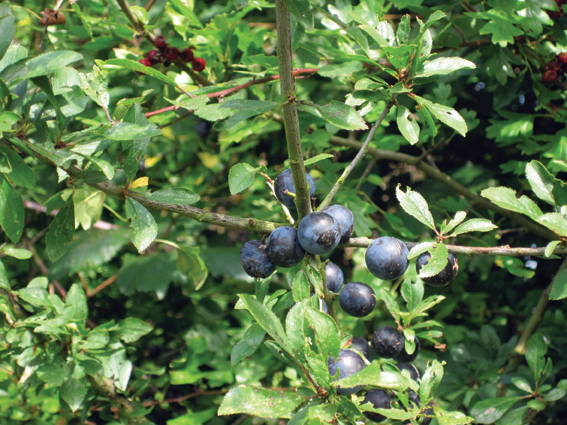
Blackthorn or sloe is a small tree but a really important part of our countryside and traditions. It is one of the plum family, with black twigs and fruit, and white blossom. In winter it looks very dark and its spiky thorns make it an impenetrable barrier. It was always much planted for hedging as well as growing wild.
Blackthorn is not the first white blossom we see in the hedges in spring; that is the very early cherry-plum. But blackthorn is the first one that really covers the hedges in blossom and creates pathways for the bees and other spring insects.
It flowers in March or April, about the same time as cultivated damson and plum trees, with small very bright white flowers in thick clusters. So long as there are not too many late frosts, the fruits follow, ripening much more slowly than cultivated plums. They are ripe about now, in October.
Perhaps the word “ripe” is misleading with sloes. They stay very bitter and are almost impossible to eat raw. But they have always been used cooked, especially to flavour other sweeter fruit like apples. Some people say they are better after a frost, and you can often pick them into November.
One of their main uses nowadays is in sloe gin and other liqueurs. This takes about two months to steep, so is always magically ready for Christmas. Two hundred years ago sloes were used steeped in water with a little cheap brandy to produce an imitation port wine.
One of the interesting things about the plum family is that they can interbreed. As well as the blackthorn and cherry plum, we also have a wild native plum called bullace. This is a dark fruit, about the size of a damson but rounder. It can be quite sour but is definitely more edible than a sloe, and makes gorgeous jams and puddings. I know of three within walking distance of here.
There are also of course orchard damsons and plums growing wild in the hedges. All these can interbreed with sloes. Because of this you may find blackthorn bushes with fewer thorns, larger flowers and juicier, slightly less bitter fruit. There are some around here, but people tend to keep their locations to themselves!
Blackthorn wood is very hard and resilient and was much used for walking sticks, using the natural knottiness of the wood to make them ornamental. It was the wood traditionally used for Irish shillelaghs. The thorns are very sharp and can puncture tyres, so hedge trimmers need to clear up carefully after themselves.
Blackthorn doesn’t seem to attract so much mythology as its relative the whitethorn or hawthorn. It appears a lot in medieval poetry and folksong, though, as a description of female beauty. Girls have skin as white as blackthorn blossom and eyes as black as sloes – including a famous one in Chaucer’s Canterbury Tales.
It also appears in weather folklore. The period when it flowers can often be a cold one, and if there is a cold snap in March or April it has been for hundreds of years referred to as a “blackthorn winter” – the counterpart of St Luke’s summer.
Black, white and red are colours found in many mythologies and religions. Blackthorn only has two of them, so it has the emblems of old age and death (black), and of youth and purity (white), but not the red symbols of maturity and passion.
It is linked to the Celtic spirit in her guise as Brigid, the bride or young woman of spring and of the Imbolc festival, and with her older embodiment as the crone who presides over the period of Samhain, the autumn festival which brings us close to the dead.
Samhain, of course, lives on in Christian times as Halloween/ All Saints’ Day at the end of October. Festivals of death, when autumn transitioned into winter, were not seen as sad affairs but as a way to connect with the people who had died but who were still present around us. So, blackthorn was seen mostly as a hopeful tree linking death and birth.
Many folk songs and stories include mention of a “prickly bush” usually as a symbol of difficulty and hardship, and this was probably visualised as a blackthorn, forming its dark thickets. For most of us, it’s one of the beautiful signs of full spring when it whitens our road hedges and canalsides.
The secondary tree for this time is ivy, which also has black berries. It is a special plant at this time because it is in flower when all other flowers have gone. It will be covered with late bees, butterflies and other insects especially if we are having a St Luke’s little summer.
It is a symbol of tenacity and staying power because of the way it clings on to stronger trees and survives extremes of weather. It was often seen as a particularly female plant, unlike the masculine holly. The way it embraces trees, together with its evergreen nature, made it often used as an image for love. It is our only native evergreen climber.
Ivy has a long association with alcoholic drink and was once believed to be able to cancel out the more harmful effects of alcohol. Drinking vessels were made of ivy wood. The ivy bush thus became a symbol for a tavern.
Ivy was also seen as having various curative and protective properties for animals, especially cattle, and its presence ensured wholesome milk. It was used as a charm to take away warts and verrucas. Sometimes it was banned in churches because of its magical and alcoholic associations!
There is disagreement about whether ivy damages the trees it grows up. It is not parasitic so doesn’t compete with the tree, and often lives in harmony with it. It doesn’t have to climb, and can grow along the ground, but finds trees handy as a scaffolding.
However, ivy is very vigorous, and its sheer weight may damage a weakened tree. It covers deciduous trees with leaves in the winter, making them more susceptible to storm damage. But it doesn’t directly damage the tree itself.
Ivy has often been used as decoration, made into wreaths (the young Queen Victoria wore a jewelled ivy wreath in her hair) or used because of the beauty of its leaf patterns. It was the most used plant for the Christmas wreath, often entwined with its partner the holly, and appears in carvings and ornamental metalwork, as well as being loved by flower-arrangers.
It is beautiful all year round. Its flowers are vital for insects in autumn and its berries for birds in winter. A real magic plant!
Here’s another magic plant: my poem linked to the Alvechurch Pumpkin Festival this October.
The pumpkin
I bought my Whitsun pumpkin in the Park,
A poor wee thing, two leaves on a few roots,
Took it home under the thunder and found a tub
Crammed it with last year’s crumbly flesh-warm compost
Planted it under my window in the sun.
The sun shone and shone, the plant grew
I watched its little tendrils corkscrew out
Clutching the rose and climbing up the wall.
Flower after flower opened, fêting every day
And dying every day, but bright with hope.
Bees and flies buzzed around it. But no fruit.
Just sun after sun smiling and cheering loudly.
Then one day, rain, and then a little swelling.
I watched it grow to golf ball size and fall off.
No fruit then. But my fruitless plant
Still sent huge fireworks of stars each day
As big as plates, now clutching the tomato plants.
People passing by stopped and stared
Dog walkers, children, neighbours, house-buyers
Some asked me what it was, this giant tomato-flower,
Other just smiled as brightness entered them.
Late summer, and another swelling comes
A cuckoo growing on the tomato plant
Making me rewrite this poem as it grows.
Not much chance, I think, in these cold nights
Yet still it grows, despite a weakened stalk,
Drinking the strength of a warm September
But shaping longer than it is around –
Is my pumpkin a marrow all the time?
Who cares. Welcome whatever it is.
Bright and beautiful as summer dawns
It lifts my heart up higher than the house
Flowering to feed the heart and soul
True to itself, fading and renewing. Like poetry
Like life, having to be rewritten, every day.
Government payout is also a reminder to sort out your ‘living will’, says Martin Pryor.
It is not often that the government offers a refund because of overcharging, but last month it emerged that the Office of the Public Guardian (OPG) had been levying excessive fees for four years.
The fees related to the cost of registration of a power of attorney, whether it was an enduring power of attorney or either of its lasting power of attorney successors – dealing with health and welfare or property and financial matters.
The OPG was meant to cover its costs with attorney registration charges, but instead ended up with an £89 million surplus. As such, this sum is being returned to those who registered a power in England or Wales between 1 April 2013 and 31 March 2017.
The maximum refund is £54, and most claims can be made via an online form at https://www.gov.uk/power-of-attorney-refund
If the person who granted the power of attorney has died, then that individual’s executor must make a claim by email. Figures obtained via a Freedom of Information request show that up to 1.8 million people may be due a refund.
If you have never registered a power of attorney, either for yourself or perhaps an elderly parent, the refund still has relevance as a reminder to do so. Enduring powers of attorney address the question, “Who deals with my affairs – personal and financial – when I cannot do so?”
Although often thought of in terms of the elderly going into care, enduring powers of attorney have a much wider relevance. Unfortunately, accidents can and do happen at all ages.
Powers of attorney are frequently dealt with alongside wills as part of estate planning – in some respects they can be regarded as a form of living will. A Lasting Power of Attorney is a legal document that authorises others – your attorney or attorneys – to act on your behalf.
There are several types of Power of Attorney and the one you need depends on your circumstances and what you want it to cover. A Power of Attorney must be created while you are able to make decisions and understand what you are doing.
Property and Financial Affairs Lasting Power of Attorney This type of Lasting Power of Attorney allows the Donor to choose one or more attorneys to make the following decisions in respect of:
Paying bills, including mortgage, rent and household expenses
Buying or selling your home
Opening, closing or operating any bank, building society or other accounts
Receiving any income, inheritance or other entitlement on behalf of the Donor
Dealing with the Donor’s tax affairs
Insuring, maintaining and repairing the Donor’s property
Investing the Donor’s savings
Making limited gifts on behalf of the Donor
Paying for private medical care residential care, or nursing home fees.
This Lasting Power of Attorney allows the Donor to appoint individuals to manage their property and financial matters at any time.
Health and Welfare Lasting Power of Attorney This type of Lasting Power of Attorney allows the Donor to choose one or more attorneys to make the following decisions in respect of:
Treatment and Welfare care
Deciding if they should have a knee replacement
Where to live and with whom
Who may or may not visit them
What they want to buy, wear or where to shop
Holidays, outings and other experiences
Running the house, choosing interior decoration and furniture
Deciding about terminal illness treatment and care
Considering where they may like to die and the funeral arrangements.
This Lasting Power of Attorney can only be used when the Donor has become unable to make their own decisions.
If you have not reviewed your estate planning for a while and you have no powers of attorney in place, you could make plans now. You never know when an accident might happen.
The Financial Conduct Authority does not regulate tax advice or will writing.
Alvechurch amateur weatherman Phil Thomas records the changes.
As we went to press, September was continuing the warming trend for this year. There was a warm start with temperatures into the 20s, but things cooled down later. It stayed mostly dry, with a few wet damp days towards the middle of the month.
There was a marked change in the weather from the 17th onwards, with two named storms with very strong winds up to 43mph locally. Rainfall over this period was more than 35mm. Autumn is here!
September 2018 (to the 23rd)
Mean Max 18.9C 0.7 above average
Mean Min 10.3C 0.7 above average
Mean 14.6C 0.7 above average
Rainfall 50mm 82% of average
Sunshine 64.8 hrs 52% of average
August continued the warm weather from July, with a maximum temperature of 28.2C on the 7th. The weather then changed to a “more normal UK summer” with wind, rain and much cooler temperatures.
Because of the very hot first week, the mean temperature of 17C was still 0.8C above the local mean.
August 2018 Mean Max 21.9C 0.6 above average
Mean Min 12C 0.4 above average
Mean 17C 0.8 above average
Rainfall 51.4mm 98% of average
Sunshine 138.3 hrs 92% of average.
Summer 2018 (June, July, August) Mean Max 23.2C 2.6 above average
Mean Min 12.2C 1.0 above average
Mean 17.7C 1.8 above average
Rainfall 81.6mm 47% of average
Sunshine 625.6 hrs 141% of average
Outlook The Met Office computer models suggest that periods of dry and fine weather are likely at times, especially in the south of our area. Occasional spells of more unsettled weather are likely, with a risk of wind and rain at times.
Overall daytime temperatures are likely to be average or slightly above, but the lengthening nights may lead to low overnight temperatures, with patchy frost locally.
More information at https://www.alvechurchweather.metsite.com
You can see an improved HD weather-cam, updated at one-minute intervals, at: https://www.alvechurchweather.metsite.com/webcam_alvechurch.php
Action from the win at Redditch United (Photo/ Ian Macvie)
AFC are involved in plenty of cup action this autumn.
Alvechurch FC progressed to the second qualifying round of the FA Cup, via a seven-goal thriller against Bromsgrove Sporting and an away win at Stratford Town.
In the home match against Bromsgrove, the 728 supporters were treated to four goals in the first 18 minutes. The visitors scored first but ’Church responded instantly through Josh March before Luke Yates gave them the lead.
A Bromsgrove penalty made the scores level at half-time, before two spot-kicks from penalty king Tom Turton won the game for AFC – despite a late Bromsgrove goal making for a nervy finish.
The Stratford Town match had far fewer chances, although Alvechurch had a goal disallowed in the first half. Despite Stratford going down to 10 men when Cody Fisher was shown a straight red card, ’Church found it difficult to break down a stubborn defence until substitute Aaron Lloyd scored the only goal with his first touch of the game.
As we went to press, AFC were due to play Corby Town in the next round.
Alvechurch then beat Bromsgrove Sporting for the second time in two weeks in the Southern League Challenge Cup. This was a far cagier affair and it took a touch of class from Kieron Cooke to secure a 1–0 victory after the dismissal of Bromsgrove’s Jason Cowley late in the first half.
AFC have been drawn at home to local rivals Highgate United in the first round of the Birmingham Senior Cup October 9 at 7.45. They also play Bilston Town in the JW Hunt Cup.
Meanwhile, having begun their league campaign with two draws and a defeat, Alvechurch recorded their first league win of the season by beating Redditch United 3–0.
This was followed by another 3–0 victory over high-flying Needham Market – in the team’s best performance of the season so far, they ran out easy winners to climb into the top half of the table.
* Alvechurch have signed prolific scorer Trea Bertie from Racing Club Warwick. The forward scored regularly for Warwick, and prior to signing for them scored 19 goals in 19 matches for Smithswood Firs.
Central defender Luke Paskin has left Alvechurch to join Lye Town, having rejoined Church at the beginning of the season. Goalkeeper Matt Sargeant has also played for Lye Town this season, to gain match fitness before establishing himself as the number one keeper at Lye Meadow.
Experienced centre forward Nathan Waite has joined Southern League Division 1 Central side Coleshill Town. He wasn’t getting the game time he wanted at AFC so decided to move on.
Former Alvechurch forward Yusifu Ceesay has signed professional terms with League 1 side Blackpool. Yusifu played a significant role in last season’s success, creating and scored many important goals, and thoroughly deserves the opportunity to play at professional level. Yusifu has signed a two-year contract with the option of a third, and all at AFC wish him well.
* For more info or sponsorship enquiries, please contact Trevor Ball at saintsarehot2@btinternet.com or visit www.pitchero.com/clubs/alvechurch
Follow the club on Twitter @Alvechurch1st
FIXTURES All league fixtures unless stated
Sat Oct 6 3pm Barwell (A)
Tues Oct 9 7.45pm Highgate United (H) Birmingham Senior Cup R1