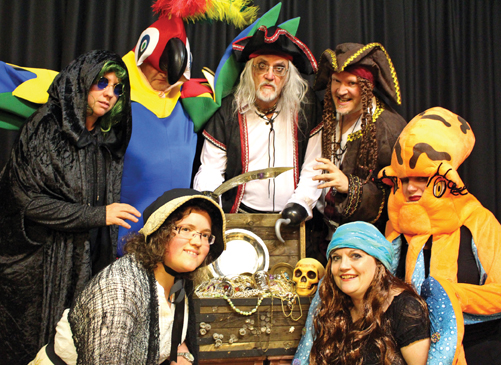
Clockwise from left: Lesley Piddington (Blind Pooh), Keith Johnston (Pretty Wally), Ges Taylor (Cutthroat Jake); Martin Salter (Slack Marrow), Gemma Batty (Handy the Octopus), Emma-Louise Hodgson (Woozy), Emily Waller (Mistress Hanky).
For their latest pantomime Alvechurch Dramatic Society are heading to the high seas for a tale of piratical skulduggery: The Lost Treasure of Numbskull Island.
Brought to you by Chris Davies and Paul Chamberlain, who are to blame for all of the Society’s recent pantomimes, the show will feature plenty of “Yo ho ho” and quite possibly a bottle of rum!
Anne Bonny is desperate to join a pirate crew, but gets more than she bargained for when the dastardly Slack Marrow and his gang sail into dock. An unusual treasure map sends them on a quest for booty, but will the curse of Numbskull Island strike again? Or will the great King Neptune and his friends intervene? And will romance blossom between young tearaway Tom and Fish Finger the mermaid?
Join us aboard the Jolly Bodger to find out! You’ll find all the usual panto fun in a tale of buried treasure, undersea creatures, shanty singers, unfortunate castaways, an oversized parrot and much more! So come and walk the plank to Alvechurch Village Hall and remember – dead men tell no jokes!
The panto will be performed from Weds Nov 28 to Sat Dec 1 at 7.30pm nightly, with a 2.30pm matinee on the Saturday. Tickets £7 (£6 concessions) from The Lounge in Alvechurch, by calling 0121 447 7071 or emailing ads.alvechurch@gmail.com
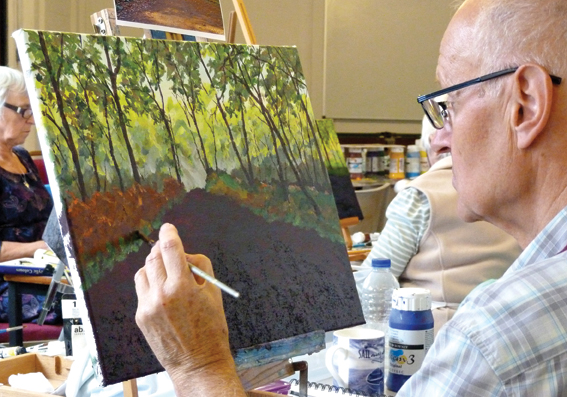
Bromsgrove artist Richard McIlwraith encourages participation in future art workshops.
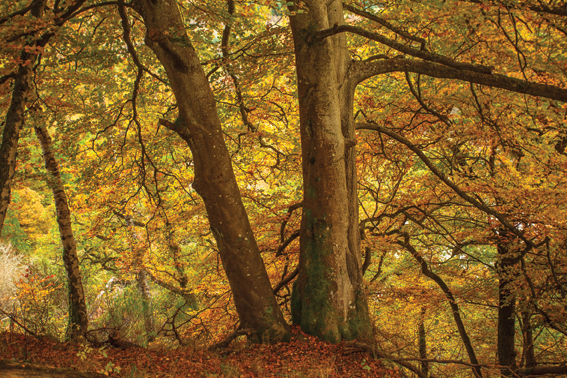
Three special places rolled into one: an art society gathering; a workshop led by a bona fide talented artist; and the trees of the Lickey Hills in the form of a glorious photograph of nature, light and colour. This was the experience of which 20 local residents took advantage recently – it could have been you.
Lickey Hills Art Society hosted the workshop at Longbridge Methodist Church, in a large hall comfortably accommodating the group of art creators. The Society, celebrating its 35th year, invited DJ Johnson to lead his Textures in Nature acrylic workshop.
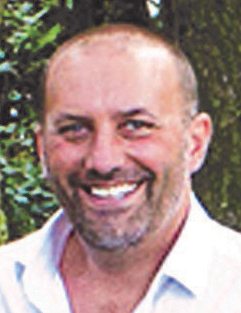
DJ is an exceptional, independent, freelance artist who loves to teach and enjoys connecting with artists, guiding them towards their own interpretations and styles. He combines traditional techniques with contemporary suggestions, for example experimenting with ways one might hold a brush to achieve differing effects.
Trained as a mountaineer, one of DJ’s passions is the majestic outdoors and he suggested in conversation with me that readers who are eager for an extraordinary challenge could try one of his extreme outdoor painting workshops up amid the crags, ridges and glaciers. How about you?
Nature on our doorstep – the 20 distinct personalities, capturing emphatically their own impressions of the same Lickey Hills snapshot, were aware acutely that this incredible scene lay literally up the lane. The power of the natural environment, manifesting itself in 20 unique visions. The energy of the landscape’s light and colour, snagging attentions.
When we walk through the woods, clocks seem to stop. In the Longbridge hall on this particular Saturday, how too the clocks seemed to stop. Absolute focus and pure art. What an atmosphere. If there is a dormant artistic craving inside you, you may need to join in next time.
The group, who paid £25 each, included experienced and gifted artists but also beginners and, indeed, a painting first-timer. It was a friendly, supportive environment where all felt free to express their individual responses to the stimulus.
For more information on DJ Johnson, see https://www.artbydj.co.uk. To liaise with Lickey Hills Art Society, email Chairperson Jennie Wilson at wjen@blueyonder.co.uk or visit https://www.lhas.btck.co.uk. Annual membership is £18 and the group meet at 7.30pm on the first Saturday of each month, except January.
To take a look at the prodigious creative output of the Society, head to Artrix through November – over one hundred pieces will be on display. Artrix opening times are weekdays 9am to 2pm, Saturdays 10am to 2pm, and on performance evenings. Artrix is located on Slideslow Drive, Bromsgrove, B60 1GN.
Please get in touch if you would like me to write about an art event near you:
richard@galleryart61.com https://www.galleryart61.com
Plant photographer Judy Lawrance shares her ideas on some colourful places to visit this season.
For once, we can’t complain about heading towards winter, since we’ve had a hot and glorious summer with the added bonus of a warm and sunny early autumn. The growing season is all but over, leaving time to enjoy the warm colours of autumn. And what delights that brings! No more lawns to cut, hedges to trim or gardens to water.
That time spent can now be used for pleasure – days out with the children or leisurely strolls through the local woods. Although the brightness of summer plantings have faded from the borders, they’ve been replaced with a canopy of subtle hues, drawing your eye up rather than down. It’s such a colourful season – a bigger picture.
Autumn is all around us, like being wrapped in a comfortable orange blanket. Drive down any of the highways in Redditch and you can enjoy the display from the comfort of your car. Whoever decided on the planting for the verges when the new part of the town was built certainly knew what they were doing.
I remember, a couple of years back, pulling into Tesco Redditch car park, getting out of my car and being stopped in my tracks. The view in front of me was breathtaking. The shoppers were going about their business, wheeling trollies into the shop, filling their car boots with groceries and checking their phones.
Couldn’t they see what was in front of them, an absolutely stunning landscape above the level of the cars, a blaze of autumn colour on the left-hand side of the store stretching as far as the eye could see.
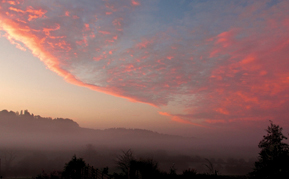
A fiery mix of orange, red, golden brown and yellow, blending together, likened to an autumn scene painted on canvas. It certainly lifted my spirits on a drab, damp day. These are the little gems that Mother Nature throws at us every year, without fail. The season is short, but beautiful.
AUTUMN SHOWS
The RHS Autumn Malvern and Harrogate Shows kick-started autumn for me, with tents full of produce grown by enthusiastic gardeners who have lovingly cared for their crops throughout the year, picking the best to compete – just for the fun of it.
This year, the “Biggest Vegetable” exhibits at the Malvern Show were eye openers, with leeks big enough to feed an army; two-foot-long beans and pumpkins the size of a garden shed (a bit of an exaggeration there, but you get the picture). It was like walking into “the land of the giants”.
The competition dahlias in the flower marquees (my favourite place) all standing to attention in their identical vases, were ablaze with colour – from the shocking pink pom-poms of “Mary’s Jomanda” with their densely packed florets, to the striking red, semi-double flowered “Hillcrest Regal.”
A stroll around the showground took you past the numerous bulb growers, selling huge selections of spring and summer bulbs, many varieties of which are very hard to find elsewhere.
PARKS AND WOODLANDS
There are some great National Trust properties with a lot going on into early November so it’s worth taking a look on the website. A visit to Charlecote Park at Wellesbourne, for instance, not only offers a beautiful autumn walk, but for children there are Halloween Pumpkin Trails during half term week, up until November 4, as there are at many of the National Trust Properties. Take a look at the unusual collection of gourds in the farm shop.
Croome Park at Wellesbourne is a great place to spot many different types of fungi in November. According to the Woodland Trust there are 15,000 species growing in the UK with lovely names such as jelly ear, scarlet elf cup, honey mushroom and beefsteak fungus. After dry summers, the autumn rains start the fungi growing so there should be plenty to see this year!
Fungi like to grow in dark, damp places, in or around fallen, rotting tree branches and many varieties just seem to pop up through the fallen leaves. Look out for fly agaric, the most famous of them all, identified by its bright red cap and white spots; they usually grow around pine trees. This is a poisonous one though, indicated by its “red for danger” colour.
Westonbirt Arboretum, probably one of the best places to visit in the UK in autumn, with 15,000 species of trees, has guided walks up until November 3. There’s an Autumn Colour hotline (0300 067 5691) to check how the leaves are looking.
A SEASON FOR THE KIDS
Autumn days are the ones I remember most from childhood, donning wellies, hats, scarves and gloves, kicking up the crisp (or sometimes soggy) leaves along the path verges, charging through the local woods searching for conkers, climbing trees then arriving home with rosy cheeks and more than likely scraped knees. Certainly not caring about the weather.
Despite the availability of more and more technology aimed at the younger generation, nothing much has changed; most children still like to do those things, in any weather!
The gardens that didn’t seem to offer them much in the summer when they were in bloom are now full of muddy puddles and are covered in crisp leaves – a perfect playground. The wide open spaces of Trentham Gardens is perfect for little ones to get rid of some energy on a cold crisp day, with a mud walk for the older children willing to get cold legs and feet.
My own children were raised in a small fishing town on the East Coast – we had the local beach but other than that there was one garden centre, two woods and a couple of parks. When we moved here 22 years ago, we were overwhelmed with the amount of places to go for a day out.
We’re now surrounded by National Trust properties with all that they have to offer: unique and quirky gardens such as those at Morton Hall, Winterbourne House and Stone House Cottage Gardens at Kidderminster. We have woods galore, hills to walk, a wonderful lake at Arrow Valley, garden centres by the dozen, and I have to mention BBC Gardeners World at the NEC once a year.
So as the days get shorter and the temperatures start to drop, it’s all too easy to curl up on the sofa and only venture out for the necessities. There’ll be plenty of wet days to come, but there’ll be many dry days for venturing out.
Amateur astronomer Brian Watkiss peers into the Village night sky.
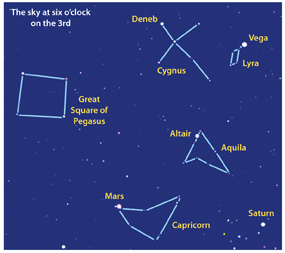
November, the month of fireworks and fun and looking forward to Christmas. We still have the Red Planet in the south as soon as the sky has got dark. Mars seems to have been with us for ever but it is now nowhere near as bright as it was in the summer.
The reason it seems to be hanging around is because we have got so far ahead of it that we are now curving around the Sun and the planet appears to be moving across the sky away from the western horizon and will leave the constellation of Capricorn, where it has been since June.
It is still as bright as the brightest stars but is less obviously a disc. On the 26th, NASA is due to land another craft here, Insight, designed to probe the planet’s interior and check for “Marsquakes” (sounds like some sort of confectionery).
Back here on Earth, if you’re quick, you might just catch Saturn low in the glow from the setting Sun. Look for it on the 11th when a thin crescent Moon is very close by. Incidentally, on the following day, the Moon passes in front of Pluto. Unfortunately, this planet is too small and far away to be seen but it’s nice to know where it is, isn’t it?
As the sky darkens, you should just be able to see a star very close to Mars. This is Deneb Algedi, the brightest star in Capricorn and possibly the only one you can see. Look for the rest of an inverted triangle of stars to the right.
Higher in the sky the great constellations and asterisms of winter are starting to appear. Above Mars to the right is another inverted triangle but this one is huge. Almost overhead is Deneb in one corner, then to the right is Vega in another and finally, lower down, is Altair in the third.
These are the brightest stars in this region of the sky so are unmistakable, and they each sit in their own constellations. Deneb can be seen to be at the head of a cross which is Cygnus the swan. Vega is at the top of a parallelogram of stars forming Lyra, which is a sort of a harp (not a ukulele, thank goodness). This little constellation is tricky to make out but, being fairly high in the sky, can be seen with a little patience.
Even trickier to discern is Aquila the eagle, which is yet another triangle, this time with Altair at its head. High above Mars to the left is a large square of stars. This is Pegasus and the number of stars you can see contained within is an indication of levels of light pollution. How many can you see?
Despite last month’s Soyuz failure, on the 15th a Cygnus supply ship is due to be launched to the Space Station so look out for that on https://www.heavens-above.com – and towards the end of the month, comet 46P/Wirtanen might start making the news, but I think that’s more for next month.
As for the fun I mentioned at the beginning of this item, that starts on the 28th in Alvechurch Village Hall. See you there!
Mary Green continues her series on trees in the Celtic calendar.
We have a wildlife star in Alvechurch now – an albino (white) grey squirrel! It hangs out in the big oak trees on Crown Meadow, and several people have seen it. Albinism is a lack of pigments in the skin and hair, and can affect many species of mammals, including us!
I hope people will keep their dogs away from it as they are its only real danger. Though grey squirrels are common, they are useful in spreading tree seeds and generally brightening up our churchyards and woodlands.
People see them as destructive, but they are only behaving naturally, and we don’t have that many wild native mammals to enjoy! Albino squirrels are rare but apparently one has been spotted in Worcester too and they often feature in local news across the country when they turn up.
It’s been a strange year, with the turn of the leaf quite late because of a mild September and early October (we did have a St Luke’s little summer!), an amazing crop of acorns even on small trees, and of beech mast and horse chestnut conkers.
There is a weather tradition that we have heavy storms around the September equinox – the equinoctial gales – and we certainly did this year with still-green trees falling in the area.
I walked along the canal in early October and felt my senses were not working properly – my eyes told me it was still summer, sunny and green with lots of plants re-flowering, but the air was cold on my face and the smell was of distinctly autumnal ivy flowers.
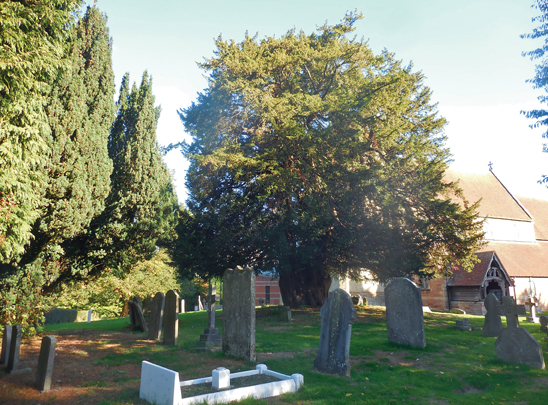
The main Celtic tree for this month, very suitable for the darkening days of November, is the yew. Everyone in the Village area lives near one. It is the largest native evergreen in England. Though not as big as the native Scots pine in height, it is often bigger in girth and certainly can be older. It is a substantial tree, one to be reckoned with.
We are especially familiar with yew trees in our churchyards. There are large ancient trees in churchyards in Alvechurch (about 500 years old), Cofton (even older), Tardebigge and St Kenelm’s. The one in Cofton is so split and gnarled it’s difficult to estimate its width: the Alvechurch one is big enough for kids to get inside.
Yews often grow with split trunks, then get hollow in the middle, so each tree is more like a small grove of trees. Yews have been identified as over 2,000 years old and some more than thirty feet around. Our native yew has branches which slope down and sometimes root themselves. If you see a neater yew with upright branches it will be a garden variety: many churchyards have both.
Yew has very characteristic leaves, making it easy to identify. They are evergreen, so needle-shaped, but not sharp. The soft needles grow either side of a central stem making frond-like leaves, very dark green except when young. The overall impression of the tree is dense and shaggy.
You will also find smaller trees growing in woods – some of the ancient woodlands around here have an understory of yew. They are not so massive there and can look quite delicate. Yews also grow on chalk downland so are more common in the south of England.
The relationship between yews and churchyards is long and complex and very unusual. Large ancient yews are mostly found in churchyards and no other native tree has this kind of association. Sometimes the yew was there before the church. Yews were very important in Celtic pre-Christian beliefs and were often planted at significant sites. These sites were then taken over as Christian churches because of their spiritual associations.
There are many reasons suggested for this tradition. One is that the tree is always dark and shadowy and thus goes with death and graveyards. At one time they were thought to be able to draw out poisonous vapours from the graves! However, its evergreen nature means it is also associated with eternal life, which it was in the Celtic traditions.
Yew branches were often carried into the church as decorations, and were used as “palm” on Palm Sunday in years when the other traditional branch, pussy willow, was not yet ready (actual palm was rarely used in England). They were and still are one of the boughs used for Christmas decorations.
Yew was also used for longbows, once an important weapon not only of war but for hunting too. Having them in churchyards meant they were protected, although there is actually little evidence that churchyard yews were used for bows. The wood was also used for walking sticks and other small objects which needed tough, hard but flexible wood.
Yews are also found by the roadsides, especially where there are crossroads, and they may well have been marker trees to help wayfinding. They were also planted near inns and other lodging houses and there are quite a few Yew Tree Inns around.
Yew flowers early in the year and produces the first heavy pollen of spring, as hay fever sufferers well know! The male flowers that produce this are often on different trees from the female trees which go on to produce the fruit. (Yew trees in churches are often planted in pairs – one near the gate and one near the church entrance.)
The fruit is actually a cone, but it looks like a berry as it has a pink waxy covering. The yew is poisonous to us, but birds can eat the berries as it is only the seed inside that carries the poison and this passes straight through the bird – thus producing new trees in new places.
Another reason given for yews growing in churchyards was to keep the poisonous foliage away from cattle, though actually cattle and sheep were often allowed to graze churchyards.
The Celtic months don’t quite match ours (as they are lunar) so there is a second tree for this time of year, the elder. It seems small and insignificant next to the mighty yew but was an important tree.
It shares some of the darkness of yew with its black berries, but also has glorious fragrant white blossom in June. It grows very quickly and doesn’t live to a great age. However, at one time it was much prized, worth money when land changed hands.
The flowers, fruit and wood were all useful and the tree easily grown. It even hosts an edible fungus. However, it was at one time not planted in churchyards as it was believed to be the tree that Judas hanged himself on after betraying Christ, and that Christ’s cross was made of elder wood (though most churchyards now have plenty of self-sown elder!). It was a valued hedging shrub, combining quick dense growth with all these uses.
Elderflowers are well known for producing syrup and cordial, and were also used to flavour cooked fruit, especially gooseberries which ripen in June, in beer and mead and to make fritters. They were a strewing herb, used to scatter on the floors and scent a room, and to stuff mattresses and pillows.
They had medicinal properties as an eye lotion and skin cleanser. The berries were eaten, made into jam or used to make wine and cordials. In autumn, a fungus called Judas’ ear or Jews ear (now often called jelly ear) grows on elder, and is edible and tasty.
The wood of the outer branches is soft and hollow and was used for pea-shooters, knife handles, oar-pins, bellows and tinder. The heartwood is dark and very hard and can be carved into more solid objects.
The leaves were believed to keep away flies, so horse-whips were made of elder, and elder leaves were plaited into harness. The leaves turn rather exotic colours in early autumn, not lasting long but beautiful shades of purple and yellow.
In the Celtic tradition, elders were powerfully magic trees, believed to keep away witches and evil spirits if planted near the house and to have life-giving properties. Rather like yew, it stood for regeneration and beginnings and endings, suitable for November and the time of Samhain, the autumn recognition of death, Christianised as All Souls.
It’s perhaps because of this powerful magic that the medieval Christians attached the story of Judas and the cross to it.
Two trees, one ancient and massive, one common and short-lived, but both imbued with the secrets of death and rebirth, and both once prized and used by people here in the Midlands.
This poem takes up the theme of peace, which we will be commemorating with the 100th anniversary of the Armistice this November.
The wild flower of peace You sit in the quiet garden. Here is peace, you say.
Among the dead-headed roses you can forget life’s worries
Weeding out the awkward thoughts, the world’s wars.
Or in the forest, you wander into a green shade
The dappled sunlight of an English summer
Thinking you have found your inner peace in Nature.
That is not peace, I say. Peace is not gentle
Or tidy or clement. It is hard, and slippery as a snake.
Peace is not the absence of conflict: that is escape.
Peace is Mandela embracing truth and reconciliation
Is Mairead Maguire and Betty Williams standing up in Belfast,
Ian Paisley’s handshake and the naked conference room.
Peace is the difficult reconciliation of opposites
It means talking to those whose ideas you hate
Shaking the hand that held the bloody knife
Somehow making the picture come together
All loose ends and tangles, but alive and growing
Like the scrub woodland, where brambles and roses
Grow among the young oaks and none dominates the other.
Peace needs weeds, flies, and flowers gone to seed
Fungus under the ground and the complexity of soil.
It meets people’s desires not at the expense of others
It means the harvest of the earth is shared among us:
There can be no peace in a country full of food banks.
Martin Pryor provides tips on deciding how to invest and how much risk you want to take.
We all have different priorities when it comes to investing. This month we explore some basic questions to ask yourself before taking the plunge.
Am I ready to invest?
Investing is inherently risky and not for everyone. Questions to consider before investing include: are you out of debt? Are you saving into a pension? Do you have the appropriate insurance policies set up to help you in case of disaster?
If you can answer yes to all of those questions, it’s more likely that you are in a position to use some of your money to invest. But keep in mind that every type of investment has potential hazards and that you could get back less money than you put in.
There is no such thing as a free ride when it comes to investments – and if you’re being promised a high return, it’s often because the investments carry risk.
If you’re thinking of investing because you’ve been approached by someone promising unusually tempting returns, think very carefully before you stump up any capital. In general, no investment is worth making if the people selling it are resorting to contacting strangers to drum up business. If you receive an unexpected phone call or email, for example, the best policy is to ignore it. Any offers you get in this way are likely to be a scam.
How much risk do I want to take?
All investments carry some element of risk, but some are generally viewed as riskier than others. Of the investments commonly bought by consumers (shares, property, funds, and corporate and government bonds), shares are typically thought of as the most volatile and therefore the riskiest. Shares can rise and fall in price as a result of a range of factors that can be difficult to anticipate.
Corporate bonds are another option. These bonds are like IOUs issued by companies as a way of raising money. Essentially, you loan the firm capital and are ultimately repaid with interest, so you would hope to get back more than you put in. However, companies can and sometimes do go bust before repaying bondholders. Companies viewed as safe bets will be able to offer lower rates of interest, while companies perceived as having a higher risk of default will have to pay more to raise the money they need.
This brings us back to our earlier point about higher rewards often coming with higher risk. With government bonds, also known as gilts, the government would have to default in order for you not to get back what you’d been promised. However, this also means that they don’t tend to pay as much.
In fact, when big-time investors are worried about risk, they sometimes flock to government bonds, which drives up the price and lowers the yield – how much you get back for what you pay. Sometimes this can even lead to negative yield, when people are willing to get back less than they paid in just because it’s safe.
Other risks may include:
Liquidity Risk: In other words, getting your money out when you need to. This can be especially relevant if you choose to invest directly in property.
Longevity Risk: This is the risk that you will outlive your savings and is especially important when considering retirement.
Horizon Risk: This could be an unforeseen event that causes you to sell investments earlier than you planned, which may mean that you lose money.
Should I take advice?
An adviser will be able to help you create a plan to meet your goal and recommend the right balance of investments for your risk appetite, while taking into account how much you could afford to lose.
You might find out your investments require more time than you are willing or able to spend. If this is the case, you should consider hiring an adviser to assess your situation and goals in order to recommend a portfolio for you.
Do I know who I’m dealing with?
Make sure any investment firm or adviser you might use is authorised by the Financial Conduct Authority (FCA). If you use an unauthorised firm, you won’t have access to the Financial Services Compensation Scheme (FSCS) or to the Financial Ombudsman should you wish to make a complaint or in the event of a firm going bust.
How much do I need to make?
It’s generally not a good idea to choose an investment solely according to how much money you think you might make. There are number of other factors that you should consider, including the volatility of your investments and how long you intend to remain invested.
Remember, returns are unpredictable and the higher you want your returns to be, the greater the odds that you’ll have to take more risk in trying to achieve them.
Think about what your priorities really are. After all, if you’re not seeking particularly high returns, why take on more risk than you need?
What about tax?
The issue of taxation also needs to be considered before investing, as your personal tax situation may have a bearing on your decision.
For UK tax payers, the tax benefits of investing in a pension plan can be considerable, especially if you are a higher-rate tax payer. So think about how your investment plans will fit in with any pension contributions.
There are other means of investing that can provide tax benefits. An Isa (Individual Savings Account) provides a tax-free way to save or invest.
It is also important to think carefully before withdrawing money from any investment as the timing and the amount of such a withdrawal could lead to you incurring a tax charge.
Do I care about ethics when investing my money?
Finally, remember that you may be investing in real companies, whose products or services may affect the wider world.
This might not matter to you, but some investors like to invest only in companies with which they agree from an ethical standpoint. For example, some people may choose to steer clear of investments associated with fossil fuels, or tobacco.
Whatever investment route you decide to take, make sure any firms you decide to deal with are legitimate. Remember, scammers may come across as very professional.
The value of your investment can go down as well as up and you may not get back the full amount you invested. Oast performance is not a reliable indicator of future performance. Investing in shares should be regarded as a long-term investment and should fit with your overall attitude to risk and financial circumstances. Tax laws can change. The Financial Conduct Authority do not regulate tax advice.
*Contact Pryor Portfolio Management for more information: Tel: 07961 162818 martinpryor@ppm-ifa.co.uk https://www.ppm-ifa.co.uk
Alvechurch amateur weatherman Phil Thomas records the changes.
October was quite mild, at least up until the 19th, with a mean temperature of 12.5C which is 2.4C above the local mean. After a quiet start to the month the weather turned stormy – there was a gust of 45mph on the 12th.
It was also very wet from the 12th to 15th, with 39.2mm making up most of the month’s rainfall.
October 2018 (to the 19th)
Mean Max 16.3C 2.4 above average
Mean Min 8.8C 2.4 above average
Mean 12.5C 2.4 above average
Rainfall 44.4mm 49% of average
Sunshine 53.7 hrs 58% of average
September had a warm start with temperatures into the 20s but cooled down later into the month. The mean of 13.9C was exactly the local mean for this month. There was a marked change from the 17th with winds including a gust of 43mph locally.
Rainfall was 49.8mm, only 82% of the local mean, however no rainfall was recorded over the last seven days.
September 2018 Mean Max 18.4C 0.2 above average
Mean Min 9.4C 0.2 below average
Mean 13.9C exactly average
Rainfall 49.8mm 82% of average
Sunshine 127.2 hrs 101% of average.
Outlook Computer models suggest that dry and brighter conditions are likely. Temperatures are expected to be around average by day, but some frost and perhaps patchy fog is possible overnight. More widely unsettled conditions could develop into November, bringing spells of wet and windy weather.
There are signs that high pressure may build across northern areas towards the end of this period, bringing a greater likelihood of drier weather and also overnight frost and fog. On the whole temperatures are likely to be slightly below normal.
More information at www.alvechurchweather.metsite.com
You can see an improved HD weather-cam, updated at one-minute intervals, at: www.alvechurchweather.metsite.com/webcam_alvechurch.php
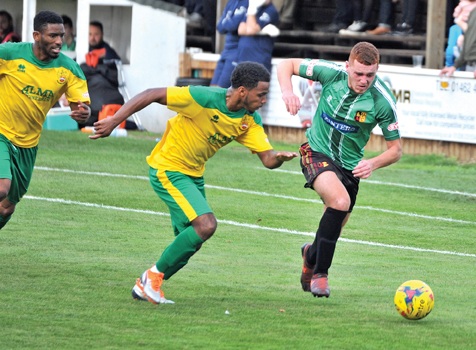
Action from the draw at Hitchin Town (Photo/ Ian Macvie)
AFC out of three cups but on course for top-six league finish.
Alvechurch FC are aiming to concentrate on league success after recent home defeats in three cup competitions.
’Church missed out on a glamour tie away at former Football League side Stockport County in the next round of the FA Cup, losing 4–1 to a clinical Corby Town, who have had a successful start to the season one league below AFC.
Despite coming into the match on a seven-game unbeaten run, defensive errors cost the team dearly. A goal just before half time and two early on in the second half sealed Alvechurch’s fate and dashed any hopes of a successful and lucrative FA Cup run for another season.
A youthful Alvechurch team were then knocked out in the first round of the Birmingham Senior Cup by local rivals Highgate United. The scores were level at half time but two second half goals secured a 2–0 win for the visitors.
History was made in the second half when 16-year-old Ben Cassidy came on to make his first team debut for AFC. Ben became the youngest ever player to play for the firsts and was unlucky not to score, hitting the post with the keeper well beaten.
Finally, ’Church met Stratford Town in the League Cup, having dispatched them in the FA Cup. Stratford took revenge with a 2–4 victory, although hope for the future was represented by Cassidy, who found the net this time, thus becoming the youngest player to start a first team match and score for Alvechurch.
AFC will be hoping for better luck when they meet Stratford yet again in the league on November 13. And they are still in the JW Hunt Cup, due to play Bilston Town as we go to press.
’Church were sixth in the league at the time of writing, having recently bagged a valuable point against title favourites Stourbridge but lost to current pole-sitters Kettering Town. The match against fourth-placed Leiston on November 24 could prove important.
* Alvechurch have signed experienced forward Andre Landell from Rushall Olympic. Andre started his career at Wolverhampton Wanderers and has played for Hednesford Town, Bath City and in America for Michigan Bucks. He made his AFC debut against Highgate United and is a vital addition to the squad.
However, fans’ favourite Andy Parsons has decided to leave the club. “Parso” has been a mainstay in defence for the past three seasons having followed manager Ian Long from Tividale FC, but has decided to move on to pastures new. His personality and great sense of humour will be missed by players and fans alike.
Also saying farewell are midfielder Babacar Suane, who joins Halesowen Town, and central defender Jordan Piggott, who moves to Welsh League side Bangor City. All at the club wish both players well.
Congratulations to captain and centre back Jamie Willetts on being voted player of the month for September. Jamie’s efforts have contributed to the club having the meanest defence in the league.
* For more info or sponsorship enquiries, please contact Trevor Ball at saintsarehot2@btinternet.com or visit https://www.pitchero.com/clubs/alvechurch
Follow the club on Twitter @Alvechurch1st
Sarah Rees reports from the Oakalls and Parklands.
The disappearance of Tom Jones in Worcester in the early hours of Wednesday September 19 resulted in an unprecedented response from the Oakalls community – and beyond.
Eighteen-year-old Tom was a resident of The Oakalls before moving to Worcester on September 16 to embark on a university degree course, studying to become a primary school teacher.
After an extensive search by police and hundreds of volunteers, Tom’s body was recovered from the River Severn on the afternoon of September 28.
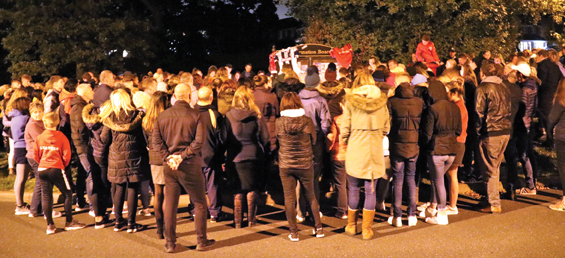
People from across The Oakalls and Parklands paid tribute to the teenager at a candlelit vigil on Sunday September 30, held near the noticeboard on Royal Worcester Crescent / Trianon Road.
An estimated turnout of more than 300 was testament to the strong community spirit that exists on the estate and which has been further strengthened by the tragic loss of one of its young residents.
More than 200 local people also visited St Godwald’s Church on the following Monday and Wednesday evenings, when the church was specially opened for those who wanted time for quiet reflection and to light a candle in Tom’s memory.
Coun Caroline Spencer, who has actively supported The Oakalls for many years, stated that she was very touched by how the community had come together to show their sincere love and sadness.
DIARY DATE – CHRISTMAS ON THE OAKALLS This year’s community festive gathering takes place on Sunday December 23 at 6.30pm, on the open grassed area by the notice board and Trianon Road.
The Blackwell Concert Band will be accompanying the carol singing and there will be refreshments available to buy and sweets for the children. Father Christmas will be making an appearance ahead of the big day.
Please contact me with your news, views and concerns about any aspect of life on the estate. Email: oakalls@villageonline.co.uk
A film made in Barnt Green will be screened as part of the Birmingham Festival of Terror on Saturday October 28.
The Legend of Dark House is a 35-minute psychological horror, written, directed and produced by Sheila Evans, who runs Walktall Productions with husband Bill.
It will be shown at 3pm at the Mockingbird Cinema, part of the Custard Factory in Digbeth where the ten-day festival is taking place.