Home Blog Page 803

Chimney protest

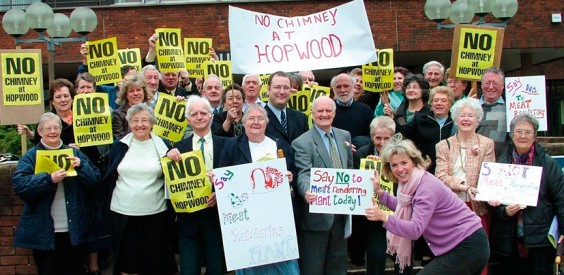
Protesters

Protesters are joined by MP Julie Kirkbride and Worcestershire County Council leader George Lord outside County Hall where the planning committee is reported to have unanimously agreed to oppose plans for a 17m chimney at Mayfield Farm, Hopwood, which would form a thermal oxidiser for an animal rendering plant.

The decision will be made at a public inquiry expected to be held in February 2006.

Love and war in Worcestershire

0

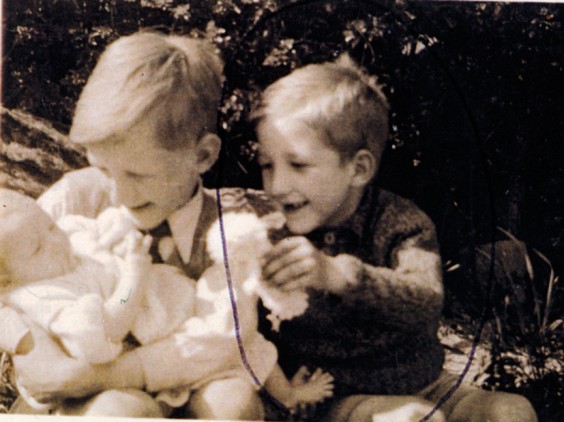
Dave and Mike with sister Judith

Mike Bannister remembers his ‘Dandelion Days’ around Cofton and Alvechurch – not least what it was to be born into a world at war.

LITTLE EDEN
Life in Cofton Hackett, 1936-39, was something of an idyll and our home at Drachenfels, 7 Ashmead Drive, was truly a place of peace.

There I was born and grew up for my first ten years, before moving to Gothic Cottages in Mill Lane, Alvechurch. Elsie Marcella, my Mom, provided sweet meals at fixed times; kept us orderly; neat and clean; said, nightly, certain prayers over us, and saw to it that we went to school on time.
 
We went to Sunday School at St Michael’s and All Angels, to hear Miss Chaffer tell the puzzling tale of “A green hill far away, without a city wall…..”  All too soon, we graduated, with Derek Harold and Michael Dance, into the choir, with black cassocks, ruff collars and surplices of starched white stuff.

We hurried to summon the flock, hauling on the twin bell-ropes, pumped the organ bellows, and together, piped the old sweet tunes of the English Hymnal.

Our house was sheltered by a tall hedge of privet. Left of the front window sprang a dense fuchsia, with flowers of carmine and blue. It grew, we were told, from a cutting of the very plant that Cardinal Newman himself had brought to Rednal, all the way from Rome. My lifelong love of ‘history’ started here.

At the back, Charles, my father, created his own small Eden. There was ‘crazy paving’ – a patio (a word still waiting to be discovered) and a rectangular, cement-lined pool, with pond life, crowfoot, newts, tadpoles, dragonflies and dytiscus beetles.

Over these diverse creatures ruled Jonah, emperor of all fishes; a huge, 5.5lb bronze carp who sipped earthworms from Charles’ gentle hand on summer evenings.

Below the pool, a rockery descended to a small lawn framed with herbaceous plants, roses, and then a vegetable garden, shaded by a tall willow. Here I was taught to make a seed drill, to sow peas, and later on, for reasons I could not quite grasp, to DIG FOR VICTORY.

What VICTORY was, exactly, came to me slowly over the next ten years. In ‘39, I was but four years old and it took time for me to realise that I had been born into a nation readying itself for WAR.

It is true that I had seen a military parade in Birmingham’s Victoria Square, even being allowed by the Drum Major himself to try my hand at making thunder from his well-worn skins.

At weekends, in Cofton Park, squaddies on manoeuvres played hiding games with brushwood in their ‘tin hats,’ darting for cover, firing off blank rounds from their Lee Enfield 303s. Even then it didn’t dawn on me that they were practising the arts of war, intent on death or glory.

WAR, AND RUMOURS OF WAR
One day, Uncle Bert Muir (size fourteen boots!) came to tea in his khaki uniform, wearing the badge of the Border Regiment, and the parachute insignia. I was thrilled, and resolved to start a collection of regimental cap badges.

Later on, a youthful Uncle Stanley Rollason came to visit, wearing the same khaki, but with a different cap badge, advertising Royal Signals. On each occasion, when they said goodbye, there were brave words, and tears in Marcella’s patient eyes.

Then Aunty Josephine Rollason, a pillar of the Salvationist Brigade, swept in, full of energy and smiles. She smelled sweet, and told good stories. Her ‘uniform’ was amazing, with a round black bonnet, half Hollywood, half chapel.

She was the Driver and Commander of a huge and shiny Red Shield van, roaring all over the British Isles, with ‘necessaries’ for sale to waiting servicemen encamped away from home.

Dad sat in his usual chair on his days off, reading the Telegraph, and telling Mom about happenings in Azerbaijan. Gradually brother Dave and I became aware that something hugely serious was up.

By ‘wireless’, Alvar Liddel told solemn news, and then Tommy Handley would come on and make everyone smile, introducing comic songs about a ‘Mr. Hitler’.

Weekday mornings, we made our ways unwillingly to Barnt Green School and later, Waseley Hills, trailing our gas mask cases. There we experienced the rudiments of terror, as meted out by ‘Gaffer’ Lawrence and Mick Munnings, unsmiling Heads of School.

At home, real life went on. We played cricket against Porrit’s wall, ran errands to Matty Johnson’s in ‘Nowhere’; went to the dentist in Selly Oak, and as a reward for bravery, were taken to watch the blacksmith forge shoes for the horses by the canal side.

At night Elsie Marcella sat with us and said, “Gentle Jesus, meek and mild, look upon this little child, pity his simplicity, suffer him to come to me.”  Sixty years on, I begin to grasp the fears and aspirations she must have carried in her secret heart. 

But bravery, and its cousin fortitude, were in the air. We were taught lines to say on special occasions, The Magnificat, and Leisure, by W.H.Davies: ‘What life is this, if full of care, we have no time to stand and stare….’

Then Alfred Edward Housman’s: ‘The troubles of our proud and angry dust/Are from eternity, and shall not fail,/Bear them we can, and if we can we must, /Shoulder the sky my lad, and drink your ale.’

At night we were sent up early to blacked-out rooms, and there we would tune in the home-made cigar-box ‘Crystal Sets’ Dad made for us. We would tweak the ‘Cat’s Whiskers’ waiting for the voices of BBC London to come clear above the crackling of the ether, and so the Angel of Sleep would come to us, part-way through Monday Night at Eight, World Theatre, Valentine Diall’s The Man in Black, or Henry Hall’s Guest Night.

Out of these mists and shadows, I first became acquainted with John Masefield, and with George Du Maurier’s Trilby, with Peer Gynt, and Marlowe’s Tamburlaine the Great.

THE MISFORTUNES OF WAR
That summer, Charles began major excavations at the foot of the garden. A pit appeared, five or six feet deep, with vertical sides. The days were rainy and damp.

One afternoon, while he was away at work in the hospital, I peered over the brink, and was interested to see how many frogs had found their way down there. Dozens of them, green and yellow, immobile, wide-eyed, stared back at me.

I crawled forward for a better view;  and then – catastrophe. I felt myself falling through space, to land upside down and with a jarring thump on cold clay. I was alone and badly shaken, staring, close-range now, at the silent froggy company. I began to moan.

After what seemed like ages, Bert Hickson came from Number 9, his beloved briar pipe clenched in his jaw. He peered at me awhile, then said, in his Lancashire way, “Eeh! Sausage, you’re in trouble, wait a while.”

I stopped moaning. He vanished, then reappeared, ladder in hand. Soon I was rescued, carted up to the house and put into the bath to a mixed chorus of comfort and scolding from a distracted Marcella.

Day by day, the Frog Pit was transformed. It became a corrugated steel Anderson Shelter, with a sloping ‘L’ shaped blast-proof entrance, and a soak-away beneath a stout planked floor. There was a brown handled entrance door leading to three steps down. Inside were two bunk beds, a chair, a chanty (potty), and a box of candles.

The walls were painted with deep green paint, intermixed with sawdust for ‘texture’ and to limit condensation. Above, this secret cell was heaped over with earth and sandbags.

What was it for, exactly? I would soon be left in no doubt.

The bombing of cities and harbours had, by this stage, well and truly begun. Night after night the drone and whistle of aircraft and missiles became commonplace things.

At the Danillo Cinema in Longbridge and on the wireless, we were educated into the realities of war. On ‘Pathe Pictorial’ newsreels I saw fire consume the East End of London, whole buildings aflame and falling forward.

Once we stood on Cofton Park, and looked across to see Birmingham, our own city, on fire with falling planes, barrage balloons in flames, and tracer bullets cutting through the red smoke-haze. The noise was fearful on every side; pandemonium on the loose.

This was not Pathe film or make-believe. It was the real destruction by fire of the world I was only just getting to know. The whole experience was a living nightmare.

The effect of such violence on the green minds of young people, then as now, seems never to have been worked out.

Heading south from sorties on the industrial heartlands, ‘enemy’ bombers would sometimes discharge their lethal cargoes close to home. One dreadful night after the Air Raid Warning siren had sounded, Dave and I were rushed from our warm beds down the garden path to The Shelter.

The bunks were made up. Candles were lit, and our sleepy eyes began to adjust to the gloom. Elsie Marcella went back home again to fill the thermos flask, and Charles to collect more cushions.

Sometime after they left us, there was a thundering blast close by. Everything shook, jolted, as if an earthquake, suddenly, had come and gone; for a terrible instant, I re-imagined the burning horror of the Pathe News.

Where were they, our Mom and Dad? Had they burned alive out there? I wailed. Brother Dave tried to calm me. Then the shelter door swung back, and to our relief, Mom appeared, flask and sandwiches in hand.

There was silence and a long delay, then some muffled grumbling in the entrance tunnel. Charles appeared in full Bud Abbot mode.

He dropped his bundle and clowned, ruefully, about how the blast had hurled him into his precious flower bed, squashed his beautiful Delphiniums, and plastered the seat of his best striped pyjamas with thick red mud.

He was incensed; ‘up in arms’ (literally), and ‘THAT B****Y ADOLF’ was to blame! Out of our confusion, he won some tired giggles. We settled down to a late supper, and waited for the dawn. 

Mike Bannister’s collection of 25 poems, Greenstreet Fragments, was published in 2003 and is on sale at £4.50 at Alvechurch Post Office. Signed copies can be bought from Mike at £4.50, post-free, from 23 Station Road, Halesworth, Suffolk IP19 8BZ.

Read part two of Mike’s wartime memories here.
Geoff’s tour de force

Geoff

Barnt Green resident and former football star Geoff Thomas has exchanged his boots for a bike as he takes on a special fund-raising challenge…

Over the past six months, Barnt Green and the surrounding area have been Geoff Thomas’s training ground as he prepares to cycle the entire length of the Tour de France route.

The gruelling 3548 km ride will raise cash for two leukaemia charities, a cause very close to Geoff’s heart since battling the disease himself.

The former Crystal Palace, Wolves and England midfielder will begin his tour on June 26, completing all 21 stages of the course in the same number of days as the professional cyclists.

Cycling on the Lickey Hills has helped prepare him for the mountainous terrain he’ll encounter, and his training regime has included lengthy rides to places like Oxford and Stratford.

Geoff was diagnosed with chronic myeloid leukaemia in 2003, at a time when he was enjoying his retirement from football and running a successful clothing business with his wife Julie.

Luckily the disease was caught in the early stages, although he still required a bone marrow transplant as well as intensive chemotherapy and radiotherapy at Birmingham’s Queen Elizabeth Hospital.

Stem cells donated by his sister were transplanted to replace the leukaemic cells which had been destroyed by the chemotherapy and radiotherapy.

The treatment was a success, and while Geoff continues to be monitored as an outpatient, it is hoped that he can look forward to a life free of leukaemia.

Geoff’s determination helped him through the intensive treatment and will help drive him to complete the Tour de France route.

He was inspired to take up the challenge after reading Lance Armstrong’s book, which tells the story of the six-times Tour de France winner’s own struggle against cancer.

“As a professional athlete myself, reading about Lance Armstrong’s battle with cancer inspired me and gave me more determination to fight leukaemia,” Geoff explains.

“Even though I trained for 20 years as a professional footballer, I don’t think anything compares with the mental and physical trials of the Tour de France.

“I’ve watched the event over the years and even the professional riders struggle on some of the stages. To do it in the same number of days as the professionals will be a major test, but it is something that excites me more every day.”

The 40-year-old is hoping to raise a considerable amount of money for Leukaemia Research. He will also make a donation to Cure Leukaemia, a new Midlands charity which is raising funds for a leukaemia centre at the Queen Elizabeth Hospital, where Geoff was treated under the care of Professor Charles Craddock.

The innovative centre will provide much-needed information and support to the people of the Midlands, as well as becoming a centre for ground-breaking research.

“It’s a huge commitment, but I’m determined to do it and raise money to help fund the medical research that I believe saved my life,” says Geoff.

If you would like to support Geoff by making a pledge, you can either telephone Cure Leukaemia on 0121 452 5081, download a pledge form from https://www.cureleukaemia.co.uk or make an online donation at https://www.geoff-thomas.com

Photo/ Richard Stanton

Lawns ‘departure’

Having read your article in Village News (April) concerning The Lawns’ planning victory, I offer the following comments:

I objected to the proposal on three main grounds. Firstly, such a development will undoubtedly increase the flow of traffic and the associated danger for pedestrians in School Lane – a concern already expressed many times by residents.

Secondly, it represents commercial development of business premises within a wholly residential area.

Thirdly, and most importantly, it fails to comply with several of the conservation measures set by the District Plan and designed to protect the nature of the area.

For example Policies S7 and S10:
“Limit the number of new dwellings to 10 per hectare.” The Lawns (one dwelling?) stands in half a hectare which at most could accommodate a maximum of four or more – not the 11 independent dwellings planned.

“Require that new development does not significantly change the character and cubic content of the existing building and that overall, the building’s total footprint should not exceed 20 per cent of the land.” The 60 sq m conservatory and two additional buildings comprising 11 self-contained “flats” will do both.

“Require new development to have no adverse effect on existing amenities enjoyed by adjacent occupants.” It will in fact destroy the ambience of the whole area.

I am obliged to point out that it was not only the “professional” Planning Department which recommended rejection of the proposals. Aside from objections by numerous local residents, rejection was also supported by the council’s own Conservation Officer, English Heritage and the Victorian Society.

What particularly concerns me is that where development proposals do not accord with the Development Plan, Local Authorities are required to defer matters to the Secretary of State under “Departure Procedures”.

There can be no doubt but that these proposals are not in accord with the Plan yet the elected councillors on the Planning Committee resolved not to pursue this course.

Since these various protective measures were very firmly applied to other recent residential developments in the area, I can only wonder why they are now being ignored for a commercial undertaking.

Finally, The Lawns in its present form has, for many years, proved a viable and successful undertaking.

Bearing in mind that there are other like establishments in the area, might I ask Councillors Hollingworth and Luck precisely what are the “much-needed facilities” this proposal will bring to the village, since I suspect the cost of residence would be beyond the pockets of most villagers – including mine!

Harry England
Alvechurch

Why not walk to school?

I feel I must write with regards to your story “Lickey End road campaign” (Village April 2005) – no one wants to see any child hurt or run over, but look outside any school and the road is full of cars, all mothers picking up or dropping off kids; many even park on the zig zag lines outside the school.

Why do they not walk – yes, that word “walk” – to school? Some only live a few hundred yards away and still come in cars; OK if you have to travel a long way, but a lot of mothers could walk and it would do them and the child some good.

I work for the Warwickshire Ambulance service and pass many schools in my job, and they are all the same. The summer is coming, so cut back on blocking up the road outside your school and walk.

Keith Jones (via email)

More questions than answers

I was very interested to see the proposal for the re-organisation of Alvechurch centre, put by David Barton in the May issue.

It would certainly solve one problem, that of through traffic, but it would raise many others and I cannot but have a slight suspicion that it was intended for the April 1 issue.

I suffered the morning journey to Birmingham for many years and I certainly share the views of Mr Blanchard. All of the regular commuters became very adept at finding “rat runs”.

The first problem that comes to mind on the proposed scheme is the car park which replaces the presumably demolished Club. I suspect that the house of a prominent local citizen in Swan Street might also need to go.

Secondly Rowney Green Lane and possibly Old Rectory Lane would see much heavier use.

Since my retirement I have used Alvechurch for shopping and for the occasional pack of fish and chips from Tudor Rose. These journeys are only marginally easier than going to Redditch, and I would have to do some hard thinking if things became any more involved.

Incidentally, would there be the resources to police the bus lane? With one bus per hour there would be plenty of room for illegal traffic.

Some time ago I discussed this problem with your Editor in his office overlooking The Square. We noticed that a proportion of cars turned off the main road, and I mentioned that on my journey from Bordesley that morning I found myself, at Lye Bridge, at the tail of six cars.

One turned left up School Lane, two right into Radford Road, one left up Bear Hill, and one, like me, turned left up Tanyard Lane to the car park. Only one continued through the village. I suspect that this reflected the normal off-peak pattern.

For a thousand years or so, Alve­church has performed the function of a “service station” on a main road, firstly from Worcester to Coventry, and latterly Redditch to Birmingham.

I am convinced there is some residual passing trade and I would be interested in the views of the local shop keepers. I for one would not like to see another dead village centre.

Much of the problem over the last few months has been due to the rotten road surface on the bypass. I suspect that the problem may now improve, especially, and sadly, as there may be less traffic in the Rover direction.

One last point; get rid of that devilish island at the bottom of Tanyard Lane – and no more speed humps.

PS: I would like to place on record my thanks to Alvechurch Parish Council for making some effort to reduce the stinging parish council tax precept which has applied over the past few years.

I feel, however, that there is still some way to go and look forward to further reductions in the coming years.

Ian Hayes
Bordesley

With a paddle

Team

A top team from The Abbey Hotel Golf & Country Club, Bordesley, prepare for the Spey River Challenge, descending from Aviemore to the sea to raise funds for the British Heart Foundation.

The secret garden

Garden

Sally Oldaker visits a special retreat offering peace and inspiration.

The beauty of nature has always had the power to inspire, to cause people to stop and think about their own place in the world.

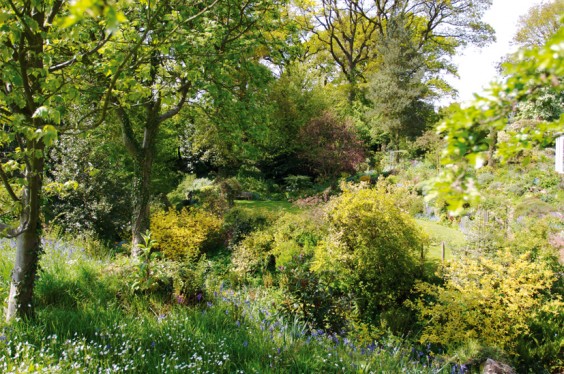
This is the idea behind Selvas Cottage Quiet Garden in Alvechurch, which aims to provide space and time for contemplation – its secluded and peaceful location making it ideal for accessing a sense of spirituality.

Jenna Plewes, who has lived in this idyllic spot for 20 years, realised that her garden was the perfect place for people to spend quiet time with their own thoughts, away from the distractions of everyday life.

“I feel so lucky to live in such a lovely spot that it would be selfish to keep it all to myself,” she explains. “Friends who had been here always said it was wonderfully peaceful and that they could sit here forever.”

In 2002 she began to open her garden to members of the public on certain days and times, so that they might share its benefits.

Paths were created on the steep ground to assist those who find steps difficult, and several separate areas were created where people could sit in seclusion or enjoy the vista, which takes in a small stream, an open field and the surrounding woodland, home to many birds and wildlife.

“It isn’t the sort of place that lends itself to visits by large groups of people,” Jenna points out. “People come here alone or in twos or threes, to sit quietly and soak up the beauty.”

Although Jenna believes that God’s will led her to share her garden, she explains that visitors don’t have to be religious to appreciate it. She says that with the general decline in church-going, places like this are important:

“Many people still have a spiritual hunger for the deeper meanings in life. The garden is an informal oasis of peace where they may glimpse something beyond themselves, whatever their spirituality.”

Visitors to the garden have found this to be true; responses have ranged from “I have stepped off the treadmill and found some peace today,” to “One is nearer God’s heart in a garden.”

Jenna says that people struggling with serious illness have also taken comfort from the garden, with one visitor saying she felt stronger for coming, and another that she now had special pictures in her mind to take away with her.

Visitors are mostly local, having heard about the garden via word of mouth. Others have discovered the spot by accident after walking nearby – “It was as if God had led them here; it was meant to be,” Jenna remarks.

Publicity is deliberately kept low-key, so that the peace of the garden is maintained. “It doesn’t appeal to everyone,” Jenna adds. “I know some people are a bit afraid of silence.”

Visitors are welcome to stay for a whole day or just for an hour or so, spending the time however they wish. Prayers and meditations are available to read if desired.

Although Jenna would like to make the garden more accessible to those with mobility problems, she has made no firm plans for further developments: “I don’t really make plans – I wait for a ‘nudge’ from God. That’s how the garden grew, slowly.”

Jenna herself has been inspired by her garden both before and after it was opened to the public, as well as by nature in general.

Having written poetry throughout her life, the subjects changing as she grew older, she was asked to put together a collection of her work in aid of the Landmark Appeal at St John’s Church in Bromsgrove, the church she attends.

“Some poems were recent; others had been written quite a long time ago when I was on a retreat,” she says. “It seemed as though God was saying’ ‘It’s about time you did something with these!’”

A small booklet was produced and sold to raise money for the appeal, with Jenna’s poems beautifully illustrated by a local artist and fellow church member, Elaine Perry.

“Elaine’s pictures fitted perfectly,” Jenna says. “There has been an amazing response to the booklet; some people have found that one or two poems have struck a chord with them, and others have bought them as gifts.”

The booklet, including poems focusing on spirituality and Jenna’s own relationship with God, is on sale at the church and at Ottakars book shop in Bromsgrove.

For directions and opening times please call Jenna on 0121 445 1624.

An example of Jenna’s poetry, showing how she takes inspiration from her own garden:

I see my life reflected in the garden.
Its seasons are my seasons,
And our cycles mesh.
We move through time to the same steady rhythm
And manifest the miracle of life.

In Spring the promise held in tiny things,
Perfect in miniature, and waiting to unfold;
Seeming so fragile to sharp frost; to threat of death,
But deep down strong and rooted to survive.

In Summer, froth and blousy beauty captivates.
Lush growth hides faults with generous display,
Blood pulses fast and days are long and langorous
And living ‘“now” the order of the day.

Then comes ripe Autumn, drawing all together,
The fruits and harvest of the full lived life
With thoughtful days of gathering and gleaning –
With hints of melancholy and decay.

And so to Winter, when pared down at last
We see the bones of things, and find their very essence.
There’s beauty in that truth, all froth of flowering gone
For hidden in the ground and under bark
Buds of new growth are waiting to be born,
And there is resurrection and new life.

Josh savours big victory

Josh

Josh Bourne, captain and defender for U10s Headless Cross Juniors FC, led his team to victory in the Cleethorpes Championship Cup against clubs from all over the country. 

This is the second tournament Headless Cross Juniors have won in the past two years.

At the end of season presentation evening, Josh was presented with Manager’s player of the Year, Players’ Player runner-up and awarded the Dedication to Football Trophy. 

As well as playing for his school, Josh attends Birmingham City FC development centre, where he was scouted earlier in the season, and he trains weekly at their Wast Hills training centre.

Lions roar to top of the league

Lions

Alvechurch Lions under 10s won the club’s first league with a 4-1 away win at The Glades while championship rivals Harborne Hotshots lost their away game at Sutton, giving our local team the title.

Goals from Josh Poole (2) and David Baker (2) sealed the victory in the Central Warwickshire Youth League.

Club Chairman Andy Cramp said: “We were 2-1 up when news came through that Harborne had lost; a buzz went round the ground as we knew the title was in sight.”

A super pass from Josh Poole released David (Becks) Baker who slotted the ball home to seal the title. Josh then fired home the fourth and the celebrations began.

Manager Dave Baker said: “We were trying to keep it quiet but the subs were going on telling all the players that Harborne had lost.

“All the players have been fantastic all season and have really worked hard in training to reach this goal.”

Alvechurch Lions were only founded in 2003, were promoted last season and went one better this term.

The club now boasts eight teams with the under-8s boys team also finishing runners up in their first season. The club hopes to field 10 teams next season comprising seven boys’ and three girls’ teams.

Above: Andy Cramp, Will Hunt, Josh Poole, Joe Douglas, David Baker, Calum Willmott, Tom Cramp, Charlie Sattertwhaite, Harry Allen, Jake Hartiss and manager Dave Baker.