Home Blog Page 80

Birch and pine

0

birch

Mary

Mary Green continues her series on trees in the Celtic calendar.

The mild autumn led to a dogwood hedge in Withybed breaking into flower in late October – it usually flowers in May or June. St Luke’s little summer went on towards the end of October, followed by a cold blast as we moved to November, when it became mild again.

The tree colour has been lovely after the warm summer, bright even on the stormy days we had, and lasting well into November despite the winds. There have been great berries, not because there is going to be a cold winter as tradition has it, but because of the year we have had so far: cold spring followed by hot summer.

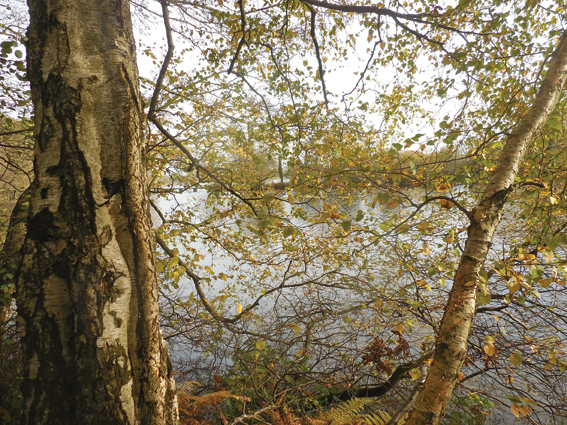
You expect the Celtic tree for December to be dark and gloomy, or at least evergreen, but the main tree for this season is the birch. December marks the solstice, when the light begins to return for the new year, so this graceful silvery tree, full of light, is very appropriate.

It is also a very resilient tree, a survivor, which will grow in inhospitable places where the mighty oaks won’t thrive: this adds to its aptness as a midwinter tree. I remember a poem I learnt as a child that started “The silver birch is a dainty lady/ She wears a silken gown.” Far from being dainty, the birch is tough and strong, and its silver is more like a suit of armour!

It’s a common tree in the north and west of the British Isles, the rest of northern Europe and north America, so was important in Celtic, Norse and native American cultures. Birch branches were brought into the house in England to celebrate May Day, and in Russia a whole birch tree was dressed up as a May bride, or a young woman was covered with birch leaves for this.

Birch was used for the fires and torches of St John’s Day – the old summer solstice celebration. In the Celtic calendar birch stands for new life, and it is one of the fairy trees believed to have magical and curative properties.

Birch forms part of many old place names, often in the form of Birk or Berk. Here we have Birches Lane from Withybed Green up to Cooper’s Hill, an ancient trackway which was planted with birches, many of which reached the end of their lives recently.

New trees were planted about ten years ago, but many did not survive a dry spring when they were planted. There are several in the streets of Alvechurch and other villages, and they often line newer roads, chosen along with rowan for their fast growth.

Birch grows fast and rarely lives to a century. It colonises the ground in acidic areas rather like ash does on the more alkaline soils. Because of this it has often been disliked by foresters and some conservationists, who remove it to allow other plants to grow.

This is not good ecology, though, as these fast-growing trees are useful in protecting young slower-growing trees. They are much better for the environment than the equally fast-growing conifers so often planted, which have a long-term harmful effect on the soil.

Birch fixes nitrogen in the soil so benefits other species. In fact, birch could be more used in forestry as it is a good renewable source of wood-pulp (for paper, cardboard and especially as a biodegradable substitute for plastic and artificial fibres) without the harmful ecological effects of conifers.

Every bit of the birch was used in the subsistence communities where it was often the main tree. All the wooden objects of home and farm, from chairs to plough-handles, were made of birch wood. In Scotland the branches are an important fuel in making whisky.

The twigs are still much used in smoking fish and meat and were also for making brooms and whisks and for thatching. Less pleasantly, it made canes and whips for punishments. Birch is used today for smoking salt, a very welcome recent revival as an addition to our food, including in nearby Droitwich.

The bark of birch trees looks fragile in its silvery lightness but is almost indestructible. If you find an old fallen birch tree trunk it will probably be just bark with the wood inside rotted away. The bark is famously used for canoe making in north America.

It also burns well, so was used for candles and torches. Its oil was an ingredient used in tanning hide. In fact, burning is the only way to easily destroy birch bark. It has been found thousands of years old buried in peat bogs and virtually unchanged from its silvery, papery state. The sap is sugary and birch wine is popular in many parts of the world.

Birch is a catkin-bearing tree, so now in winter small catkins will be growing on the branches. In spring the male catkins will shake out long and wiggly, like hazel catkins but a rather browner shade. Their pollen falls on to smaller green catkins holding the female flowers. The winged seeds in autumn are loved by birds especially finches, so they are spread by them as well as wind-blown.

Birch has beautiful small leaves, light green and rustling in spring, turning a lovely yellow in the autumn. You may see a strange thing growing on birch – there are some on the birches outside the Lewkner Almshouses in Alvechurch.

These are often called “witches’ knots” and look a bit like birds’ nests. They are made by an insect that lives on the tree and makes the twigs form these dense mats. Birch also hosts many fungi, especially the birch polypore, russule and bolete.

As well as the familiar silver birch, there is another kind in the far north of Britain, the downy birch. This is browner but very beautifully scented from the resin on the leaves. I once spent ages on a Scottish campsite looking for the source of that wonderful smell!

The secondary tree in the Celtic calendar for midwinter is an evergreen – the pine or fir – the word used can refer to both. Scots pine is the only native one, but firs have been planted for several centuries. None is local around here, though there are lots of planted conifers.

Most of the pines around here are Monterey or Corsican pines rather than Scots. They were very popular in the 19th century, and you can see them around all the big houses on Cooper’s Hill, on the Lickeys, and in the fine Wellingtonias in Alvechurch.

Scotland was once covered in pine forest. After this was lost, due to a combination of human destruction and climate change, the land became deforested. During the 19th and 20th centuries, fir and other imported conifers were used to replace them, but were not good for the environment even if they did support the paper industry. Nowadays there are reforestation projects with Scots pine, and I have seen this beautifully done around Ullapool.

We have become so accustomed to these conifers that our main family celebration of the year, Christmas, revolves round a fir or pine tree, usually a Norway spruce. But when we had the hot dry summer this year many Christmas tree growers lost their crop, which reminds you that they are happier in the colder and wetter north.

Trees are so important to us (however much we ignore them or dispose of them as inconvenient) that it is very appropriate that we mark the end of one year and the beginning of the next with a Christmas tree. Never mind if it was imported from northern Europe – it still represents hope and the continuity of nature. Perhaps we should bring in a birch tree this year!

Trees come into my poem too, written this autumn. Thank you everyone who has said they enjoyed my year of trees, and everyone who helped me through a difficult year of dealing with cancer. I wrote the poem on the day I got good news about my progress.

Fools’ gold
It is always beautiful, my early morning window
But twice a year it takes my breath away
In spring the plum and damson blossom bursts out
Like snow, like wedding, white cloud and mist
And I fear for it, as the cold frost hides its fingers.
In autumn the ash and plum flame to bright gold
Shining and shaking in the wind like coins
Like Rapunzel’s hair, like gold spun in the cellar
By Rumpelstiltskin’s slave, fools’ gold, fairy gold.
Is this just a cheap hoax, beauty out of reach
To be snatched away and leave us poorer still
Like the hard gold in this Vanity Fair of life?
No, this is the real gold, no fake news
This gold means the trees will move into winter
With their hearts full and their branches clean
Swaying in the gales and cold without breaking,
Working away in the dark, creating leaves
And blossom, to make me love and fear,
Promising I can eat its fruit again next year.
Increases and frozen thresholds in Budget

abacus

ADVERTISEMENT FEATURE

Martin

Martin Pryor picks out the main points from an unexpectedly interesting Budget.

The last Budget before Brexit proved to be more interesting than expected. It was delivered five months before the Brexit deadline and the start of the 2019/20 tax year, and threatened to be an interim affair, as decisions announced in October risk appearing seriously out of date by the time April arrives.

In the event, Mr Hammond chose to be more radical than expected, declaring that, “austerity is coming to an end, but discipline will remain”.

The main points of interest to emerge were:

*  On 6 April 2019, the personal allowance will rise by £650 to £12,500, reaching the target originally set for 2020/21 in the 2017 Conservative manifesto.

*  The basic rate band will increase by £3,000 to £37,500, making the higher rate threshold (personal allowance + basic rate band) £50,000. This also matches the 2020/21 target.

*  Both the personal allowance and higher rate threshold will be frozen for 2020/21. They will rise in line with CPI inflation from 2021/22 onwards.

*  Despite rumours, there were no changes to inheritance tax (IHT), which means the residence nil rate band rises to £150,000 on 6 April 2018. However, an overhaul of IHT could still emerge when Mr Hammond presents his Spring Statement.

*  The pension lifetime allowance will increase to £1,055,000 for 2019/20, in line with CPI annual inflation to September 2018. There were no other adjustments to pension allowances.

*  The capital gains tax annual exempt amount will increase to £12,000, in line with inflation, for 2019/20.

*  There were minor technical changes to EIS funds, after the many changes to venture capital trusts and enterprise investment schemes in the 2017 Budget.

*  The adult ISA contribution limit for 2019/20 was left unchanged at £20,000, although the limit for Junior ISAs did increase £108 to £4,368.

Frozen thresholds

Many tax rates and thresholds were frozen, which offers Chancellors a subtle way of raising additional revenue. This will be necessary, as an examination of the spending commitments given in the Budget reveals that more than £27.6bn of a total £30.6bn will be spent on the NHS by 2023/24.

For example, the main IHT nil rate band stays at £325,000, the threshold set back in 2009. The starting points for additional rate tax (£150,000) and the phasing out of the personal allowance (£100,000) also haven’t increased since their introduction in April 2010.

Combined with the increase in the personal allowance, these frozen thresholds mean that from April the band of income potentially subject to 60% marginal tax (currently 61.5% in Scotland) covers half of the income between the £100,000 taper starting point and the £150,000 threshold for additional rate tax (45% or 46% in Scotland).

The higher rate threshold

The increase to the higher rate threshold for 2019/20 has three knock-on effects:

*  The upper earnings/profits limit for full rate National Insurance contributions (NICs) rises to £50,000, effectively clawing back nearly 40% of your income tax saving if you are an employee with earnings above £50,000.

*  The income ceiling for pension automatic enrolment contributions could increase to £50,000, £3,650 above the current limit. Such a rise would coincide with the increase in minimum total contributions from 5% to 8% of ‘band earnings’ – £6,032–£46,350 in 2018/19.

*  The £50,000 income threshold for the high income child benefit charge is unchanged for 2019/20, meaning it will apply once higher rate tax starts to be paid.

If you would like to discuss how the Budget affects you, please get in touch.

The value of tax reliefs depends on your individual circumstances.
Tax laws can change. The Financial Conduct Authority does not regulate tax advice.

Contact Pryor Portfolio Management for more information:
Tel: 07961 162818
martinpryor@ppm-ifa.co.uk
https://www.ppm-ifa.co.uk

Surprisingly dry month

Red cloud
Red cloud

Phil

Alvechurch amateur weatherman Phil Thomas records the changes.

November, up until the 20th at least, was a very mild month. The average temperature was 9.3C, which is 2.6C above the local average. March was the last month with a near-normal average temperature. 2018 will probably be one of the warmest years in recent history.

Rainfall was low this month, only 30.4mm (39%) – very low for November which is usually quite wet and windy.

November 2018 (to the 20th)
Mean Max  12.1C  2.3 above average
Mean Min   6.5C   2.9 above average
Mean        9.3C    2.6 above average
Rainfall   30.4mm   39% of average
Sunshine  57.1 hrs  90% of average

October started out mild, with an average temperature of 12.5C – 2.4C above the local mean. The weather turned stormy, with a gust of 45mph on the 12th.

It was also very wet from the 12th to 15th, with 39.2mm of rain, making up most of the month’s rainfall. It then turned much colder and drier over the last 10 days, with the mean temperature ending up just 0.3C above the local mean.

October 2018
Mean Max  14.5C  0.6 above average
Mean Min   6.4C    exactly average
Mean       10.4C    0.3 above average
Rainfall     49.2mm   55% of average
Sunshine  125.9 hrs 136% of average.

Outlook
Into early December, there is a lot of uncertainty; we may get a short-lived milder spell with winds from the west, or perhaps see even colder conditions if the winds turn more northerly or northeasterly.

There may be a continuation of the cold and mainly settled conditions – however, there is a chance that during early December the weather pattern may change, with fronts moving in from the west across the Atlantic.

This would bring longer spells of rain, interspersed with brighter, showery interludes, and it would also become less cold. But, even if the change does happen, it won’t be long before we have more settled conditions again, perhaps by the middle of December.

More information at https://www.alvechurchweather.metsite.com  

You can see an improved HD weather-cam, updated at one-minute intervals, at:
https://www.alvechurchweather.metsite.com/webcam_alvechurch.php

Reaching for the moon

earthrise
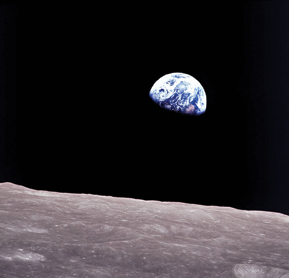
Earthrise on the Moon from Apollo 8         (courtesy of NASA)

Brian

Amateur astronomer Brian Watkiss peers into the Village night sky.

December, already? Well, the Christmas ads have been on telly for over a month and the radio is playing all the old Christmas songs, so it must be. Actually this December marks a very special anniversary: 50 years ago, men went to the Moon for the very first time.

Probes had been there before but Apollo 8 was the first spacecraft to carry human beings. They didn’t land, of course; that was to be six months later, but it was the first time a Saturn V rocket was launched with men on board and they decided that it should do what it was designed to do – go to the Moon. It meant the crew were away for Christmas and they took one of the most famous photographs of all time (below).

Back down here on Earth, Mars is still with us after six months, although not as bright as it was back in the summer. Look for it in the south as soon as the sky has gone dark. It really has been a treat this year and it’s good to hear that NASA has managed to get its remaining rover, Curiosity, working again after a glitch in October. It had a memory problem which was cured by switching to a back-up system. I wonder if they could help me?

Mars is now the only bright planet in the evening sky, although Neptune is close by – but that is for a good telescope, as is Uranus over to the left in Pisces. A crescent Moon wanders by from the 14th.

If you’re up and about early in the morning, Venus rises just before five o’clock and is visible in the south east till the Sun obliterates it at about eight. You may get a glimpse of Jupiter just before this. A thin crescent Moon is here too for the last few days of the month.

This month also sees two more exciting Solar System events. The first of these is the Geminid meteor shower which peaks on the night of the 13th, but look for them anywhere in the sky for a good few days either side of this date.

The second is the close approach of comet 46P/Wirtanen which occurs on the 16th. It was originally thought that this comet would be visible to the naked eye around this time but latest predictions are less optimistic.

What is known is that all comets are a bit unpredictable, so keep your eyes peeled for a fuzzy blob moving up the sky between the Pleiades and Taurus for a few days either side of this date. A good pair of binoculars should be able to pick it out.

Russia is set to launch three astronauts to the ISS on the 3rd of the month, the first launch since the failure of a Soyuz on the 11th of October, so look out for that.

The USA should launch a re-supply vessel on the 4th so there may be a bit of a spacecraft traffic jam at the ISS at this time. This may make one or the other visible from Alvechurch, so go to https://www.heavens-above.com for times and places – and don’t forget to look out for the unknown flying object that always crosses the night sky on the evening of the 24th!

A mine of information

book

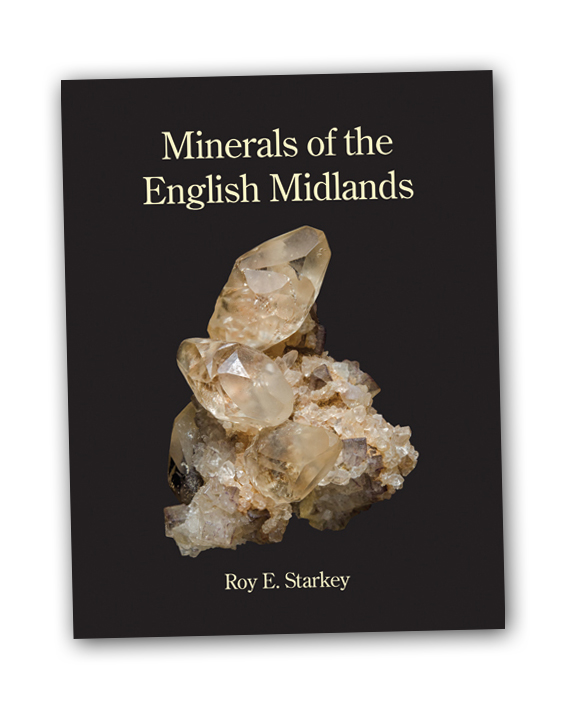
Aston Fields author and mineralogist Roy Starkey has produced a beautifully-illustrated book exploring important mineral deposits in the surrounding area.

Aimed at the general reader as well as the more specialist collector, Minerals of the English Midlands was launched at the UK’s largest mineral show at Bakewell in Derbyshire.

The book, running to more than 400 pages, is the culmination of four years’ research and has seen Roy delving deep into museum stores and drawers across the nation.

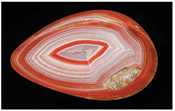
Lavishly illustrated with more than 900 images, the book includes a detailed history of the formerly important Droitwich and Stoke Prior salt industry, and features a wonderful selection of brightly-coloured agates from Marlbrook Quarry (left).

agate

Roy explains, “Many local people don’t realise that it was the unique combination of readily-available coal, iron ore and limestone in the Midlands which powered the Industrial Revolution”.

Economically important mineral deposits in Shropshire and Derbyshire have produced an amazing treasure trove of stunning mineral specimens. Decorative stones such as Blue John, Ashford Black Marble and Alabaster are known around the world and put the Midlands firmly on the map of geological collectibles.

Minerals of the English Midlands is available from Roy by emailing roy@britishmineralogy.com or via https://www.britishmineralogy.com

Tales of historic Hanbury

book

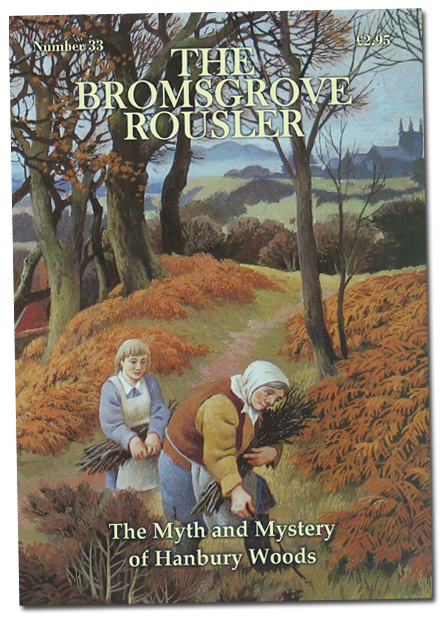
The 2018 edition of The Bromsgrove Rousler, the popular local history magazine, has been published by The Bromsgrove Society.

Hanbury gets lead billing this year. Local artist and writer Robin Shaw explores the history and ecology of Hanbury Woods, plus there’s a review of A History of Hanbury by local historian Andrew Harris – and a painting of Pipers Hill by Norman Neasom on the cover.

Two articles focus on the lives of local women with remarkable stories Mary Johnson was an 18th-century heiress who suffered terribly at the hands of her gold-digging husband, William Chance.

The life story of Jean Davidson is also profiled. Best known as a former Chair of the Bromsgrove Magistrates and for her charity work, Jean has a fascinating backstory, including working for the intelligence services during the Second World War.

Other contributions include a history of the Park Gate Inn, off Kidderminster Road; photographs of the town in the 1960s by Bromsgrove-born documentary photographer Nick Hedges; and extracts from a talk by poet Sir Geoffrey Hill, one of Bromsgrove’s most famous sons.

The Bromsgrove Rousler is available, still at £2.95, from a wide range of outlets including: WH Smith, Foto Factory and Coffee Two in Bromsgrove High Street; Banner Foods in Aston Fields; It’s A Gift in Barnt Green; Blackwell Stores; and most local garden centres.

This and past editions may also be purchased as a download at https://www.bsoc.co.uk. An index to all editions of the Rousler back to 1986 is available as a free download.

A new chapter for Sue

sue

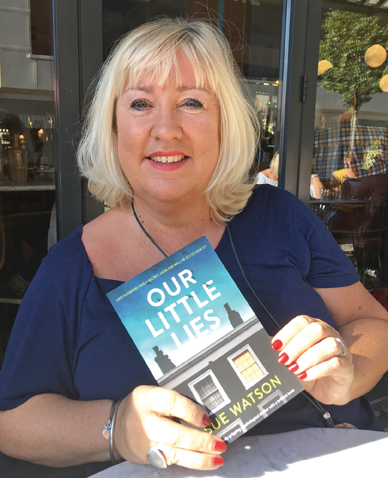
Oakalls author Sue Watson has branched out from romantic comedy fiction with her latest novel, a dark and twisted psychological thriller.

Sue tells us that Our Little Lies, her 13th book, sold more than 10,000 copies in its first week and shot to the top of the best-seller lists in the UK, US and Canada.

“I’ve always wanted to do a thriller,’’ says Sue. ‘’Sometimes I’d be really tempted to sneak a murder into my books but my editor wouldn’t let me and said if I wanted to kill off my characters I should try another genre.”

“Our Little Lies is a story about a woman with a picture-perfect life,” she explains. “But when her surgeon husband mentions a female colleague’s name, she is thrust into a tangle of lies and fear, unsure who she can trust – including herself. And there’s a real twist.”

Sue was previously a journalist and TV producer with the BBC and has been writing for the last 12 years. The rights have been sold to publish Our Little Lies in Poland and Italy where Sue’s other novels have been top sellers.

The book is available in both ebook and paperback format on Amazon, Kobo and iTunes.

The story of Finstall 

launch
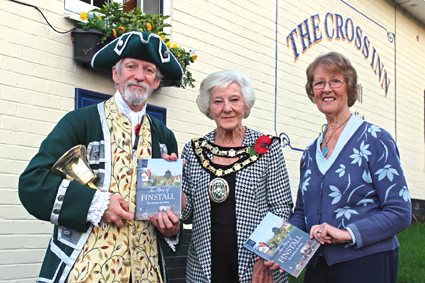
Jennie McGregor-Smith (right) with Chairman of Bromsgrove District Council      Caroline Spencer and Town Crier Kevin Ward at the book launch.

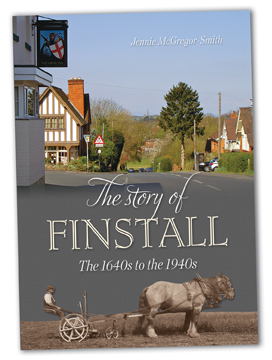
Finstall author Jennie McGregor-Smith, whose previous works have covered the Victorian expansion of Bromsgrove, Aston Fields, Blackwell and Burcot, has turned the spotlight on her own village with a new book called The Story of Finstall.

Jennie’s incredibly detailed research follows Finstall’s journey from the 1640s – when there was no village centre, just a few small farms and hovels – to the 1940s, when a German plane dropped high explosives in the grounds of the Prep School, and the privations of rationing led one family to swap their Austin 7 Tourer for half a pig.

These are just some of the anecdotes to be found in this fascinating book, which will appeal to anyone who enjoys finding out more about their home area and to older residents who will actually recall some of the places and characters in the latter stages of the story.

The author, who was awarded a British Empire Medal in the 2018 New Year Honours list for services to her community, says she thoroughly enjoyed researching and writing the book “because I found out such extraordinary things”, especially the information on the Civil War.

book

We learn that The Cross Inn, where the book was launched, has been a pub since at least the 1780s – and that there was once an ale house by Finch End farmhouse, as well as The Boot Inn, now Coombe Cottage (Jennie notes that hops still grow in the hedge there).

Later, she tells how the face of Finstall was changed by the arrival of several major families such as the Albrights, the Ellins and the Brettells; Quaker industrialists from Birmingham and the Black Country. After William Albright of Finstall Hall died, it was his daughter Catherine who arranged for the Village Hall to be built on Albright land, as well as the new Post Office and the allotments.

Then there are stories about the well-known buildings in Finstall. Rigby Hall, for example, was briefly the home of “Salt King” John Corbett, who arranged annual parties for local children, and some years later the building was used by a Government Ministry in World War II.

The Stud Farm, where Penmanor is now, was renowned for breeding racehorses, while current residents of The Oakalls will be interested to learn more about the farms that preceded the housing development – as well as the tenants whose divorce case in 1915 was so scandalous it was even reported in The Times.

Jennie introduces us to various village characters, such as a trio who all lived to be 100 or older in the late 1890s (when average life expectancy was a mere 47 years), including Joseph Guise, the longest tenant of Caspidge Farm, who had lost an arm in a threshing accident.

Further trivia includes an accident involving a beer train in 1881, causing the local fields to be “deluged with beer”, and details of some rather harsh punishments for petty crime.

The book is available direct from Jennie at a cost of £12 (plus £3.20 postage) – call 01527 872422 or email jennie@mcgregor-smith.com

Calendar people

calendars

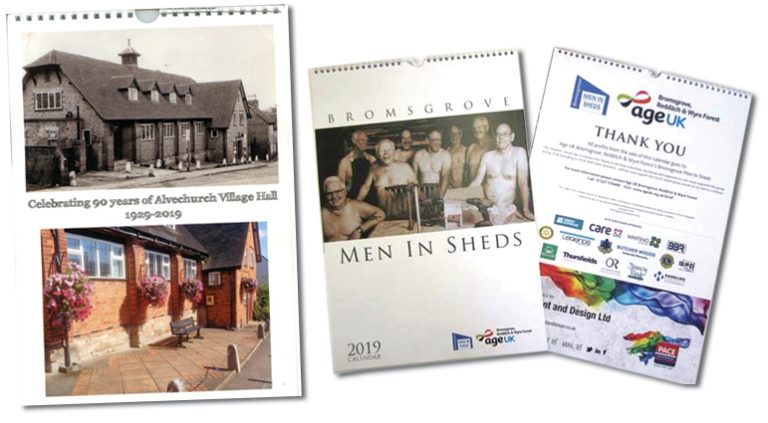
Alvechurch Village Hall’s committee has produced a 2019 calendar, highlighting the many groups that use the venue.

It costs £5 and is available from The Lounge, Crow’s butchers and the parish council office, or from Norma on 07496 or Julie on 07455 892909. Proceeds go to hall maintenance.

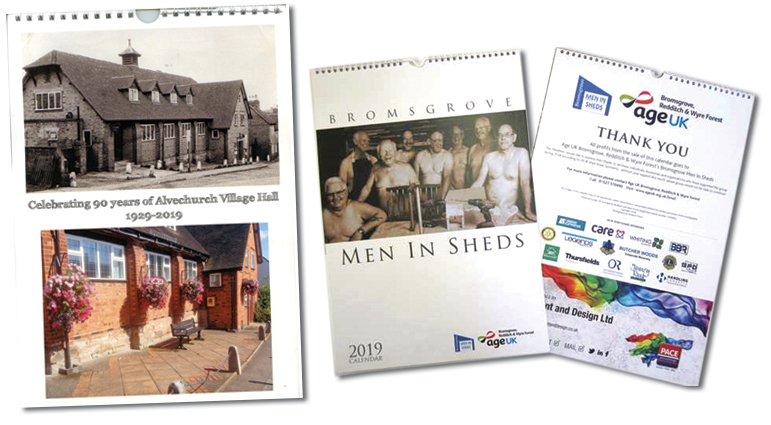
* Men in Sheds, the Age UK initiative that brings isolated older people together for DIY projects and friendship, have also created a cheeky calendar in aid of the charity – to buy one, contact Jo on 01527 868855 or Jo.Hughes@ageuklbrwf.org.uk

The joy of Christmas

decorations

Our guide to the celebrations taking place in the Village area.

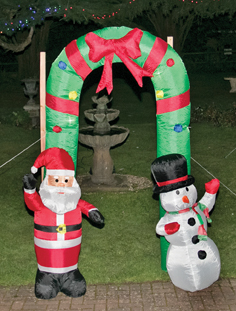
The Best Time of the Year is almost here, and plans for Christmas celebrations are well under way across the Village area, starting with the Lights Switch-On in the centre of Alvechurch on Friday November 30 where the Christmas tree has just been installed. Santa will flick the switch at 5.30pm, and there will be carols from Alvechurch Community Choir.

The Lounge will be open for refreshments, and villagers can then make their way to the Baptist Church for the opening of the Christmas Tree Festival with mulled wine and more carols. The Festival runs until December 4, with trees decorated by village groups and organisations (click here for the full timetable of activities).

Alvechurch resident Karen Hillmansen has come up with an idea to involve more people in the celebrations and also evoke memories of the much-loved Alvechurch Alight processions of yesteryear.

She and a group of friends will gather at 121 Birmingham Road at 5pm, and would like to invite any other residents to come along, bring their own electric tealight lanterns and walk down to the village centre – arriving in time to have a drink, listen to the carol singing, watch the switch-on and visit the Festival.

Meanwhile, Alvechurch is also running a best shop window competition, plus a best-dressed house contest – judging for the latter takes place on December 13.

Barnt Green’s big switch-on event takes place on Saturday December 1 from 4pm. There will be music from Cats Chorus Choir, dancing by Star Project, and appearances from the Town Crier, Santa and Mrs Santa. The countdown to the switch-on starts at 5pm, and the winner of the village’s best shop window competition will also be declared.

Lickey’s annual Christmas concert is on Sunday December 2 at Holy Trinity Church at 4pm, with Father Christmas to switch on the tree lights. Blackwell’s tree at The Wheel will be lit on Friday December 7 at 5.45pm, straight after the fair at Blackwell First School. Santa will of course be in attendance at this event, too.

The next festive event in Barnt Green is on Saturday December 8, when St Andrew’s Church hosts a Nativity Scene Festival with a display of nativity scenes from around the world. Pop along between 10am and 4pm.

Then on Saturday December 15, the new development at Cofton Fields gets its own Carol Service, taking place from 4pm in Aero Way Park. On Friday December 21 there will be Community Carols in Cofton Hackett, from 7pm at end of Chestnut Drive (by the Myhill Field).

On the same evening from 7pm, Finstall Village Hall hosts a Community Carols event with choir members from St Bartholomew’s and St Godwald’s – all welcome.

As we get closer to the big day itself, the community festive gathering for the Oakalls and Parklands takes place on Sunday December 23 at 6.30pm on the open grassed area by the noticeboard and Trianon Road. Blackwell Concert Band will accompany the carol singing and Father Christmas will appear at around 7pm.

Finally, if you want to walk off all that Christmas fare, Barnt Green’s annual Wassail Walk is on Thursday December 27 – this will begin around 3pm in Millennium Park and proceed to a local orchard. For full details see https://www.barntgreen.org.uk