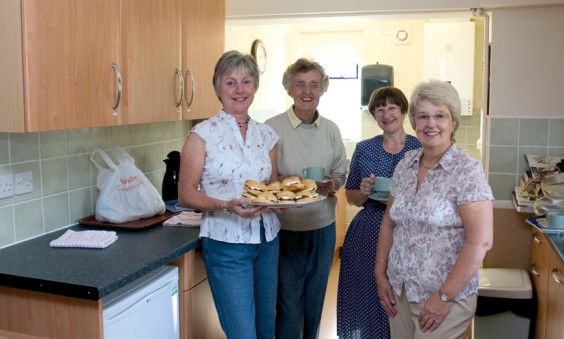
Members of Alvechurch WI serve tea and scones in the new kitchen at Alvechurch Village Hall during an open afternoon to show villagers the new-look facilities at the hall, including much-improved gents’ toilets upstairs.
Members of Alvechurch WI serve tea and scones in the new kitchen at Alvechurch Village Hall during an open afternoon to show villagers the new-look facilities at the hall, including much-improved gents’ toilets upstairs.
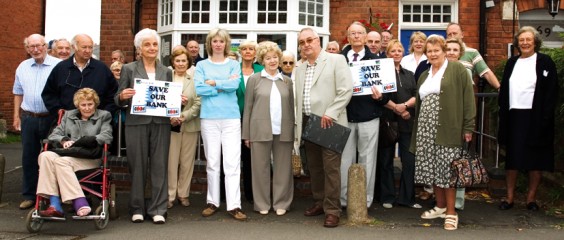
Barnt Green residents, backed by local politicians and Bromsgrove MP Julie Kirkbride, gathered in protest outside the Lloyds TSB bank branch in the village, which is again threatened with closure.
Villagers successfully fought off closure of the Hewell Road bank six years ago, but now Lloyds TSB insist that current use of the branch no longer justifies it remaining open.
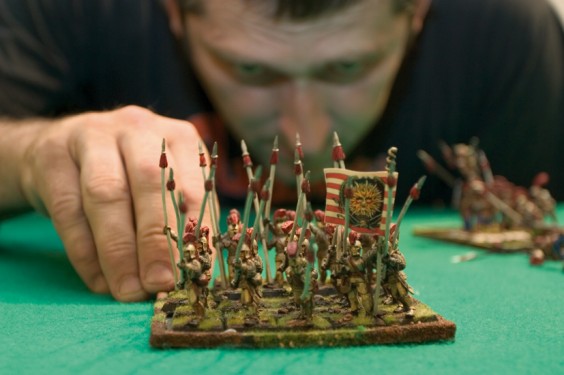
A new Alvechurch club offers the chance to play games of tactics, logic and skill, writes Karl Farrell.
Fancy yourself as a budding Caesar or Maximus (Russell Crowe in Gladiator)? Want to lead 300 Spartans against the Persians? Maybe you see yourself as a Pharaoh leading an ancient Egyptian army, or even a WWII tank general. Possibly you prefer a friendly game of chess or to shake the bones in a game of backgammon?
Well, you can do just that – and have a pint at the same time – at the recently inaugurated Chess, Backgammon & Wargaming Club, which meets every Monday evening at Alvechurch Sports & Social Club.
Backgammon is probably the oldest game in the world. It’s very easy to play, but takes a lifetime to master. It requires good tactics, an adaptable strategy and, with the advent of the doubling cube, good judgement and steely nerves.
Most people know how to play chess. It’s the most concise, precise and brain-hurting game I know. It’s 100 per cent skill; there’s no lucky dice or turn of the cards involved.
Originating in India around 450 AD, it was initially a wargame used in training army officers. The modern day Castle (or Rook) was initially an elephant model.
Elephants were widely used in ancient Indian armies as a major attack weapon; they caused terror to cavalry units and would make a right mess of infantry blocks.
Which brings me onto Wargaming (one of my armies being an ancient Indian).
A wargame is like a game of chess but using hundreds of pieces instead of 32, several types of dice, a rulebook and a playing surface usually about the size of a pool table.
You lay out some terrain such as hills and woods, organise your nicely painted model soldiers into units, line them up and beat your opponent with a cunning plan (well, you don’t always beat him, to be honest!).
Modern day wargaming was developed (like most decent sports and games) in Britain. The hobby exploded in the 1970s, mainly due to a Birmingham-based outfit called the Wargames Research Group who published the first widely adopted set of rules for the ancient period.
Ancients is my main period (thus the bias in this article) but if there’s been a conflict at any time in history, anywhere in the world, then you will find published rulesets for it.
Other major periods include Renaissance, Seven Years War, Napoleonic Wars, American Civil War, Colonial Wars, WWI and WWII.
Most youngsters will be familiar with Dungeons & Dragons and the Warhammer Fantasy battles. Well, Warhammer have a ruleset for ancients which I sometimes use, and (to my surprise) they aren’t too bad.
You’re welcome at the club whether you’re an expert or learner, male or female, young or old (under-17s need to be accompanied by an adult). Social Club membership is not necessary for joining, although becoming a member allows full use of all the Club’s facilities (snooker, pool, Sky football etc).
The club meets every Monday (except most Bank Holidays) from 7pm onwards. For more info please ring Karl Farrell on 0121 445 4616.
Above: Matt McVeigh sends in the troops.

Local historian Anne Bradford brings another spooky story from the Lickey Hills…
The Lickey Hills are delightful in sunny weather but can be bleak and unnerving when night falls, or in colder months when the trees are shrouded in mist.
Michael Farrel used to work at Beacon Croft House at the top of Pike Hill, Blackwell, and lived at West Heath. He always walked the four miles to and from work, taking the same route around the foot of the Lickeys.
This incident took place at about 4.30pm about three days before Christmas 1975. The light was fading and Michael was alone in the hills…
“It was my last day at work before Christmas and I was loaded up with cards and Christmas presents. We had been very high-spirited at work. I was very happy and content, even carefree.
“I was not in any way in a state of mind which would induce hallucinations.
“As usual I walked down Cherry Hill Road and on to the Lickeys, took the main path for a short way, then a side path. This skirts the side of the hill and saves having to climb.
“About 100 yards along the narrow path, I was suddenly aware of movement about 10 yards ahead and to the right. It was dusk but I could see it quite clearly, and it was vigorous enough to stop me dead.
“A white mist about eight feet in depth, what I could call a classical mist, hovered two or three feet from the ground above the bracken. I realised that I was seeing something autonomous of my own perception and no construction of my imagination.
“As I watched, the centre of the mist became more dense and assumed human form. This more opaque mist which formed the figure was glowing and the peripheral white haze formed a kind of aura.
“I could see only a life-sized shape without detail and the lower half was less distinct than the upper, so I could not make out whether it was male or female.
“Then it began moving in what I can best describe as a leisurely, graceful dance. The head slowly bent forwards then lifted and bent backwards, and what appeared to be the arms were lifted above the head then lowered again, as if in slow motion.
“I was so frightened I can’t remember more than that. The incident occurred within 10 or 15 seconds and during that time I felt my mood change from euphoria to absolute panic.
“I took off as fast as I could across the Lickeys, only coming to my senses when I lost my footing and fell down a ditch near the Barnt Green Road.
“I had experienced something that was beyond my comprehension and powerful enough to put me in a state of shock for a few hours afterwards.”
* This story is taken from Ghosts, Murders & Scandals of Worcestershire, which also contains terrifying tales from Tardebigge, Beoley and Hanbury. It should be available from good bookshops priced £7.50. Anne’s newest book, The Haunted Midlands, is out soon.
If you’ve had a ghostly encounter somewhere in this area, give us a call and we may feature the tale in a future issue.
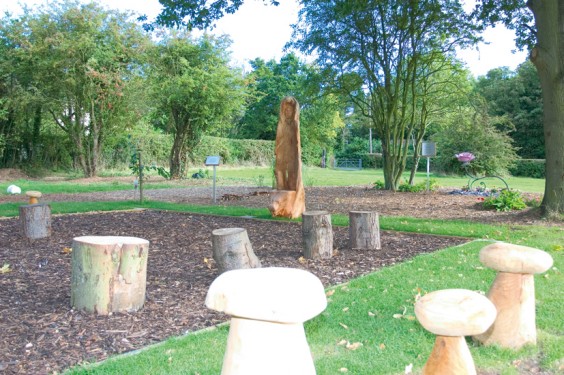
A moving tribute has been paid to a Blackwell teenager with the opening of a memorial garden for use by children of the village.
Jennifer Jones, who died from cancer in July 2005 aged 19, was a former pupil of Blackwell First School and teachers who had known her were keen to create a lasting memory of her at the school.
“Jen’s Place” was opened last month and is already being used by groups from the school who can sit for storytelling in the peaceful setting in a corner of the school field.
It was brought about by a committee of people from the Blackwell community, including Blackwell First School, Hunters Hill School and Jen’s friends.
They secured a £3,000 Awards for All Lottery grant and support from local businesses, then a large group of volunteers cleared the land at the top of the field by St Catherine’s Road.
The storytellers’ chair was carved by wood sculptor Jim Heath and “Jen’s Rose” was made by blacksmith artist Michelle Parker.

Plaques have been installed explaining the reason for the garden and also displaying Poem for Jen by her friend Caroline Saunders (see below).
Jennifer’s parents, Steve and Kay, said: “We are uplifted and honoured by what our wonderful community has achieved and delighted that children and young people will benefit from and enjoy this beautiful compliment to our daughter.”
Denise Lee, Deputy Head at Blackwell First School and one of the leaders of the project, said: “This area is for the youth of our village, and for past and present pupils of our school.
Somewhere to meet, to enjoy and to remember. It is our tribute to Jennifer, to her spirit, and a belief in youth itself. Let it be enjoyed by many but abused by none.”
Poem for Jen
Think of something special about me whilst I sleep
Think of something special – now’s not the time to weep
Think of all the friends I made
The dreams I held, The tricks I played
Think of all the nerves I frayed:-
(staying out late, skirts too short,
dodgy boys, school reports)
Yes – think of something special now that I’m asleep
And when the hurt starts fading and the tears begin to ebb
Think of me without the pain
Upside down on the climbing frame
Wearing hot pants in the rain, or
Telling the same bad joke again
So think of something special now that I’m asleep
This memory’s a legacy I’ve left for you to keep
Soon it will not be a trial, but
You will notice in a while
You can’t resist an inner smile
For laughter always was my style
So – think of something special now that I’m asleep
At last someone other than me has had the warden idea (Barbara Pack, The Village, September).
We need to get out of the mindset of modifying our society and surroundings to accommodate the motor car, and instead make the motor car fit society. The only person I know who attempts this is Ken Livingstone.
Instead of spending thousands of pounds on useless anti-parking ideas and hideous speed warnings, as in Burcot (where 75 yards away cars are parked full on the pavement, and nothing is done), we should use the laws that already exist and employ two or three mobile wardens (maybe on scooters) to randomly visit all the villages and town suburbs and give £30 fixed penalties to cars parked on pavements, double yellows, crossings, bends and brows, traffic lights, road markings and at bus stops etc.
This would return the footpaths to the pedestrian, force the traffic to slow down and just 40 tickets a day would generate over £250,000 net per annum, and since I can usually count 50-plus cars on pavements between Bromsgrove and Blackwell alone, 40 per day is not many.
The same wardens could be used to report things like potholes, broken drain covers and paving slabs, anything that may require attention or repair.
Brian Wearing, Blackwell
Unfortunately my last deer sighting in Alvechurch – a few weeks ago – was of one that had been killed by a motorist and was lying on the grass verge at the side of Birmingham Road near the motorway bridge.
It was on the left-hand verge as you leave the village, at the point where some motorists are in mid-acceleration, leaving the built-up area, and before they brake for the roundabout.
We have had muntjacs visiting our grounds in Old Rectory Lane for more than 10 years, usually solitary animals, but on one occasion mother and one offspring who visited over a number of weeks three or four years ago.
Unfortunately the speed and volume of traffic in Old Rectory Lane means that all wildlife is vulnerable to fatal accidents (humans too). To date, water birds using the Arrow have been the victims.
It’s hard to understand the mentality of drivers who choose to use Old Rectory Lane and travel at speeds that result in fatalities to wildlife. It is after all a quiet, single-track, winding lane that is enjoyed by many local residents who enjoy taking a stroll there.
What happened to the quiet country lane concept?
Christine Swainson, Alvechurch
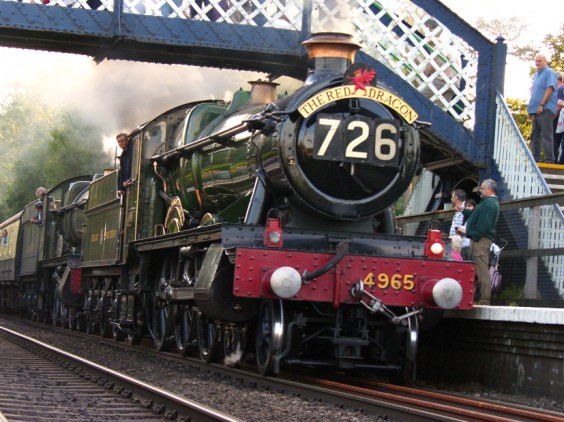
The Red Dragon steams into Barnt Green returning to Birmingham from Newport.
It was on a rail tour and was running around 50 mins early, meaning some people might have missed this wonderful sight.
Picture/Matthew Brewer
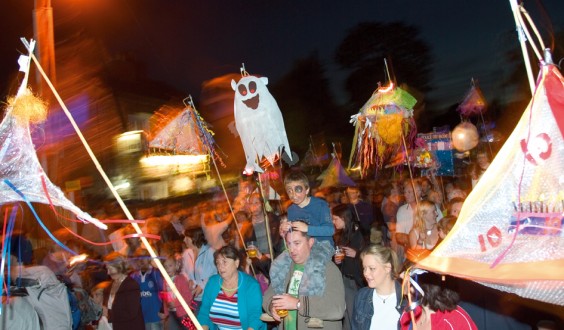
The 10th Alvechurch Alight festival set the village aglow with another spectacular lantern procession through the village.
While the “glow stick” illuminated lanterns weren’t quite as bright as last year’s electric bulbs, the high spirits of the revellers lit up the Saturday night.
Leaving from the Weighbridge pub with music from Alvechurch’s Banda Sem Nome samba band and Bromsgrove’s Someone at the Door, the crowd swelled in numbers all the way to Alvechurch FC’s ground, where a fireworks display lit up the night.
One of the organisers, Annette English, thanked everyone who had helped with the events, adding: “I could take up a whole page with thank-yous!”
Hannah Genders takes on a design project with an international flavour.
Since completing the TV series I presented on organic gardening, I regularly receive emails from all over the world. Often people want to say how much they enjoyed the programmes, which is really encouraging.
Sometimes I get asked questions on all sorts of subjects, ranging from which organic spray to use on tomatoes in South Africa to advice on how to start an organic vegetable garden in Denmark! I do like this unexpected aspect of making the series as it gives my little studio a truly international feel.
One such email came through four months ago from a couple who had bought a chateau in France. More than just advice, they were looking for a designer who would work with them on a five-year restoration project for the chateau and grounds.
I thought it was definitely worth a look even though it seemed a bit daunting. A warm weekend in June saw my husband Mike and me flying to France to check out this project.
We arrived in the dark so it was only on the Saturday morning that the size and beauty of the place became apparent.
I say “we” – actually I walked the grounds with our host and chatted through ideas of what we could achieve while Mike stayed behind to catch up with some work on his laptop.
While sitting in the kitchen he became aware of an almighty kerfuffle breaking out in the courtyard – neighbours’ dogs had arrived and were taking one of the chickens apart.
He rushed out to save the other chickens by giving one of the dogs a sharp boot up the backside and managed to send them scurrying home. I got the impression it wasn’t going to do much for Anglo-French relations in the area.
So, back to the gardens. The chateau is situated in north-west France and stands in about 80 acres of land, most of it woodland that has been left to go wild – it needs a good woodland management programme to bring it back to its best.
This will run in a five to ten-year cycle and will involve removing the dead wood, clearing out invasive weeds, coppicing hazel and planting up new trees as the old ones are cut down.
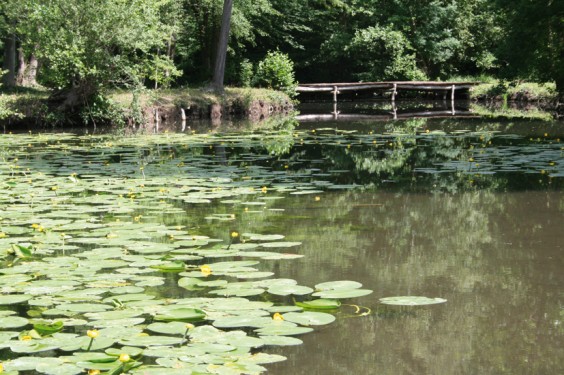
At the back of the property is a series of lakes all fed by the local river.
One in particular stood out for me as it was covered in wild water lilies. These lakes are also home to two vicious black swans which we were warned to steer clear of.
Apart from some mature trees and a beautiful old orangery that I fell in love with, most of the grounds are a blank canvas. This gives the opportunity for some really exciting design work, taking the formality of the French garden style and transforming it into a classically beautiful garden to complement the style of the house.
I envisage much of the planting will be romantic; a mixture of old fashioned scented roses, lavender and deep blue iris. While this would echo the style of gardens in the area, I will be using English cultivars as we have the edge on growing strong, healthy plants that repeat-flower and are disease resistant.
With a project of this size, I expect to be working on it for the next five years and would roughly break it down into about seven projects.
The first of these will be the fruit and vegetable gardens behind the central courtyard; the area is walled on three sides so I hope to include plenty of espalier fruit trees to make the most of the warm stone backdrop.
This is a great place to start and was actually the link with my series, as the owners saw what we achieved at the Pot Kiln garden and liked it – this, however, is on a very different scale.
It’s a very exciting project and one that will give me numerous headaches, I am sure, but it’s still a privilege to be working on it and I will let you know how I get on.
Oh, and I need to brush up on my French too! Au revoir!

We hope you enjoy our magazine in print and online. Please get in touch anytime via email at the address below.
Contact us: info@villageonline.co.uk
© All content is the copyright of Platform Publishing & Media Ltd 2025. For further information, please email info@villageonline.co.uk