Home Blog Page 767

New members for hall committee

Alvechurch Village Hall Committee has been bolstered by the appointment of Chris Davies as treasurer and Frank Molloy as vice-chairman.

The committee had lost many of its stalwarts over the past two years, but still managed to carry out substantial improvements to maintain the hall’s place as one of the most attractive buildings in the village – with competitive hiring rates.

A Christmas Fayre will take place on November 11 from 2-4pm. Meanwhile, anyone who would like to hire the hall should call Barbara Baker on 0121 447 7382.

A ‘grand’ time for The Midland Sinfonia

Nigel Morley

The Midland Sinfonia has been performing classical music at St Laurence Church in Alvechurch since its formation in 1995.

While the quality and variety of the concerts has achieved a dedicated following, one particular area of the repertoire was restricting the group’s programme.

Last season TMS launched a “Piano Appeal”, making overtures to potential donors and organisations offering possible grants. The success of these approaches has allowed them to purchase a new Petrof Klasik grand piano.

“The generosity of our patrons, donors and sponsors has been fantastic,” says Chairman Keith Woolford.

“Initially, we thought we may have to settle for a reconditioned model, but when the funds started to build up were able to look to the future and have invested in this wonderful, gleaming black piano. It sounds good, too!”

Now installed in the church, the instrument will allow more concerts with piano accompaniment, and solo works.

“We are also pleased to return the compliment to St Laurence Church, having used their ‘workhorse’ over the years, and offer them the use of our piano for church purposes,” Keith continues.

October saw the first TMS Piano Festival, held over three days, to celebrate the piano’s arrival, and on November 19th it’s the Youth Showcase, introducing talented students on cello, piano and violin.

Jenni Payne, one of the musicians featured, will put the new piano through its paces. For this special concert, in St Laurence Church at 3pm, tickets are £5.

On Dec 2 TMS present a Christmas Candlelight Concert, at 7.30pm in the same venue, with a performance of Handel’s Messiah. The event also incorporates the Worcs of Art exhibition in the Ark.

For bookings, call 0121 445 7261 or see https://www.midlandsinfonia.co.uk

Pictured: Musical director Nigel Morley.

trees for everyone

Common beech

Hannah Genders finds plenty of inspiration in the collection of trees at Arley Arboretum.

I had been meaning to visit the arboretum at Arley for years, and finally got the chance one recent Saturday.

Mike and I were already in Stourbridge test-driving some vans – a very boring prospect for me, and I confess that I become a complete girlie with vehicles of any kind and am only interested in the colour.

Still, the thought of spending an afternoon looking at spectacular trees kept me sane.

We decided to park in Bewdley and walk the four miles to Arley. You could do this and catch the steam train back if you only wanted to walk one way.

The footpath follows the River Severn north and has some really stunning views. Once you reach Arley the arboretum is at the top of the village behind the church.

The grounds at Arley were originally planted in 1820 by Lord Mountmorris – there are now 22 acres open to the public including the arboretum and walled gardens, and they can be easily walked round in an afternoon.

I am always impressed by someone who would want to spend time and money creating an arboretum, not only because I love trees but also because it requires unselfish foresight to plan something that will take several hundred years to mature. 

The estate seems to have fallen into disrepair by the 1950s and was taken on by a Mr Roger Turner, described as a Midlands industrialist and philanthropist.

He not only restored the arboretum and grounds but built numerous properties in the village itself. He died in 1999, leaving the arboretum in the care of a charitable trust, and his grave can be seen in the churchyard.

Entering the arboretum via the teashop – good news if you have walked from Bewdley and forgotten to pack the sandwiches – the first part of the garden is walled and contains an Italian garden and orchard.

I thought this area was rather quaint; not spectacular but nicely planted with borders of herbaceous perennials that would look particularly good from April to June.

You then pass from the walled garden to follow a stone paved path around the arboretum – I mention the path because it is lovely stone and would cost a small fortune to put in at today’s prices.

This really is the area to inspire visitors. There are many pine trees in the collection, but it was the older native or semi-native trees that I really loved, so here are my favourites in no particular order:

* Lucombe Oak – (Quercus x hispanica ‘Lumcombeana’) – I can’t remember seeing one of these before; it is a really large tree with a very thick ribbed bark. As a hybrid of the Cork and Turkey oak it also has interesting leaves that are semi-evergreen.

The Turkey oak is not favoured by growers as it produces a cheap wood unlike our lovely English Oak, but still a beautiful tree.

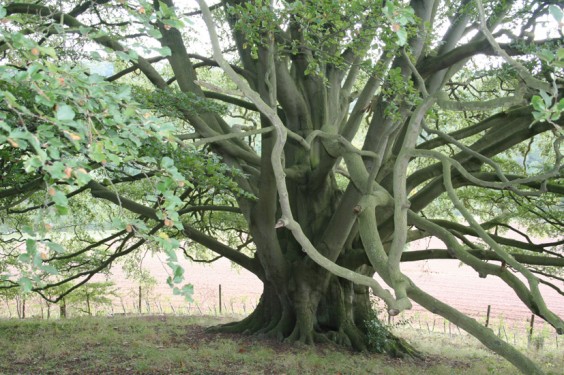
* Common Beech (Fagus sylvatica), pictured above – anything but common to me! There are two that stand out at Arley: firstly the layered beech that has rooted where the branches touched down to the soil.

The old trunk has long since disappeared but the shooting branches extend a quarter of an acre.

There is also a stunning beech tree on the edge of the arboretum near the well that overlooks the surrounding fields – I really couldn’t choose between them.

* Hornbeam (Carpinus betulus) – although this one at Arley had a deeply divided leaf, I didn’t manage to write the cultivar name down as I was so busy taking photos.

Still, a great tree, very similar to the beech in habit but the bark is different and the hornbeam does hold its leaves longer than a beech tree if you are thinking of planting one.

* Sweet Chestnut (Castanea sativa) – the lovely bark grows in a sort of ribbed spiral as the tree ages, and of course there are chestnuts if you get to them before the squirrels do.

With such a warm autumn (the hottest September on record, I am told) none of the trees were really showing their autumn colours.

I have made up my mind to revisit Arley in a month’s time, and who knows, with all those Acers yet to look their best I might need to change my list of favourites.

Arley Arboretum 01299 861386
Admission about £4 – well worth it
Open mid-March to mid-November
https://www.arley-arboretum.org.uk

Gunfire over the Lickeys

0

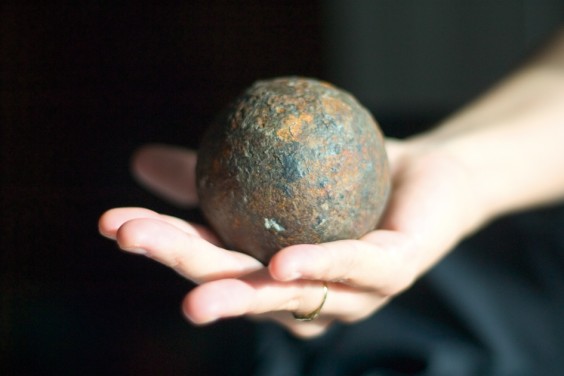
Cannonball

The Lickey Hills may be a peaceful haven these days, but 150 years ago you would have been wise to keep your head down as much of it was an artillery range.

After the discovery of cannon balls there in the 1970s, historian Charles Blount presented the following account to the Lickey Hills Local History Society in 1981.

This, and the cannon ball featured above, were among the effects left by Charles at his Barnt Green home when he died earlier this year.

In 1979 the discovery of a number of three-pound and six-pound cannon balls embedded in the ground on the western slope of Cofton Hill brought to light a forgotten fact – that from 1831 to 1871 the artillery range of the Worcestershire Yeomanry Cavalry had been on the Earl of Plymouth’s property in the Lickey Hills.

The Yeomanry Cavalry, one regiment to each county, was started in 1794 mainly, if not wholly, as an integral part of the vast force raised for the defence of the country against French invasion during the Revolutionary and Napoleonic Wars.

In 1803 the Yeomanry Cavalry numbered no less than 44,000 men, well-trained and equipped largely by private and voluntary effort.

Although its services were never required in the field, save against the ineffectual French landings at Fishguard (Wales) in 1797 and Killala (Ireland) in 1798, this large mounted force undoubtedly contributed much to the security of the country.

The end of the French Wars in 1815 was followed by the discharge of large numbers of men from the army and navy into an economy depressed by the long and difficult transition from wartime to peacetime production.

The result was mass unemployment, with no effective system of poor relief to prevent extreme hardship and suffering. This led to riots in various parts of the country, which had to be restrained by the Yeomanry Cavalry as there was no police force at that time.

By 1822 the revival of economic activity and prosperity gradually ended the hardships of the post-war period, and rioting ceased to be a threat.

The government, saddled with the enormous National Debt resulting from the long French wars and financially crippled by the abolition of income tax when the war ended, was seeking every means of reducing its expenditure.

With the return of external and internal peace the Yeomanry Cavalry seemed to have lost all purpose and it was, therefore, disbanded in 1827 as an economy measure.

But the government had misjudged the situation. The period of post-war prosperity was brief, and by 1829 many things began to foreshadow another and more widespread outbreak of general disorder.

The situation was complicated by the determination of the middle class of professional men, factory owners and shopkeepers to gain the right to vote for Members of Parliament, and its success in persuading the working class that Parliamentary reform would lead to the satisfaction of all its grievances.

The establishment of the Metropolitan Police in 1829 by Sir Robert Peel relieved anxiety about the maintenance of law and order in the capital, but lack of both effective police forces and Yeomanry Cavalry left the rest of the country at the mercy of rioting mobs.

As a result, in 1831 the Worcestershire magistrates invited the Earl of Plymouth to “resuscitate the lately disbanded Yeomanry Cavalry” and to take command as Colonel-Commandant.

Such was the anxiety about the maintenance of law and order among the landed gentry and farmers that the regiment of Worcestershire Yeomanry Cavalry was raised, uniformed, equipped and trained with amazing speed.

It consisted of a regimental headquarters situated at Lord Plymouth’s mansion, Hewell Grange, between Redditch and Bromsgrove, and ten troops of horsemen, two based at Hewell, each of the remaining eight in towns scattered throughout the county.

Each troop consisted of fifty NCOs and men, officered by a Captain, a Lieutenant and a Cornet. A permanent Drill Sergeant, a pensioner from a regular cavalry regiment, was appointed to each troop.

By September 1831, the training of the regiment was sufficiently complete for it to parade at Worcester for inspection and official approval. 553 men of all ranks paraded out of an authorised establishment of 662.

At this period it was usual to attach what were called “galloper guns” to cavalry regiments, and two three-pounder guns were accordingly issued to the regiment of Worcestershire Yeomanry Cavalry.

These were horsed with a team of four horses apiece, and manned by a detachment of a sergeant and 22 gunners, commanded by a lieutenant.

Although authorised, the artillery was supernumerary to the establishment until 1843, and the government’s financial grant to the regiment was not sufficient to pay for the artillery. Therefore, the whole cost of the artillery was borne by the Earl of Plymouth out of his own pocket.
Inscription

Between 1831 and 1843 the Earl and his brother-in-law, Colonel the Hon. Robert Henry Clive – who succeeded as Colonel-Commandant on the Earl’s death in 1833 and retained the command until his own death in 1854 – paid £18,470 towards the upkeep of the regiment out of a total cost in the same period of £63,891.

The gunners were shown as supernumerary to the establishment and were paid by the Colonel-Commandant out of the private fund. They were attached to the Tardebigge Troops, and all came from the Hewell Estate.

They had a Sergeant Instructor who was a pensioner of the Royal Horse Artillery. They drilled and exercised with the guns every Saturday afternoon.

The guns were kept in a building of the stables at Hewell Grange, which became known as the Cannon House. The ammunition was also paid for out of the private fund.

The firing range used by the gunners when they practised with live ammunition was situated on the Lickey Hills, then part of the Hewell Estate. The guns fired from a field called Narborough’s Field, eastwards across the valley into the western slope of Cofton Hill over a distance of about 1,000 yards.

From Narborough’s Field, Cofton Hill appears as much higher ground and therefore formed an effective stop-butt for the three-pound cannon balls. The fact that the intervening ground was much lower greatly reduced the risk of a ball striking anyone who trespassed on the range.

(Narborough’s Field can be found by entering the Lickey Woods at the junction of Twatling Road, Mearse Lane and Lickey Square, and turning right along a minor path a few dozen yards from the entrance gate. A long straight path leads to an open scrubby square field of hawthorn, bracken etc).

In 1843 the gun detachment was included in the establishment and adequately financed by the government. In 1853 two six-pounder guns were issued to replace the three-pounders, and a captain and four drivers were added to the establishment.

But as the three-pounder guns had been paid for by the Earl of Plymouth they were regarded as the property of his family, and were retained at Hewell when the six-pounders were issued.

In 1871 the artillery detachments of the Yeomanry Cavalry were abolished, and the two six-pounder guns were returned to the Ordnance Department in 1873.

The use of six-pounder guns on the range from 1853 to 1871 explains why the cannon balls found on Cofton Hill in 1979 included 23 three-pound balls and twelve six-pound balls (as well as many fragments amounting to a number of additional balls which cannot be estimated).

Between the re-formation of the Worcestershire Yeomanry Cavalry in 1831 and the foundation of the county police forces on the model of the new Metropolitan Police in 1839, the Yeomanry Cavalry was frequently called out by magistrates to prevent or put down riots – their arrival at a place threatened by rioting was usually enough to prevent it.

This period of social and political unrest fell into two phases. Up to the passing of the Great Reform Act in 1832 the purpose of the agitation was to persuade or force the government to extend the right to vote for members of the House of Commons to the solid and prosperous middle class, and as far as was practicable to give each vote equal weight.

It was contrary to its nature, and contradictory of its claim to political responsibility, for the middle class to support its demands by rioting.

But the working class had been led to believe that the reform of Parliament would cure poverty and unemployment, and it readily supported the demand by rioting, particularly in towns.

In the country violence was directed chiefly against the introduction of labour-saving machines – harvesting machines, threshing machines etc – which the agricultural labourers feared would reduce their wages or even throw them out of work. So they broke machinery, burned ricks, and tried in other ways to intimidate the farmers.

The Worcestershire Yeomanry Cavalry were in action against the rioters in 1831 at Upton-on-Severn (where the boatmen and hauliers were resisting the introduction of horse-towing), Worcester, Stourbridge, Dudley, Wolverhampton, Castle Bromwich (riots by colliers and nailers), and Tewkesbury.

As a result the disturbances, which in 1831 were general throughout England and Wales, assumed far smaller proportions in Worcestershire than in most neighbouring counties, “notwithstanding the unusually dangerous and lawless character of the colliers, nailers and others of the same class, so numerous both in town and country districts”.

Lord Plymouth and his regiment received many votes of thanks from magistrates and public meetings for their support in saving the country from mob-rule.

After the passing of the Great Reform Act in 1832, rioting was soon resumed when the working class found that the new middle class Parliament and government produced by the reform of Parliament was, if anything, more hostile to its attempts to improve living standards than the unreformed Parliament had been.

This movement is known as Chartism, though the agitation spread beyond the direct supporters of the People’s Charter, which set out demands for the further extension of the right to vote and other political reforms.

But in 1839 the new county police forces became responsible for the maintenance of law and order, and the Yeomanry Cavalry ceased to be used to support the magistrates against violence.

On May 15, 1834, the whole regiment paraded on top of the Lickey Hills to the north-west of the old high road between Birmingham and Worcester (which had been diverted along lower ground through Rubery in 1831).

The occasion was the laying of the foundation stone by the Lord Lieutenant of the County, Lord Lyttelton, of a memorial to the 6th Earl of Plymouth.

On a commanding site overlooking Bromsgrove and the wide extent of the Severn plain was raised an obelisk of Anglesey marble with a total height of 91 feet, six inches.

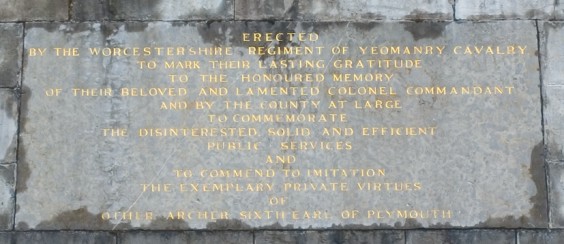
Of a total subscription of £982, £576 was raised by the regiment, whose name heads the inscription on the monument’s base:

“Erected by the Worcestershire Regiment of Yeomanry Cavalry to mark their lasting gratitude to the honoured memory of their beloved and lamented Colonel-Commandant and by the county at large to commemorate the disinterested, solid and efficient public services and to commend to imitation the exemplary private virtues of Other Archer, Sixth Earl of Plymouth.”

Sue’s reward

Sue

Barnt Green fundraiser Sue Medcalf has won a top charity award for her work in developing one of the region’s biggest fundraising events.

Sue, a community fundraiser for Cancer Research UK who works closely with the charity’s Barnt Green Committee, received the Leadership Behaviour award following months of work developing the Relay for Life project – which came to fruition in September 9 when the Midlands Relay took place at Redditch’s Abbey Stadium.

The idea behind Relay for Life is to bring the whole community together in one location, raising money as well as celebrating advances in research and treatment.  22 teams took turns to walk, run, skip or crawl around the track in a relay, after a lap of honour by cancer survivors.

The Redditch event – one of more than 40 taking place in the UK this year – raised £31,000. Redditch company AT&T has also agreed to donate at least £15,000 to the fund, and the Redditch Round Table contributed £1,000 on the day.

“It was inspirational – a fantastic event.” says Sue. “I’d like to thank the organising committee for all their work.”

For more info on Cancer Research UK’s projects call Sue (01527 596529) or see https://www.cancerresearchuk.org 

Traffic has no rhyme or reason

0

‘Beware! Beware!
Be cautious there.
School Lane’s not wide.
You could collide.’

‘It’s one-way traffic.
No need to panic.
Driving down is not permit.
Upwards only is legit.’
 
‘Are you sure?
I could have swore
I have seen cars descend.
Do the rules apply if you’re resident?’

Lynn Royle, Alvechurch

Rising to the challenge

Graham, Jo, Michael

Jo Wyatt has risen to the challenge issued to former Barnt Green Brownie, Guide and Ranger members to help the appeal for a new scout and guide hut in the village.

Jo, whose father, Graham Cudd, is a former Barnt Green Cub leader, raised £400 from a coffee morning, cake sale and raffle.

The appeal to replace the hut burned down in 2004 has raised £42,000 towards the £405,000 project.

Anyone else who would like to rise to the challenge should call 0121 445 3907 for further details.

Pictured: Jo with father Graham (left) and appeal chairman Michael Docherty.

Traditional supplies online

Joe

A Barnt Green grocers is aiming to bring traditional, local shopping into the 21st century.

Customers of Barnt Greens and Joslyn Catering can do their shopping online and have fresh, locally-sourced produce delivered direct to their door.

The Hewell Road-based business, already popular for its high quality produce, is one of the first in the immediate area to take advantage of computer technology in this way, and owner Joe Lynch (right) believes that the development will prove beneficial to the community.

“With the new service, you can simply find our website, punch in your details and password, and do your shopping from the comfort of your own home,” he explains.

The online service is not the only area of development for the business – Joe has always offered as much locally-produced food as possible, and now hopes to ensure Barnt Greens becomes known for the quality, price and variety of produce available.

He is sourcing fruit and vegetables from the Vale of Evesham, where it is grown and cared for in optimum conditions, as well as offering very localised items such as milk from Grovewood Dairies at Hopwood.

“I am a massive believer in local food, and my ultimate aim is to change the way people think about the food they eat,” says Joe.

The recent appointment of his brother Milo has meant Joe can concentrate fully on developing the business and finding the best products, while Milo looks after the day-to-day running of the shop.

“We’re not just like all the other fruit and veg shops – I want to offer something really special,” says Joe.

Still only 24 years old and running a successful twin-faceted business, he and Barnt Greens are proving a great inspiration to other small firms as well as a valuable part of the local community.

https://www.barntgreens.co.uk

Bikers’ cash boost

Cheque handover

Teenage motorcyclists David Hughes and David Corbett, of Stratford Pyramids MCC, handed over a cheque for £450 for Andy’s Fund to Andy’s father, Glenn Perrygrove, and fund trustee Sharon Williams.

The money was raised during three motorcycle race meetings at Weatheroak and the club wanted to show their appreciation for residents’ support and tolerance over the summer. The club also donated £250 to the Air Ambulance.

Meanwhile, work has begun on the conversion of the Perrygroves’ Alvechurch home using designs and advice given for free by architects the David Edward Partnership.

Ghostly terror down the lane

0

Ghost rats

Reader Karen Hitchcock recalls a supernatural encounter in Lickey End.

In 1987 I was 19 years old and living on the Old Birmingham Road. I remember it was a hot summer and as a smoker at the time I spent a lot of time taking the family dog Buster for long walks.

My favourite place was at the bottom of the alleyway that runs from the Old Birmingham Road to Staple Flat. There is a raised-up grassy patch that gives a full view of Staple Flat all the way down to where the lane bends and disappears out of sight.

This was my smoking place. (If you look up the road you will see the Round Woods in the distance).

The lane is quite open as it has a long grass verge on the left side that runs nearly the length of the lane. All the houses are behind you when you sit there with the farm entrance just a short walk on the right side of the road.

I had to stop taking my dog for a walk down the lane when dusk was setting as I had felt quite scared a few times – I’d seen a very strange triangular red-orange, dull flickering flame moving from one side of the lane to the other, where the grass verge ends.

It was very strange-looking and it had the appearance of a person pacing from one side of the lane to the other.

I could not understand what it was, as there are no lights in this part of the lane and nothing close by that it could be a reflection from.

I started to go down the lane during the day and early evening when there were plenty of dog walkers about – this is a popular lane with people taking dogs up to the Round Woods.

One evening at about 7pm I walked the dog down the lane and back and sat down on the grassy patch at the bottom of the alleyway. I remember it was July or August and a very hot, lovely summer evening.

I was smoking my ciggy when I suddenly heard this whispering voice close by, saying “Listen, listen, listen” over and over again.

I couldn’t tell where it was coming from and I thought it was my brother, hiding in the bushes trying to scare me. I stood up and looked but couldn’t see him.

When I stood up I could hear footsteps on gravel and two male voices talking. I looked but could not see anything. I knew something strange was happening but thought it must be the sound of voices carrying from the track leading to the farm.

I walked to the farm track entrance as this was the only gravel that the noise could have come from.

I was so shocked when I looked down the lane, because it was empty. I stood and looked for about 20 seconds and then walked back up the lane and stood by the alleyway entrance.

All this time I could still hear the men talking and the footsteps crunching on gravel. I turned and looked down the lane towards the woods, and saw two men walk around the bend in the lane and begin moving in my direction.

I knew then that there was something very very funny going on but I didn’t feel scared; I just stood and looked.

The two men’s shapes were dark and fuzzy and looked to be hovering above the lane and moving in slow motion. The voices and sound of gravel got louder and more angry-sounding.

Then one man suddenly jumped on the other and then they were fighting, thumping and pushing each other and the man who had started the attack pushed the other into the hedge where the grass verge ends on the left side of the lane. The man he pushed vanished into thin air. 

The sounds suddenly stopped. The man who was left in the lane turned and faced my way and I felt very scared.

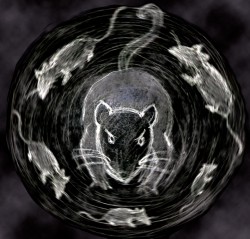
He suddenly shot forwards and changed into a black round shape (it looked like a large dog) and ran down the lane towards me so fast – as the shape got closer it got smaller and smaller until it looked like a black rat scurrying in a round black ball.

I was frozen to the spot and couldn’t have outrun the shape if I wanted to – it was travelling so fast. Just before it got to the farm entrance opening it faded as quickly as it had started.

My dog started barking and we both turned and ran up Staple Flat past the houses and didn’t stop running until we reached the Old Birmingham Road. I didn’t go dog walking that way again.

I have asked around for information about this lane, and have been told that the alleyway from the Old Birmingham Road to Staple Flat used to be an old cart track that went to the farm.

I read in your magazine that the Old Birmingham Road follows an early Roman Road and I would like to know if Staple Flat was part of it.

I am interested to know if anyone else has ever seen or heard anything strange in this lane.