Hannah Genders plans ahead to appeal to late summer wildlife.
With Christmas just around the corner and everything dying back outside, it can be difficult to remember how great our gardens were looking earlier in the year.
Christmas and the New Year are such a good time to get out the gardening books and begin planning what you want to achieve for the coming year, so this month I thought I would offer some inspiration for you and the wildlife you could attract.
The whole subject of wildlife gardening is such a massive one that I am concentrating on just one area in this article, namely how to use the late summer flowering perennials.
We have enjoyed such a wonderful dry, warm autumn this year – and lots of us have been aware of how the flowers on many of our garden plants have hung on well into November.
As I have been out photographing these flowers in my own garden I am also conscious of how important flowers are to our insect life for the late nectar.
When you begin to see your garden as part of a much larger landscape, the importance of providing food and shelter for birds, bees and butterflies becomes ever more apparent.
In the UK we are building so many new houses and covering up large areas of our garden in hard landscaping – I read in a recent BBC report that in London alone, an area 22 times the size of Hyde Park was covered up in people’s front gardens. That’s about 12 square miles of planting!
These facts are presented to us not to make us feel guilty about what we aren’t doing, but to see how significant our little patch of garden is. In a city or town landscape these individual gardens can form wildlife “corridors” where animals and insects can literally hop from one garden oasis to the next.
For those of us who live more rurally, the diversity of flowers in our gardens can provide valuable nectar for butterflies and insects when the countryside is lacking – this is happening more and more as we see the farming landscape become more intensive with less hedging and trees.
Shrubs that provide winter berries are particularly valuable to birds for this reason.
Wildlife gardens have tended to concentrate on native species in the past but the current thinking is to provide as wide a range of plants as possible.
This means that we are not only doing some good for our bee and butterfly population, but also creating a garden that looks beautiful and gives us flowers to enjoy well into the autumn months.
With this in mind here are my top five late summer flowering perennials to do just that. All of these would thrive in an open sunny site with free draining soil that has good fertility (has had compost or well rotted manure added):
* Verbena bonariensis – complete with its own peacock butterfly, this wonderful plant has flat purple flower heads from September onwards and will always attract plenty of wildlife. Try planting it with tall grasses like Miscanthus for dramatic effect.
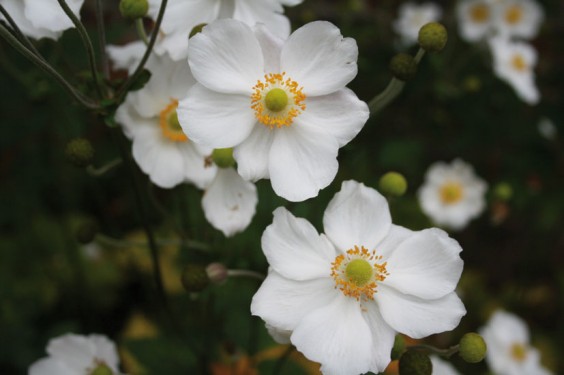
* Anemone x hybrida ‘Honorine Jobert’ is a beautiful white version of the Japanese anemone – it will brighten up any late summer border (pictured above)
* Echinacea purpurea – sometimes called the cone flower, and you can see why. A beautiful colour and good architectural shape.
* Rudbeckia – its common name is black-eyed Susan. Quite a hard colour to use well from a design point of view but try mixing it with some blues.
* Angelica – sometimes referred to as a herb rather than a perennial but will make a dramatic statement in any border and these small composite flower heads stay on the plant for ages.