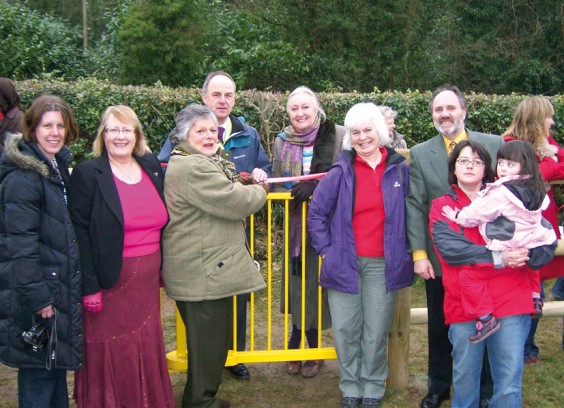
Lickey and Blackwell parish councillors and villagers joined Bromsgrove District Council Chairman Janet Boswell (third from left) for the official opening of the new £40,000 Blackwell play area.
Lickey and Blackwell parish councillors and villagers joined Bromsgrove District Council Chairman Janet Boswell (third from left) for the official opening of the new £40,000 Blackwell play area.
ADVERTISEMENT FEATURE
Inspiration for seriously stylish indoor and outdoor living…
At last, the winter shows signs of being over and we can look towards spring and even summer.
As well as planning holidays, barbecues and new outfits, this is a great time for revamping homes and gardens – and we’ve got plenty of inspiration for you on both fronts.
First, Barnt Green-based interior designer Mary Barber Fray shares her tips on what’s in fashion this season:
It’s spring time and the major design houses have launched their new interiors collections. The words “contemporary luxury” best sum up the overall mood, with individual collections interpreting this theme in different ways.
The culture of disposable consumerism has been replaced by longevity as an underlying theme, and the over-riding feel is one of elegance, beauty and craftsmanship.
Luxurious velvets, beautiful embroideries, stunning woven and printed silks, glamorous and vibrant shimmering silk satins abound. The grand scale designs which have been prevalent over the last few seasons are much in evidence still, but are now tempered with florally inspired patterns and lighter, fresher spring colours.
Richly patterned archive prints and weaves appear in sumptuous and vibrant colourways, as well as the gorgeously faded tones of antique textiles, and incorporate echoes of the Rococo, Baroque, and ethnic influences.
Sophisticated black and white monochromatic schemes are also still popular, mimicking the fashion collections.
Finally, metallics continue strongly but more subtly than previously, with lustrous golds, silvers and bronzes interwoven into fabrics, applied as subtle glazes to linens and cottons to give a sheen or provide a shimmering, pearlescent feel to fabrics and papers.
Wallcoverings show an abundance of pattern, continuing the last few seasons, but these are also more subtle and usable – the new papers are intended for all four walls of a room, rather than making a striking statement on a “feature wall”.
New furniture designs reflect this feel of longevity too. Pieces with simple, strong but glamorous lines reminiscent of the 1920s or 1950s, and furniture with a baroque, extravagant influence, are in evidence.
Key to both is the quality of materials used (wood, high-tech gloss, metallic or rich lacquer finishes) and craftsmanship.
Mixing antique or vintage furniture and lighting with beautifully crafted new pieces in more contemporary settings is a key trend, and one I predict will be with us for a while.
Contact Mary on 0121 445 6500.
Interior design seems to be all about luxury this season, but what about the garden?
We’re definitely overdue for a long hot summer, which means plenty of time spent outdoors – so it might be time to spruce up tired old garden furniture and scruffy plants, especially if you’re going to be entertaining al fresco.
Local garden centres offer plenty of inspiration and are well worth visiting; not only are they handy to get to, you’re also likely to receive a far more personal service than you would at a national chain.
Burcot Garden Centre, now under new ownership, is a case in point – why not pop in to see what’s new, take advantage of expert garden advice and finish off with a complementary tea or coffee in the all-new Cafe Fresh?
Attractive outdoor furniture can make a real difference to the look and feel of your garden, from comfortable hammocks and swing seats to natural wooden benches and subtle stone ornaments.
Why not invest in a couple of sun loungers or lawn chairs – even if we don’t achieve record temperatures, what could be more relaxing than reclining on the lawn with a refreshing drink?
A traditional hammock is also a fun addition to the garden, and don’t worry if you haven’t got trees to attach it to: modern versions often come with their own sturdy stand.
A pond is a great way of encouraging wildlife to the garden as well as forming an attractive feature, and the popularity of ornamental fountains and water features shows no signs of diminishing.
Circular patios, decking and structures such as pergolas will also add interest – perfect for those who don’t have the time or inclination to look after high-maintenance plants.
If you do want to introduce plants and flowers to the garden, it’s worth asking for some advice from an expert – staff at garden centres will offer planting and maintenance tips when you buy your plants, or you could employ a garden designer to take on the whole project and transform your outdoor space into a perfect paradise.
However, to make changes on a smaller scale, you can add colour by using large and colourful pots, pretty lanterns or outdoor fairy lights, solar-powered change-colour tubes to light up a path, or a miniature herb garden.
Larger gardens may well have room for a shed, where garden furniture could be stored in inclement weather alongside garden tools and machinery.
These days, though, a sheds can be far more than a simple four-sided hut stuck at the bottom of the garden – times have changed, and discerning garden lovers are choosing to have a shed (or “garden room”) built to their own specifications.
New company Jade Sheds, based in Bromsgrove, manufactures top quality bespoke sheds and garden buildings, fully treated to withstand the British weather and erected in your garden by skilled builders.
The firm will even remove your old shed, and also offers a repair service for existing sheds.
A really good quality, properly insulated garden building could also serve as a home office, a playroom or even a guest bedroom… but remember, as regular viewers of Coronation Street will know, it may be an idea to get permission from the local authority (and your neighbours!) before going ahead with a larger building. SO
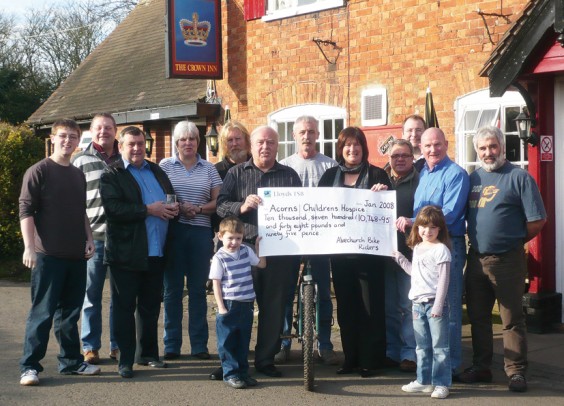
Organisers and participants in the Alvechurch to Worcester Bike Ride presented a cheque to Dawn Pawlett, of the Acorns Children’s Hospice.
The total from the event in June was £10,865.95 – the cheque says less because there were some late donations – which brings the total raised for Acorns by the ride over 10 years to £50,572.04.
The village of Finstall will be holding an Open Gardens Day on Saturday 12 July to raise funds for the restoration of the village hall.
The organisers are looking for volunteers to open their gardens, as they would love to have a cross-section of types of garden.
Spokeswoman Fran Rogers said: “Do you have a little gem of a garden hidden away?
“These are the essence of English village gardening and of enormous interest to keen gardeners. Don’t forget that vegetables play an important part in this.
“No need to worry about a few weeds, few of us ever achieve perfection, and it is always reassuring to know that people are human.”
If you would like to join in, call Fran Rogers on 01527 872109.
The day will be combined with an on-foot treasure hunt and an evening pig roast at the village hall.
Many thanks to everyone who supported the City of Birmingham Brass Band Charity Concert held in aid of the Primrose Hospice on Saturday February 2 at Alvechurch Village Hall.
It was a fantastic concert, and it was lovely to see Alvechurch Village Hall full to capacity. Our thanks to the Village Hall committee for the lovely venue.
I am so pleased to be able to inform you that the concert made £1,000 for the Primrose Hospice.
Once again, many thanks to all who helped to make this a very special evening.
Di Farlow, Alvechurch
& the City of Birmingham Brass Band
The concept of “Nimbyism” should be ditched.
Most ordinary people who are denigrated and dismissed as Nimbys – usually by voracious developers, housing associations and local councillors who care about nothing but profit, statistics and their allocated budget – are taking the sort of action that we should be applauding.
They know, love, and care about their local area, and they make the effort to maintain and improve it as an inhabited environment.
I absolutely believe that local people know how their community could and should function, and that they are prepared to accept expansion and new housing to a capacity that they feel is consistent with their own needs and demands.
If locals don’t look after their localities, who will? Barratt Homes? Tesco? Persimmon?
Because the people we democratically elected to represent us seem to take on their own agendas as soon as they get into office and totally ignore the recommendations of their qualified planning officers and also the wishes of local communities.
Three or four houses is all that is needed on this site but the Parish Council along with Bromsgrove District Housing Trust have taken advantage of this small site by cheaply acquiring the adjacent green belt land and turning a proposed small development into a large housing estate (with the assistance of Bromsgrove District Council’s Planning Committee), increasing the hamlet of 60 houses by an extra third.
Unbelievably there are still some councils that have a moratorium on granting permission for any new houses – and I mean any, whether it’s a mansion or a small flat conversion, and yes you’ve got it! Bromsgrove Council is one of them.
Why a moratorium? Because the councils involved claim that there are enough “sites” in the system to last for a few years.
The number of sites they have to identify is set by a “target” dreamed up at various levels of bureaucracy mainly unelected regional government assemblies (previously called Quangos) who impose ever-rising housing targets.
This is a massive problem for lots of small local house builders – unless you happen to have a site with permission – in which case you make a killing.
That is a sign of a monopoly “market” in which wealth is created not by honest workmen but by town hall bureaucrats occasionally letting the workmen do their job.
There is only a finite amount of land in this country and it needs someone to look after it, so until we get back to true democracy where the population has an elected representative voice I say: Yes! I must be a Nimby too!
And probably 90 per cent of the inhabitants of Hopwood who signed a petition against this unsustainable development are probably very proud Nimbys as well, and we, unlike our “Shameless Nimbyism” friend, have had the courage of our convictions to put our names to it.
Adrian Smith
Ash Lane, Hopwood
The childish name-calling continues; we are now snobs.
All I have to say on that matter is, we in Hopwood are all hard-working individuals who have started at the bottom of the property ladder and I myself after more than 30 years can afford to buy a property in a location of my choice.
We are getting away from the real issue here, which is the scandalous way the Bromsgrove Planning Committee has overridden all policies to grant permission for “affordable housing” in order to meet housing targets, not the housing needs of Hopwood.
Bromsgrove District Housing Trust has snatched a piece of cheap greenfield land to build these houses on. It will not pay the going rate for brownfield sites, where they are supposed to build and where it is appropriate and sustainable, that is in Alvechurch village.
Central Government has made extra funds available to councils for just such a purpose, so where is the money going?
It’s because it’s social housing that Bromsgrove Planning Committee has granted permission. Have no doubt that had plans been submitted for private “executive homes” they would not have been granted permission and quite rightly so – it’s a greenfield site and it should not be developed, ever.
If we as residents do not stand up for what we believe is right for our community and environment, then we are failing in our duty to preserve what is left of our green and pleasant land.
L Smith, Ash Lane, Hopwood
Am I the only person who is getting confused? What is this “free“ green bin collection (The Village News, February 2008)?
Surely this is part of the recycling refuse service that we pay highly for in our council tax.
Due to global warming, gardening now goes on throughout the year; grass cutting has already started, pruning is well underway, and my green bin is already full of hard wood cuttings which I cannot add to my large compost bin.
Surely someone on the council is aware of this situation. It is inconvenient enough that we do not have this service for four months of the year – to take it away completely will mean a round trip of approximately eight miles to the refuse tip, using cars which we are asked not to do.
To expect pensioners to pay another extra charge when they are struggling to pay council tax, higher gas, electricity and water charges is diabolical.
We have rules about litter, dog mess and now alcohol – does anyone ever get fined? Do the CCTV cameras work?
Every Sunday morning the bus shelter outside the Red Lion in Alvechurch is littered with cans, half-full plastic pint containers and even wine bottles, plus all sorts of food containers; this right under the CCTV camera.
The litter and dog mess have got very bad over the past year. What kind of people desecrate our village in this way?
I am confused. How much do these useless cameras cost? Perhaps the money should be put towards paying for our refuse collection!
Mrs L Willis
Alvechurch
Each year we are “milked” with the council tax, in the region of £1/4m, and what do we get for the money that we are forced to pay? Very, very little, I suggest.
What has been spent in Bordesley over the last few years?
I have been trying for three years to get a bus shelter at the centre of the village with a pedestrian crossing for the children and the older folk, and traffic calming of this horrendous road, but all I get is ridiculous excuses, the last one being “there was no one at County Hall to sign off the request”.
As a good friend of mine said: “The Lord built the world in six days, but Bromsgrove cannot get a bus shelter put up in three years.”
What a system! And we keep paying each year!
Prof Peter Sanders, Bordesley
This is the first of what I hope will be a regular series of articles about wildlife in The Village area. I’m not a professional wildlife watcher, just a passionate amateur.
I live in Withybed Green, but my walks take me all over the local villages, woods and canal, where I have been looking at what grows, flowers, flies, runs and calls for many years. I hope to share with you what I have seen in the last few weeks when I am writing, and what to look for in the month you get The Village.
Starting writing this in January was daunting. I look around and everything is locked down for winter: the trees black skeletons, berries gone, the grass brown and muddy, the birds quiet. But walking reminds me of how alive everything is at this time.
Everyone’s first flower of the year is the snowdrop, which is a native wild flower, though mostly introduced in this area. It is already out in gardens, but will soon be coming in woodland, especially on old estates.
The snowdrop is the flower of St Brigid, a saint based on an ancient Celtic Goddess whose feast day is 2 February, so you should be seeing them now.
However, there have been other flowers out already. Gorse is bold yellow on waste ground and roadsides. “When gorse is out of bloom, kissing’s out of fashion”.
One of my favourites is the white dead nettle. Never was a flower more inappropriately named, as it is one of the most alive plants I know. It flowers every month of the year. You might see other white or green early flowers: hogweed, daisy, chickweeds, spurges and the profuse dog’s mercury will all be out locally by now.
If you look at the trees, you can see spring there too. Hazel and alder have catkins, growing almost perceptibly; pussy willow will come next, and the sticky buds are swelling on the horse chestnuts. Red and yellow twigs begin to glow on dogwood and willow.
Exactly what stage plants reach by the time you read this depends on local weather. In 2006, I only saw three different flowers out by the end of January; last year I saw twenty-one. This part of the Midlands can be cold in winter, with frosts holding everything back, though in mild years spring comes very early.
I compare notes with my sister in north Yorkshire: surprisingly it is often colder here. She already had celandines at Christmas; we are seeing the first ones about now.
The bright yellow celandine is the start of real spring. Some people confuse these with buttercups, but they are earlier, have many narrow petals, and open fully only in bright sunlight.
They grow everywhere, from churchyards to hedge banks, woods and canalsides. In similar places you will also find coltsfoot. This is a small dandelion-like flower with many medicinal uses, including cold-cures, appearing nakedly before its leaves do.
February is one of the times when weather prediction is built into our folklore, of course. February 2, as well as being St Brigid’s Day, is also Candlemas Day (or, in the USA, Groundhog Day.)
On Candlemas Day, legend says, if the weather is bad, winter will soon be over, but if it is fine and fair, winter will come back with a vengeance. There is often a spell of cold and snowy weather about this time, after a milder spell, so there may be some truth in this.
Another name for this cold spell is the “blackthorn winter”, and this reminds us of the other spectacular flowering of early spring. Last year I saw blackthorn in flower in January, but this year it will probably be late February before the first ones come, and March before it is fully out.
Blackthorn is the dark, thorny bush with early starry pure white flowers, and of course later bears the fruit called sloes. It does, however, have a relative that flowers even earlier and is often confused with it.
This is the cherry plum, a taller and more graceful tree with slightly larger and more loosely arranged white flowers on bare twigs. It grows along roadsides, and probably the best place to see it round here is on the main road from Hopwood to Birmingham, around Grovely Farm.
It’s always there by the third week in February, and sometimes earlier – look for it now! True blackthorn comes a week or so later, usually, and forms dense blocks of white on its black twigs along lanes and roads.
However, blackthorn and cherry-plum, with the bullace or wild plum and the damson, all interbreed and form a fascinating continuum of flowers of different sizes and flowering times.
Meanwhile, the hawthorn leaves are coming out. They come remarkably early, usually by mid-February along some roadsides and in a little sheltered spot near Alvechurch church.
As I write this, the birds are quiet. The robin is such a noticeable bird in the winter because it keeps on singing, probably because it is heavily territorial. On the canal, the mallard ducks are already paired up and have started their courting behaviour, bobbing and weaving at each other.
One of our few winter visitors, the redwing, has been. It is a relative of the thrush but has a noticeable red flash under the wing. It comes in winter and settles in flocks wherever there are plentiful berries.
You may have noticed last autumn that the berries came early, but they were also stripped early, and there are far fewer left than there were last January. The exception is ivy, which is still flowering as I write, alongside ripe and ripening berries.
A big collared dove is making short work of the berries outside my window. By the time you read this, the birds will have started the dawn chorus, which is traditionally in full flow by St Valentine’s Day on February 14. I hope you’re enjoying it!
Since I am a founder-member of the Withybed Green Poets group, I am adding each month a seasonal poem, by me or another member of the group.

We hope you enjoy our magazine in print and online. Please get in touch anytime via email at the address below.
Contact us: info@villageonline.co.uk
© All content is the copyright of Platform Publishing & Media Ltd 2025. For further information, please email info@villageonline.co.uk