A brand new festival is coming to Barnt Green this spring, promising a fabulous day of giggles, drawing, amazing storytelling, and a wonderful chance for children to meet their favourite authors.
Barnt Green BookFest is a spin-off from Bournville BookFest, which has had many requests to bring its events to a wider area. It’s organised by Busy Parents Network, a not-for-profit CIC founded by Sarah Mullen, who wanted to run fun, high-quality and affordable events for families to enjoy together.
Bournville BookFest began in 2013 and has grown to include 120 events over 10 days. This year, three one-day events – Barnt Green BookFest, Solihull BookFest and Sutton Coldfield BookFest – have joined the BookFest family, so that the team can bring authors, artists, storytelling events and workshops to even more children.
Barnt Green BookFest takes place on Saturday March 16 at St Andrews Parish Centre, and is sponsored by Oulsnam estate agents, who have supported the Bournville events since 2013.
Steven Lenton, illustrator of World Book Day edition Cruella and Cadpig, will be doing a live draw-along show for two- to six-year-olds. Steven will also appear together with author Tracey Corderoy, with their picture book Shifty McGifty and the Missing Masterpiece (ideal for kids aged three to seven).
Catherine Doyle will present The Storm Keeper’s Island, a spellbinding adventure book for seven- to 12-year-olds, and there’s also a How to Write Funny Stories workshop, with comic Ian Billings, who wrote the scripts for CBeebies’ Gigglebiz and ChuckleVision. Perfect for seven- to 12-year-olds who want to make their mates laugh!
The full programme and tickets are available from https://www.bournville bookfest.com
Barnt Green photographer Mark Winson gives us a preview of his first exhibition.
Village readers may remember our “Guess the Close-Up” series from a couple of years ago, in which we published photos of landmarks around Alvechurch.
Mark Winson, who took those pictures before he moved from Alvechurch to Barnt Green, says he has been honing his skills over the past two years – and he’s now holding his first-ever photography exhibition, in Harborne during the whole of February, featuring images of people and places around the Bullring Markets and Digbeth area.
“I’m relatively new to Birmingham, so enjoy roaming the city streets and losing myself in the more colourful, vibrant parts of town,” says Mark.
“I’ve always been drawn to markets, the sights sounds, the bargains and of course, the people. After a few daunting visits to the Bullring Market and Digbeth, where my camera and I felt a little conspicuous, I soon settled into a more comfortable approach, usually finding a perch or leaning post and just waiting for something to happen.
“Instead of looking back through sepia-coloured glasses, I wish my images to be contemporary and reflect the exciting times we live in – and try to capture the sounds, smells, noise and colour of the markets and surrounding area as they are now.
“I hope you enjoy my images and if you feel a desire to pick up a camera and follow your creative instincts, don’t let any lack of technical know-how stop you – get out there, be brave, bold and express yourself!”
The exhibition is at the Basement Cafe & Bakery, 374 High Street Harborne, B17 9PY, throughout February.
Bromsgrove artist Richard McIlwraith meets local poet and illustrator Penny Turner.
Head to The Jinney Ring Craft Centre and seek out a small ground floor studio-shop, from where Penny Turner greets you with a smile. The room sets your imagination firing: lines of enchanting poetry spark your own creative impulse; fascinating illustrations of whimsical, gleeful characters add visual dimensions to the carefully crafted words.
Penny dreams up, writes and draws. The result of this triple-process is a powerful set of appealing scenes and stories that have the potential to entertain the whole family and to introduce us all to playful and hilarious characters and situations. You can imagine Penny chuckling away quietly to herself as she exquisitely brings to life her comic thoughts.
The room is full of captivating gifts. There are illustrated books, greetings cards, giclée prints, mugs, money boxes, coasters and cushions. You feel a charming atmosphere of delight and humour, a heart-warming ambience that leads to laugh-out-loud moments when the unique creations adorning the walls and shelves capture your attention.
Penny is self-taught and has committed herself for the past five years to this beautifully creative life. She loves wildlife and our Worcestershire countryside – this is clear in her irresistibly jolly and heartfelt poems and pictures. For example:
The moon was blue, all soft and pale As I hitched a ride on a giant snail. We sailed a lake, its waters pink, With a friendly cat in a kitchen sink. We sailed, and sailed, and sailed away Till the night became the colour of day, And met a bird with rainbow wings That flew us home on lemon strings.
Her latest book is titled Four Little Mice and is sure to combine drama and frivolity, charm and wit: a must-buy indeed. Penny gives talks and presentations at local groups or clubs, revealing the ideas behind her poetry and the various techniques used to bring ideas to fulfilment.
So, I hope readers make a special journey to the Jinney Ring (Hanbury Road, Hanbury, Bromsgrove, B60 4BU) and drop in on Penny to see and read for themselves the entrancing work on display. For more details, visit https://www.penny-turner.co.uk or email penny@penny-turner co.uk
Please get in touch if you would like me to write about an art event near you: richard@galleryart61.com https://www.galleryart61.com
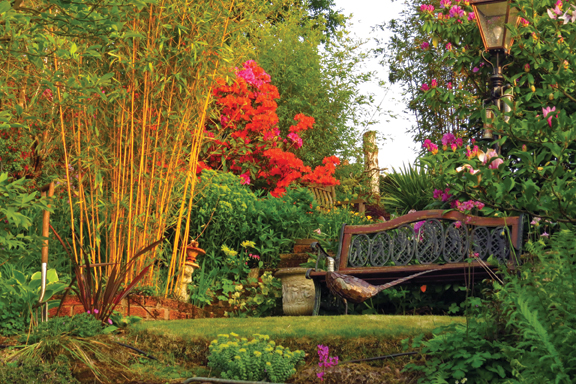
Dave Morgan looks ahead to garden openings across the Village area.
Call me an old cynic if you like, but when anyone tells me they have a great opportunity for me, I assume there is a catch – and there often is! However, in the case of gardens opening for the NGS (the National Garden Scheme) the opportunity is to view some of the best gardens in the county, enjoy a cup of tea or coffee and a piece of delicious homemade cake – and often buy a plant or two at very reasonable prices. You may also pick up a few gardening tips and ideas shared by the garden owners! The catch? Well – apart from paying the entrance fee, there isn’t one.
Added to which by visiting the gardens open under the scheme you will be supporting charities such as Macmillan Nurses, Marie Curie, and Parkinson’s UK. Last year the NGS gave over £3 million to these and a few other organisations, all of which was raised by folks visiting local gardens and enjoying a great day out in an English garden. How’s that for a great opportunity?
What’s more, you don’t have to travel far for some amazing gardens – and indeed some that don’t open every year – so it’s a good opportunity to visit them while they are open.
This year gardens attached to no fewer than eight properties in the small hamlet of Withybed Green will be open to the public on Sunday June 30 from 1 until 6pm. Worth putting that in your diary as these gardens only normally open every two years, and this year includes two brand new gardens: 1 Front Cottages and 1 Rear Cottages.
1 Front Cottages has a small garden with patio, summer house, lawn, borders and a variety of plants in containers. In contrast, 1 Rear Cottages is only really starting out on its journey as a garden, in that it is effectively a blank canvas at the moment – with just a log cabin that has been built to get even closer to the countryside views that surround the property.
However, owners David and Serena have a vision of what they want the garden to look like and it will be interesting for visitors to see it now and then again in two years’ time when Withybed Green, hopefully, will be open again.
Among the other gardens open in the hamlet are a number of other small cottage gardens plus some considerably larger ones, including one very well-respected rose garden that has been featured on TV gardening programmes such as Gardeners’ World.
Another local opportunity this year is at Marlbrook Gardens. This group, which for many years included three separate but very different gardens, was reduced to two five years ago when John and Janet Morgan decided to retire their garden, Saranacris, from the NGS.
After last year’s opening, garden owners Alan and Lynn Nokes, of Round Hill Garden, also decided to retire from the scheme due to health issues. However, John and Janet have now decided to re-open their garden – possibly for one last year. So not an opportunity to miss!
Saranacris is a small but unusual and steeply sloping garden created in a former sand quarry by the owners. It’s a plantsman’s garden crammed full of a wide range of plants, where you will find well-loved favourites growing among the rare and unusual.
Water is the theme throughout, with a stream, waterfall and koi pond as well as a number of small informal ponds and water features. Overall, the garden is designed in rooms separated by a range of natural features or informal planting and a network of paths allows the visitor to wander around in differing ways opening up a variety of views and vistas.
There is a glasshouse on the patio planted with a range of semi-hardy plants; examples include gingers, Abutilon and a large Tibouchina with its wonderful purple blooms in late summer. Another feature of the garden is the roof terrace and conservatory, primarily home to John’s collection of gingers, accessed from the patio via a spiral staircase. Visitors can sit and linger on the roof terrace with refreshments while taking in this mid-level view of the garden.
The other garden in the Marlbrook group is Oak Tree House, which will also open on its own in May for an evening opening with wine for the visitors, whereas the two gardens together will open on July 21.
So now’s the time to get hold of the new Worcestershire NGS county leaflet, available from most good garden centres and libraries, and start planning for visits to some of the area’s wonderful gardens. You can also find out more from the NGS website – https://www.ngs.org.uk
Mary Green looks at the hidden powers of our plants.
In the old way of describing the year, February is the first month of Spring. Spring begins with Candlemas in the Christian year or Imbolc in the Celtic pagan year, both of which are at the start of February.
At one time Christmas decorations were left in place until Candlemas (a custom apparently surviving just into the 20th century in some places) when winter was officially over. This way of counting spring makes much more sense, as the equinox (March 21) then falls in the middle of spring, just as the solstice (December 21) fell in the middle of winter.
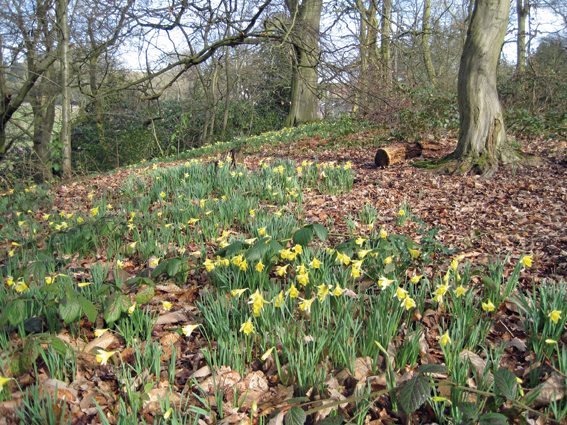
As you’ll know if you’ve read my articles in the past, in both traditions the plant of this season is the snowdrop, belonging with the white candles of Candlemas and Imbolc, and one of the few flowers everyone recognises. These days they often flower quite early, and mine came up by January 9 in this mild winter, so I hope they’re still flowering for Candlemas.
Snowdrops are a good example of the hidden powers of plants, which is my theme for this month. They flower so early in the year that most of the insects necessary for them to be pollinated haven’t come out yet. In a mild year they might, but the snowdrops come even through the snow. (Snowdrops protect themselves by having their heads bowed, shedding rain and snow.) So, they need another way of reproducing. Hence the bulbs. It’s no coincidence that most of our bulbs are on spring-flowering plants.
Flowers that grow from bulbs can set seed like other plants. But often they don’t. Instead they store up in their bulbs the nutrition they have absorbed. The leaves die down and take the nutriments down into the bulbs, and these will come up again, or can split into two and create a new plant. That’s why it’s important never to cut off or mow the leaves of bulb plants.
Snowdrops are best moved by digging them up while in leaf and after flowering – “in the green” as it’s called – which is more successful than planting bulbs and far more than using seeds.
Animals like eating bulbs, not surprisingly as they are full of nutrition. Squirrels and badgers are both known for this, as well as rats and mice, especially with tulip bulbs. That’s why many plants carry poisons in their bulbs to deter them. Both snowdrops and daffodils carry galanthine: perhaps tulips are too over-bred to have it.
Of course, a poison is the same as a drug. In too great quantities snowdrop and daffodil bulbs are poisonous to us. There have been reports of people eating daffodil bulbs by mistake for onions and being ill. But in the right quantities, galanthine is a drug now being used to treat dementia. This is just one example of how old plant-based remedies are being rediscovered by modern science. (I have just recovered from a wound dressed with a seaweed-derived packing. Seaweeds were traditionally used to heal wounds).
You may wonder why almost all our drugs originally came from plants, since plants’ purpose in life is to reproduce themselves, not to cure human ailments! Well, because plants can’t move, the substances they carry are their best defence against predators.
These poisons are produced more strongly when the plant is under stress: if grown without any danger it may not produce them. Hence, daffodils are being grown way up on cold Welsh mountainsides to produce the best galanthine.
Plant substances meant as deterrents are often not entirely poisonous to us. Some, like galanthine, aspirin and so on, can be used as drugs and have always been used in herbal medicine. Others carry bitter flavours which put insects and other creatures off eating them.
These plants are also often highly nutritious, traditionally forming important sources of food for us. Wild plants in the cabbage and lettuce families, and fruits of everything from tomatoes to cocoa, have been bred from wild plants to become our foods. The bitterness of the original plant is often a clue to its high nutritional content.
Unfortunately, at some point in our culture we developed a taste for sugar, and gradually bred the bitterness out of our plants and the sweetness into them. So cultivated cabbages and tomatoes are higher in sugars but less nutritious than their more bitter originals. You can still taste some of the original bitterness in kale and Brussels sprouts, and especially in chicory.
Remembering that plants produce more substances if under threat, it matters how they are grown. Something grown without stress in a climatically-controlled greenhouse won’t produce all its native trace elements. Plants also need to take in the complex of elements from the soil and the mycorrhizal fungi in it that will allow them to produce these.
Nowadays many plants are grown hydroponically (i.e. in water with some added fertilisers) for sweetness, evenness and high yield, and lack all this complexity. Something grown in the soil of your allotment with your home-made compost, struggling against the weather, will be far better for you!
Or you could eat wild plants – but not bulbs of snowdrops, daffodils or bluebells. There is one family of bulbs you can eat, starting at this time of year. Wild garlic or ramsons, and its cousins wild leek and Cornish garlic, come into leaf from February and you can take a few leaves if you have permission. It grows well in gardens, especially Cornish or three-sided garlic, which I’ve been eating since December.
Other early flowering plants have clever ways of protecting themselves. The first two bright-coloured flowers along the canal towpath in February are coltsfoot and celandine, both yellow and attractive to insects. As the weather can be very cold and wet at this time, these flowers only open in the sunshine, when the early insects will be flying. If a celandine is open in the shade, it has already been pollinated.
Both these plants are old medicines. Coltsfoot was used for coughs, and you can still buy cough linctus with coltsfoot. The large, soft leaves come later in the year and were dried and used as a smoking tobacco. (Herbal tobaccos were used before the coming of actual tobacco, and later as a substitute for it, and were usually less harmful.) Celandines were used to treat piles.
These early flowering plants’ survival techniques pale into insignificance next to our strangest plants – the carnivores. We have one true native carnivore, the sundew. This plant has leaves surrounded by bristles, which close over insects and then produce an enzyme which digests them.
Sundew grows in boggy, peaty areas in the north and west of England, Wales and Scotland. It was used for centuries to produce a medicinal potion, especially to help the digestion of meat. Other plants like cuckoo pint and butterwort also make sticky substances to attract flies.
Shepherd’s purse is something that grows commonly all around here – it lives on waste ground and in the cracks along pavements. You’ll recognise it: a small white-flowered plant in the same family as bitter-cress, thought of as a weed, but having very distinctive heart-shaped seed pods. These shed tiny seeds which fall on hard ground and have very little to grow on.
However, when they get wet, they expand and form a mucilage around them. This attracts insects to feed on it, but also contains a toxin which kills the insects. The seed then absorbs the proteins from the insects, enabling it to grow on hard ground and be a highly successful plant.
This reminds us that there is no such thing as a weed in nature. However, the plants we think of as weeds have something in common – they are very successful! Hence, they are often the ones with strong substances in them, many of which are usable for us as food or medicines. They are all around you in February, coming up alongside the paths, ignored by most people.
Here is a February poem from a couple of years ago, and a thank you to all the people who organise and take part in all the walks in this area.
Walking Everywhere there is mud and cherry-plum blossom And the grey clouds let slip occasional spits of rain We set off together but are soon straggled The striders and the natterers and those whose dogs Need help through the stiles, and time to sniff. I need time to sniff really, but I keep up Moving up and down the line to talk and see. We cross the Meadows and greet the ancient oaks Pass the new houses, talk about house prices. We discuss cherry plums and how to eat them (As a sauce for pork) and the blackthorn, so early, And the mandarin drakes whose female has appeared (A little toy duck, undercoated, not painted) We speculate if they are dad and son. We wonder Where the cob has gone from the swan family. Around the fishing lakes there’s no-one there – Sunday afternoon, and no-one fishing – Everyone else by the fire or in the car. Here we are, walking, in the mud and blossom.
Amateur astronomer Brian Watkiss peers into the Village night sky.
February, and sunset is now five o’clock and getting later – thank goodness. As soon as the sky starts to darken, look to the southwest and you can see Mars is still following us around. It is now no brighter than the first stars to appear, but its colour never fails to give it away.
On the 10th, a crescent Moon is just underneath. Full moon, on the 19th, again finds the Moon very close to perigee and in fact, it is slightly closer to the Earth than it was for the eclipse last month. It is also as far away as it gets this year when it is new on the 4th but I can guarantee that this will make absolutely no difference to its appearance on this date.
“But where are all the other planets?” I hear you ask, and, after admonishing you for starting a sentence with “but“, I would reply: “Round the other side of the Sun so they are all visible in the morning.”
Indeed, if you are up and about around six in the morning you can see Jupiter and Venus climbing up from the southeast horizon. Later in the month Saturn starts to follow them and they are all joined by a crescent Moon on the 27th.
Back to the evenings and this is the time of year when we see the real “stars” of the winter sky. They contain the full range of everything that it’s possible to see with the naked eye, from where stars are born to the oldest of all stars.
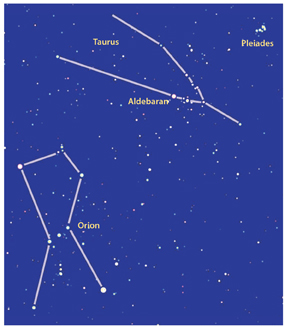
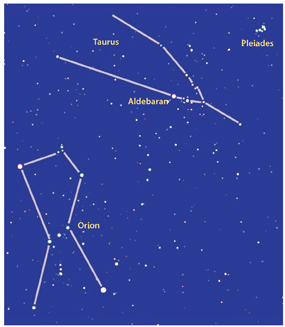
First off, high in the south is the fuzzy patch of stars known as the Seven Sisters or the Pleiades. This is an easily-recognised little cluster of blue stars sitting in, or rather, in front of, a cloud of gas. They are that colour because they are very young and hence very hot indeed. They have probably recently condensed out of the very cloud that they illuminate.
To the left and a little below is a very orange star. This is Aldebaran, which sits in a vee of stars forming Taurus the Bull and sometimes referred to as the Bull’s fiery eye. It is at the opposite end of its lifetime to the stars of Pleiades, being very old and approaching the end of its life, so has cooled and expanded into a red giant.
It is also one of the closest stars to us at about 65 light years away. In fact, it is so near that a space probe launched 40 or so years ago, Pioneer 10, will pass close by – in two million years’ time!
To the left and below Taurus is the king of the winter sky, Orion. This huge constellation dominates the southern sky and is, without doubt, the most impressive of all the visible star patterns.
Finally, it is sad to report that the hoped-for launch of SpaceX Crew Dragon is delayed to this month at the earliest because of NASA‘s funding being frozen. This is due to US government in-fighting and indecision. Glad that sort of thing never happens here.
Alvechurch amateur weatherman Phil Thomas records the changes.
January, at least up until the 18th, was a very bland month from a weather point of view with little in the way of any extremes. Rainfall was very low; only 7.7mm, and only a tiny fraction of the winter wind and rain we normally expect.
Although a slightly colder weather pattern began to appear towards the end of the month, the temperatures for January overall will probably end up being fairly near normal.
January 2018 (to the 18th) Mean Max 7.6C 0.9 above average Mean Min 2.1C 0.9 above average Mean 4.8C 0.9 above average Rainfall 7.7mm 11% of average Sunshine 32.4 hrs 64% of average
The first seven days of December followed the bland November trend. Following an anticyclone on the 13th, very cold air was brought across the UK. However, from the 16th onwards the month ended with mild grey conditions, leading to a mean maximum of 6.7C, which is 2.4C above the local 30-year mean.
December 2018 Mean Max 9.3C 2.2 above average Mean Min 4.1C 2.6 above average Mean 6.7C 2.4 above average Rainfall 109.6mm 158% of average Sunshine 56.1 hrs 115% of average
Yearly Means 2018 Mean Max 14.5C 0.8 above average Mean Min 6.6C 0.8 above average Mean 10.6C 0.8 above average Rainfall 734.5mm 97% of average Sunshine 1541.7 hrs 123% of average
Outlook Met Office computer models seem to predict cold and sometimes very cold weather for the extended outlook. It will be changeable though, with spells of strong winds and rain, turning to snow at times. Overnight frosts will be common and widespread.
Snow will mainly affect higher ground in the north, but there will be a higher risk than usual of snow at lower levels, even in the south. With easterly winds predominating, the driest and brightest weather is likely in the northwest.
More information at https://www.alvechurchweather.metsite.com You can see an improved HD weather-cam, updated at one-minute intervals, at: https://www.alvechurchweather.metsite.com/webcam_alvechurch.php
Alvechurch resident Jonathan Oseland is getting ready to run this year’s London Marathon in aid of Brain Tumour Research.
Jonathan chose the charity because a friend of his, Katie Smith, is currently battling a brain tumour. He hopes to raise the required minimum of £3,000 to help combat the disease, which kills more children and adults under the age of 40 than any other cancer, yet only receives one per cent of the funding of the national spend on cancer research.
“I’ve taken part in “Tough Guy” races for charity and I ran the Birmingham half-marathon in 2016, but a full marathon’s going to be a bit different,” says Jonathan. “I’m doing as much training as I can, although at this time of year a lot of it has to take place in the dark!”
You can donate at www.justgiving.com/fundraising/jonathan-oseland1, and read Katie’s story at https://www.babiesbooksandbraintumours.wordpress.com
Action from the New Year’s Day defeat at Banbury (Photo/ Ian Macvie)
Alvechurch are back in the promotion race after an end-of-year dip in form.
A mixed bag of results in December and early January saw Alvechurch slip out of the play-off places, but they soon recovered their form and were back to seventh in the league as we went to press, with games in hand over some of their rivals.
After a win at Royston, with new signing Lee Chilton scoring his debut goal, 2018 ended with two defeats – firstly to Redditch United, who claimed the local bragging rights on Boxing Day with a deserved 4–2 victory.
However, Andre Landell’s 25-yard strike was voted goal of the month and despite the defeat, the goal will live long in the Alvechurch supporters’ memory.
The final game of the year was a disappointing 3-0 home defeat to Tamworth, which was followed by a 3–1 away loss to Banbury on New Year’s Day.
However, fortunes began to pick up with a 1-0 win at Stratford, another 1–0 against Halesowen Town, and an excellent 3–0 away win against St Neots (notable in that both teams had their captains sent off), featuring two goals from Lee Chilton.
The twice-postponed home encounter with Leiston was due to take place on Jan 29.
* In an initiative between Birmingham City FC and local non-league clubs, three under-18 Blues players are to join Alvechurch. The idea is for the players to mingle with the AFC first team players, travel to away games and gain matchday experience.
The three players are central midfielder and defender Tate Campbell, Nick Okoro, a winger who can also play as an out-and-out forward, and George Baker, a right-sided full back or midfield player. Everyone at Lye Meadow hopes their stay at the club will be beneficial and enjoyable.
* There have been several recent changes concerning the goalkeeping position. Matt Sargeant has now left the club, to be replaced by experienced goalkeeper Danny Crane. Danny previously played for Rushden & Diamonds in the EFL, and has also represented West Bromwich Albion, Burton, Lewes, Cambridge United, Corby, Solihull and Hednesford in an illustrious career.
Special congratulations must go to goalkeeper Tom Parsons, who is just starting his football career and has been promoted to the first team squad. Tom will train with the first team to gain valuable experience and work with the goalkeeping coaches and first-team ’keepers as part of his football education.
Central midfielder Rahis Nabi has joined from Burnley under-23s, having played for West Bromwich Albion under-18s. Rahis has also experienced international football having represented England at under-17.
AFC are delighted to have re-signed attacking midfielder Lee Chilton, who started his career at Lye Meadow in 2002 before moving on to Leamington. Lee has played at the higher level of non-league football, at Halesowen, Stourbridge, Telford and Stafford, and in 2007/08 he was the Midland Football Alliance Player of the Year.
Lee has already proved a vital addition to the squad, being voted player of the month for December.
Influential centre back Mark Smith has left Lye Meadow and joined Stourport Swifts. Mark played a major part in Alvechurch’s success over the past four years, winning both promotions and cups with the Lye Meadow side, and will be a major addition to the Stourport squad.
* Congratulations to eight-year-old Harvey Rose for winning Alvechurch FC’s recent competition to design a mascot the club, with his winning design, “Alvin” (right).
The competition was judged by chairman Richard Thorndike and manager Ian Long The club would like to thank everyone who entered.
* For more info or sponsorship enquiries, please contact Trevor Ball at saintsarehot2@btinternet.com or visit https://www.pitchero.com/clubs/alvechurch Follow the club on Twitter @Alvechurch1st
FIXTURES All league fixtures unless stated Sat Feb 2 Kings Lynn Town (A) 3pm Sat Feb 9 Bedworth United (H) 3pm Sat Feb 16 Biggleswade Town (H) 3pm Sat Feb 23 Leiston (A) 3pm Sat Mar 2 Rushden & Diamonds (A) 3pm Sat Mar 9 Lowestoft Town (H) 3pm Sat Mar 16 Barwell (H) 3pm Sat Mar 23 St Ives Town (A) 3pm Sat Mar 30 Hitchin Town (H) 3pm
Your chance to own a piece of Alvechurch FC’s sporting history. . .
With Alvechurch FC enjoying recent success, a Rowney Green resident is looking to share a piece of the club’s history.
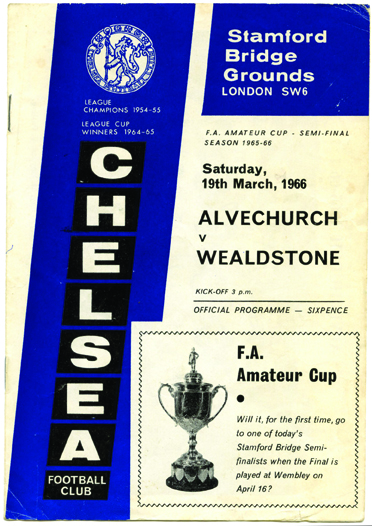
Steve Ianson was a 12-year-old spectator when the team played Wealdstone in an FA Amateur Cup semi-final in 1966, and he kept the matchday programme as a souvenir.
“I came across it recently when I was having a clear-out, and I thought it might be an idea to auction it and raise a few quid for charity,” he says.
The match was played at Stamford Bridge, home of Chelsea FC, and Steve says he mainly remembers the long journey to London with his grandfather and a friend, and sitting outside a pub on the Fulham Road while the men had a pre-match drink.
With Alvechurch unfortunately losing the game 1‑0, the day was rounded off with a commiseratory pint at the Red Lion when they got home!
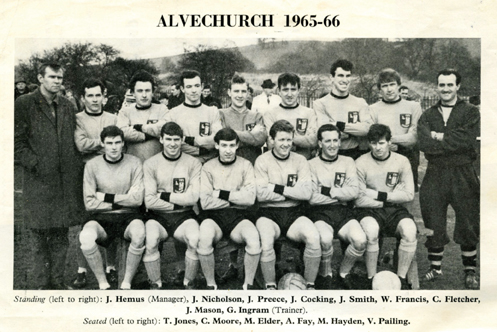
The programme, costing the princely sum of sixpence, contains photos and information on both teams, revealing that this was the first time AFC – then sitting fourth in the Worcestershire Combination – had reached the last four of the Amateur Cup, having dispatched Skelmersdale, Stowmarket, Enfield and Crook Town en route.
One nugget reads: “The secret of this team from tiny Alvechurch (pop. 4,000) is its wonderful spirit. The headquarters is the village pub, The Crown, where players, officials and supporters intermingle, and organise ‘off-beat’ social occasions. Last year they held a televised cake-eating competition.”
It goes on to say, “Basically they are a team without stars, although many of their fans rate [John] Mason as the best centre-forward in the country.” Well, he had scored five goals in this campaign already.
Wealdstone, beaten 4–1 by ’Church in the previous season’s competition (all four goals scored by Mason), not only took their revenge but went on to bag the 1966 trophy.
If you are interested in making a bid for the programme, you can contact Steve on 01527 61367. Any money raised will be donated to Breast Cancer Care, which Steve has chosen as his charity during his captaincy of Kings Norton Golf Club.
* Did any other readers attend this match? Or does anyone else have sporting memorabilia to share? Get in touch with us in the usual way.