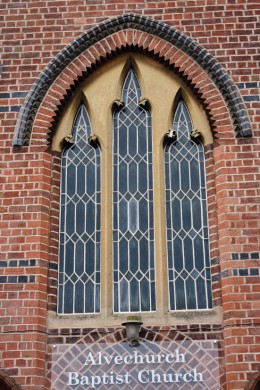
Did you guess correctly? The close-up pictured here showed the front window of Alvechurch Baptist Church on Red Lion Street.
Look out for more in a future magazine!
Did you guess correctly? The close-up pictured here showed the front window of Alvechurch Baptist Church on Red Lion Street.
Look out for more in a future magazine!

More than 2,000 people visited the Jinney Ring Craft Centre in Hanbury for “Animals R Magic”, a fun day in aid of The Cinnamon Trust and local animal charities.
One of the most popular attractions was the Fun Dog Show organised by MBG Vets of Droitwich, with a record number of 100 entries.
The overall champion was Shadow (right, with owner Andy Kennington), a 19-year-old golden oldie awarded “Judges’ Favourite”.
There were also demonstrations from Dogs R U Agility, the Midwestern Gundog Society and Canicross Worcestershire (cross country running with dogs).
Visitors got involved in Severn Area Rescue Association’s demonstrations by hiding in the woods on site to be tracked and found by Dyno, who never failed to get his man or woman.
The event has raised over £4,000 for The Cinnamon Trust and much more for good animal causes locally.

Nine-year-old Kavya Maganty, of Barnt Green, was the latest winner of a Mini Vinny in our monthly competition.
If you want to win one for yourself, you’ll need to try to locate the little hedgehog hiding somewhere in your September magazine.
Just tell us where he’s hiding via phone, email, post or Facebook – please include your contact details, especially if leaving a voicemail message – and we’ll draw a winner at random.
The closing date is midnight on the 18th of every month. We’ll let you know if you’ve won and you can collect your Mini Vinny from our office – and pose for a photo with your prize!
Mentor Link, a charity that provides long-term dedicated social and emotional support to vulnerable and distressed children and young people, is seeking a male mentor to support a boy in school with additional learning needs.
The aim of mentoring is to support with social integration; improve relationships; help to achieve full potential and boost confidence and self-esteem.
If you have experience of working with young people with additional needs or would like to volunteer for 30 mins to an hour a week, the charity would like to hear from you.
Mentor Link requires two character references, and enhanced DBS clearance. Induction training, travelling expenses and ongoing training provided, plus a dedicated team of support staff.
More info from Karen Arnold on .(JavaScript must be enabled to view this email address) or 07875 438659, or Head Office on 01299 822336 or .(JavaScript must be enabled to view this email address)
Find out more at https://www.mentorlink.org.uk or see the Facebook page.

Alvechurch amateur weatherman Phil Thomas records the changes.
August, or at least the first half of it, was wetter and cooler than expected, with daytime temperatures struggling to reach 20C and sunshine levels lower than the local mean.
The 5th was very stormy with thunder and lightning, just over 9mm of rain falling in around about an hour. Overall, it had not been a good summer month as we went to press.
August 2017 (to the 14th)
Mean Max 19.5C 1.8 below average
Mean Min 11.5C 0.2 below average
Mean 15.5C 1.0 below average
Rainfall 41.2mm 79% of average
Sunshine 49.9 hrs 32% of average
The first 10 days of July were very warm and summer-like, with a maximum of 29.5C on the 6th. The mean temperature for the month was 17.4C, 0.5C above the local mean, although the final week was cooler and more changeable.
Rainfall was also above normal, with 85.0mm or 138% of the local mean. The 21st was very wet with 25.1mm of rain in less than 24 hours.
July 2017
Mean Max 22.1C 0.5 above average
Mean Min 12.7C 0.5 above average
Mean 17.4C 0.5 above average
Rainfall 85.0mm 138% of average
Sunshine 149.9 hrs 96% of average
Outlook
The computer models going into September show little agreement on a warm end to the summer.
With the jet stream still active across the Atlantic towards the UK, it seems to suggest spells of changeable weather with a few warmer sunny days mixed in.
More information at https://www.alvechurchweather.metsite.com
You can now see an improved HD weather-cam, updated at one-minute intervals, at: https://www.alvechurchweather.metsite.com/webcam_alvechurch.php

If you’re planning to get your garden growing again, now is the ideal month, says Hannah Genders.
These are a few of the jobs I’ll be doing in my garden this September, which is really a time to get going again in the garden after the summer and it’s the perfect month for gardening projects.
Lavender: I have lavender growing at the top of a low wall outside the back door; it’s quite common lavender called Lavendula angustifolia ‘Hidcote’ and tends to keep a neat habit and flowers for a good long period from May to late August.
The flowers are fading now and it’s the ideal time to trim them off. With any lavender, a regular prune is ideal – cut off the flowering stalks but never cut into the old woody part of the plant or you will kill it.
I just trim off the flower stalks and save them, which also keeps the plant neat for the winter.
Raspberries: Autumn raspberries will be fruiting now; it’s the summer ones that fruited in June that can be pruned.
Cut back the old canes that had fruit on them during the summer and tie in the new tender shoots, which will give you raspberries next year. Then give the plants a good mulch at the base with either well-rotted garden compost or manure.
Meadows: I have a small meadow area around our swimming pond and it’s been fabulous during the summer but is now at the end.
Late August or early September is the right time to cut back a meadow, once it has gone to seed – and mine has, apart from the yarrow that I will leave until it’s dropped all its seed for next year.
Cut back hard and rake out all the cut material so that no extra nutrient is added to the base of the plants by having rotting organic matter there.
Beans: My climbing French beans have pretty much finished but my runner beans are still going strong. I’ll keep picking them but only the small tender ones; if they get too large I leave them for the pods to seed up and use them like borlotti beans in stews.
The variety I’ve grown this year is the same as last year and it’s called ‘The Czar’. It is ideal for this; tender young beans and plenty of them, followed by beans for drying. I’ll also save a few so I can grow on new plants next spring.
Courgettes: These have pretty much finished now, though they might just last until the first frost. Clear away the plants and add them to the compost.
I lightly dig over the soil where they have been to help break it up.
Fruit trees: Plums can be pruned now and I’ll be doing my tree this year as it is touching the neighbours’ house. Whatever the variety, pruning of plums should be cut back once they have finished producing.
I have two plum trees: one is ‘Pershore Purple’, a local variety and very tasty, which crops in August – while in the back garden there is a ‘Bullace’ which is usually a hedgerow tree in Worcestershire.
This has small red and yellow plums about one third of the size of normal plums – they are very sweet and it has cropped amazingly well this year. In my opinion, plums are usually bi-annual in that they tend to have a good year and then a sparse year to follow.
Pruning climbers: This is the ideal month to prune many of your climbers. Many people neglect to do this and the plants become overgrown and don’t flower so well.
For summer jasmine, cut back the stems after flowering – the aim is to create a framework of branches that are well spaced and not too entangled. If you have a very overgrown plant, be brave and cut back the neglected plant to about half a metre from the ground to reinvigorate it.
Honeysuckles are another plant that tends to get left and becomes overgrown. For all deciduous honeysuckles (those that drop their leaves in winter), cut back the stems as soon as they have grown as tall as you want them to be.
Thin out any overgrown and tangled branches, cutting back by around one third to a new side shoot. The only exceptions are Japanese honeysuckles which are evergreen and need pruning in late spring.
Borders: To keep borders neat and protect more tender plants during the winter, after a good weed, cover the ground between plants with about four inches of mulch, either homemade compost, composted bark or well-rotted manure if the plants could do with a feed.
Lawns: If you are needing to lay any new lawn from turf or seed, or indeed plant up a new meadow, September is always the best time to do it.
We are currently putting in a wildflower meadow for an eco-house project in Bristol, and the seed will usually take better in September than April as there tends to be a higher rainfall on average to help germination.
This is also the ideal time of year to scarify your lawn, raking out the thatch that has accumulated at the base of the grasses and giving it a good aeration and feed.
Alternatively, you can borrow someone’s hens, like I’ve done for three weeks while a neighbour is on holiday, and they do it for you! I
Move the run each night and they scratch up the thatch and fertilize as they go – we get a few eggs each day as an added bonus. Sid, our dog, loves watching them all day too.

Bromsgrove Photographic Society is holding an exhibition of members’ prints in the Meeting Room at Bromsgrove Library, until the end of August.
Most of these images won awards in the recent Photofolio Exhibition run by the Midland Counties Photographic Federation in which BPS retained its reputation as a club of photographic excellence.
The members’ work shows the diversity of the club as it covers portraits, landscapes, still life and nature in both classical and creative ways, produced by experienced members – hotly chased by some of the talented newer members.
An open evening on Tuesday August 29 at 7.30 pm provides the opportunity to see what the BPS can offer with its mix of presentations from renowned photographers, studio evenings with professional models, the very popular monthly competitions, hands-on practical evenings and a continuous programme of skills and knowledge improvement.
The club also offers a well-balanced membership with a narrowing male/female ratio and a wide age grouping although the club would like to recruit a few more younger members.
The chair’s message is: “We are a friendly group that will make you feel welcome, so please do come along and meet us on the 29th”.
The club meets at the Avoncroft Arts Centre, Redditch Road, Stoke Prior, B60 4JS (turn left into drive just before the pedestrian lights close to the Hanbury Turn Pub). A map is also available on the club’s website https://www.bromsgroveps.co.uk.
Above: Colin Close, Gail Lewis, and Roger Lewis (chair).
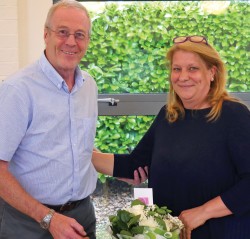
Helen Doherty, retiring clerk of Lickey & Blackwell Parish Council, was presented with a gift by councillors (including Chairman Nick Forknell, pictured with Helen) in recognition of her service.

Bromsgrove Photographic Society starts its new season with a visit from a world-renowned photographer.
On Thurs Sep 21, award-winning wildlife and nature photographer Des Ong will deliver the Bill Chambers Memorial Lecture (named after a leading light of the society for many years).
Born in the tropics, Des grew up with a firm interest in nature. Five years ago he turned professional, and has been travelling and photographing wildlife across the globe.
Des will share some of his projects, giving some insights into his approach and techniques, and will answer questions from the audience.
The ticket-only lecture takes place at Bromsgrove School at 7.30pm. Tickets £2.50 (first-come, first-served). The tickets are numbered and will also be entered into a prize draw.
To reserve a place, email Jan Harris on .(JavaScript must be enabled to view this email address)

Mary Green celebrates the bounty of autumn.
September is one of those months that feels like summer one minute and autumn the next.
It starts our meteorological autumn, but in some Eastern cultures is part of a separate season focused on harvest. And of course it’s famous for the Keats poem, describing it as the “season of mists and mellow fruitfulness.”
It’s this fruitfulness that gives the colours now as the flowers finish, combined with the gold of harvested fields. And the first leaves begin to turn gold later in the month.
We had a good early summer in this area, quite warm and very dry. Then it went cold and wettish. The corn crops might be suffering, as they like it the other way round!
However, there should be a great fruit harvest. The earlier crops in the summer included an excellent harvest of English strawberries, blueberries and cherries – I even bought English apricots this year.
There were more berries than usual on my wild strawberry plants. Then came the cherry-plums, those early small round red or gold plums which flourish around here, along with their cultivated version, the pissard plum – the dark one with the bronze leaves.
Now in September we have the true plums and damsons. The old plum tree at the Tardebigge Lime Kilns orchard is so laden with fruit that one of the branches has had to be propped up to prevent it breaking off. The damsons are also packed with fruit.
All five apple trees are fruiting beautifully now that the coppiced hazel hedge lets in the sunlight. The Lime Kilns are open for the Heritage Weekend on September 9 and 10, so go and have a look.
In my garden the golden plums so typical of Withybed Green are ripe and sweet. I think I have finally discovered which variety they are. A lot of people say they are Pershore Egg Plums but they are not the same.
They are very sweet when ripe and have a distinctive red fleck on the skin. I think the tree is one called Warwickshire Drooper. Many of ours are sucker-grown from very old trees.
This is the kind of plum that used to grow along the canal near the Station Road bridge in Alvechurch until Network Rail destroyed them for a temporary car park.
Damsons of course are also a Midland speciality, though one which is gradually disappearing as the old trees go and new ones are not planted. They have gone feral in lots of places and grow in hedges and along the canal.
They are sweet enough to eat raw when ripe, but like the local plums they don’t keep long once ripe.
Our native wild plums, though, are not ripe yet. The wild plum or bullace is set and turned purple, but will not be sweet until October.
The small sloe or blackthorn fruit weren’t considered ripe till after the first frost, when you could make your sloe gin. But you can make your damson gin without any sugar if you like, any time now!
Meantime the early apples are ready. The wild crab apples are small and golden, and sour! The early eating apples tend to be red-skinned types, but there are some old yellow varieties too, often growing as wildings – seeded by birds.
None of these early apples keep well, so you need to eat them quickly. You probably won’t be able to give them away this year, as everybody has so many!
There are still some flowers in September, and many of these are golden. One of the hawkbits, which I mentioned in July, is the autumn hawkbit. This is a tall, handsome late-flowering plant with single dandelion-type flowers.
The ubiquitous ragwort is still about in September too. Another of the daisy family plants, the pretty tansy, should still be flowering now.
This is the one with the large heads of little button like yellow flowers, an old herb with a strong smell. There is still some hanging on to life on Alvechurch station.
But there are also some new flowers. Along the canal is orange balsam, a very late summer flower. It’s very attractive, and although related to the Indian Balsam it is a native plant and does not out-compete other plants.
The latest flowering canalside plant is the bur-marigold, another in the daisy family. This has attractive ferny leaves. The flower had a large centre and very small yellow outer florets.
It’s quite rare these days, and we’re lucky to have it around here.
It isn’t the latest flowering plant in the hedges, though. That is the ivy. At this time of year, ivy is full of heads of small yellowish flowers with a very strong scent, which many people find unpleasant.
The flowers are full of pollen and nectar, and ivy is full in September of late bees and even butterflies. Last year someone called me over to look at an ivy-covered garden hedge in Station Road which was buzzing and alive with bees.
There is even a special butterfly that feeds on ivy. This is the holly blue. As its name suggests, in May it feeds on holly flowers.
But it often has a second brood, and in September it feeds on ivy. So the holly and the ivy are linked in ways other than the Christmas carol!
Insects are very active still in September, including the spider-like harvestmen, and you will find spiders too of all kinds. One of the lovely sights of a September morning is a dew-spangled spider’s web on the hedge.
Elsewhere in the hedges are berries galore, colourful in red and black. The edible ones you can find now include elderberries, blackberries of course, rosehips and hawthorn. All of these can form part of hedgerow jams and chutneys, especially if paired with crab apples.
The prettiest of the poisonous ones is bryony, which makes beautiful necklace-like loops along the hedges.
The drying out of grass and the start of the turning of the leaves gives a gentle golden glow to this time of year, where things are growing naturally and not mown to permanent green.
Many other plants, such as hops, dock and bracken, turn gold too. Fungi can be colourful, ranging from silvery puffballs to the golden wax-caps.
The first native trees to start changing colour are the horse chestnut, hazel and ash, though some non-native ones turn even earlier.
At the start of September our native trees are usually still green. They will turn soon, though, and we will see their colours later in the month.
Oaks, though the leaves are still green, carry golden-brown acorns and also oak-apples, a growth caused by the gall wasp.
Hazels have golden-brown nuts among their golden leaves, though the squirrels will probably have had the nuts already. Horse chestnuts go earthy brown, and of course have conkers.
Ash especially changes colour to gold very suddenly, losing its leaves soon afterwards. So look out for the ash going gold, and don’t blink, or you’ll miss it!
Here’s a poem I wrote last September:
Autumn ritual
A quiet autumn ritual. I dismantle
The tomatoes and hang them up to ripen
Filling the porch with their scent
I bring the garden furniture indoors
And move the pots of plants nearer the house
I pick more damsons and search the cupboard
For gin, which there never is. I collect another
Bowl full of fallen apples from the grass
As geese wheel and circle, going nowhere.
Everything is green still, but just waiting
For the chill at night which sits up on the hill
In the harvest moon, and will come down.

We hope you enjoy our magazine in print and online. Please get in touch anytime via email at the address below.
Contact us: info@villageonline.co.uk
© All content is the copyright of Platform Publishing & Media Ltd 2025. For further information, please email info@villageonline.co.uk