Home Blog Page 139

Scout groups seek helpers

Scout groups in and around Bromsgrove are seeking volunteers to ensure young people can experience the fun and adventure of Scouting.

Seven Scout Groups meet in locations around Bromsgrove including Barnt Green, Blackwell, Catshill, Finstall as well as the town centre.

Scouting is open to boys and girls aged 6–25 with the younger sections of Beaver Scouts, Cub Scouts and Scouts meeting at these local venues.

At the age of 14 Scouts move on to a centralised Explorer Scout Unit in Bromsgrove and at the age of 18 members join Scout Network.

Every Scout Group in Bromsgrove currently has girls and boys waiting to join, their numbers restricted by the ratio of adults to young people.

A few more adults helping would enable existing leaders to open more Beaver Colonies and Cub Packs.

If you could spare a few hours, working either directly with young people or supporting behind the scenes, please call Val on 01527 837060 or visit https://www.bromsgrovescouts.org.uk.

Frosts after a mild start

Sunset in Alvechurch

Alvechurch amateur weatherman Phil Thomas records the changes.

November started off as quite a mild month, with only a few ground frosts (grass frost). The second half of the month then turned drier and colder with some air frosts.

Rainfall was also quite low at 32.9mm, considering November is normally a wet and windy month.

November 2017 (to the 17th)
Mean Max 11.1C   1.3 above average
Mean Min   4.3C   0.7 above average
Mean     7.7C   1.0 above average
Rainfall     32.9mm   42% of average
Sunshine 46.3 hrs 73% of average

October was much milder than would be expected, with a mean temperature of 12.4C, well above the local mean.

The second part of the month was very stormy. First we had ex-hurricane Ophelia on the 16th, with gale force winds of more than 40mph.

The 21st also had a normal autumn storm, Brian, again with winds over 40mph locally. With only 32.6mm of rainfall, October was much drier than normal.

October 2017
Mean Max 15.7C 1.8 above average
Mean Min   9.2C   2.8 above average
Mean     12.4C   2.3 above average
Rainfall   32.6mm 36% of average
Sunshine 96.8 hrs 105% of average

Outlook
Looking towards Christmas, computer models are finely balanced at the present. A large area of high pressure may develop into the central Atlantic, resulting in a more northerly, colder airstream.

This high pressure is at present producing a battle zone of cold to the north and milder air to the south. The dividing line is presently across the centre of the UK, so it may lead to a colder December with more wintry conditions.

More information at https://www.alvechurchweather.metsite.com 

You can see an improved HD weather-cam, updated at one-minute intervals, at: https://www.alvechurchweather.metsite.com/webcam_alvechurch.php

Purple people power

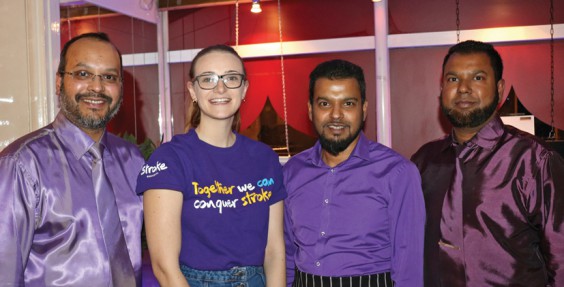
Uddin brothers

ADVERTISEMENT FEATURE

Spice Valley Balti in Bromsgrove will host a special fundraising dinner on Monday January 29, to raise money for the Stroke Association in Bromsgrove.

Guests, who are asked to wear something purple, will enjoy a three-course meal with coffee and mints. Live entertainment is planned, plus a raffle with plenty of great prizes.

Tickets are £20 and all profits from the event will be donated to the charity.

100,000 strokes happen in the UK each year, and there are more than 1.2 million stroke survivors. The Stroke Association is the UK’s leading charity dedicated to conquering stroke.

Their mission is to prevent stroke and achieve life after stroke through support services, prevention campaigning, education and research.

For stroke survivors in the West Midlands, the charity runs the UK’s only Life after Stroke Centre, based in Bromsgrove. At the centre survivors take part in activities, which aid recovery and provide social inclusion.

Ruth Tandy, West Midlands’ Community and Events Fundraiser, said: “We are thrilled and incredibly grateful that the restaurant has chosen to raise money for the Stroke Association.

“The money will go a long way in helping to support people who are living with the effects of stroke, as well as their families and carers.”

SVB, on Worcester Road, was opened in 2000 by three brothers from the Uddin family – Gias, Monir and Muhammad. Eight family members now work at the award-winning restaurant.

They raised £178 for the Stroke Association in October with event in celebration of the restaurant’s 17th anniversary in Bromsgrove.

To book tickets for the Purple Charity Night please call 01527 578989.

Launch of a dragon

SpaceDragon

Amateur astronomer Brian Watkiss peers into the Village night sky.

December, the darkest of all the months.

The Winter Solstice is on the 21st, though the earliest sunset is from the 9th to the 16th when it occurs at seven minutes to four in the afternoon and the latest rise is a few days after the solstice, at 18 minutes past eight in the morning.

This is due to the Earth wobbling around its elliptical orbit, giving us shifting Solar Noons and the Equation of Time (?) but the shortest day is still the 21st.

Speaking of elliptical orbits, the Moon is closest to Earth (perigee) on the 4th, which is very close to the Full Moon on the 3rd. Will this make it look different, I wonder? The only way to find out is to get out and have a look.

This early full Moon means it will have quietened down by the 13th – which is the peak of the Geminid meteor shower, so keep an eye out for shooting stars around this time.

There is a second meteor shower this month too: the Ursid meteors peak on the 22nd although you may spot meteors at any time. The trick is to look.

Whenever you step outside on these dark winter nights, take a few moments to examine the sky – it may surprise you.

The late sunrise is handy if you want to find planets. From six in the morning till the Sun takes them away, Mars can be seen to the left of the bright star Spica, low in the south-east. A little further away, towards the horizon, you can find Jupiter, which should be very obvious.

During the course of the month, Mars will sink lower and Jupiter will climb a little higher each day. On the 14th, a thin crescent Moon is close by, guiding you to them as well as adding to the spectacle.

The 14th is also the 45th anniversary of the last time men walked on the Moon. Gene Cernan, the commander of Apollo 17, left the surface with the words: ”We came in peace for all mankind”. This mission was also the last launch of a manned Saturn 5, the largest rocket ever built by the USA.

As it happens, late December should see the launch of a new large space transport system when SpaceX straps three of its Falcon rockets together for a demonstration flight.

We won’t be able to see this from Alvechurch, but a single Falcon is due to launch a Dragon resupply spacecraft to the ISS on the 4th, so visit www.heavens-above.com to see whether this is visible, especially as it approaches the Space Station.

Actually the ISS is always a great spectacle whether or not a spacecraft is approaching, although sometime before the 17th, expedition 53 should leave to make way for the launch on that day of a Russian Soyuz carrying expedition 54 to the station.

A busy time up there – but then everywhere is busy at Christmas.

Have a happy one!

Above: SpaceX Dragon resupply vehicle 2017 (Picture courtesy of NASA)

Chance to try rugby

Girls playing rugby

Kings Norton RFC held its Annual All Girls Primary School Tag Rugby Festival at the Hopwood Park facility, with a total of 10 teams involved.

All teams and girls taking part were awarded medals for participating and trophies were awarded to each team for their school trophy cabinets.

The Winners’ Shield went to newcomers Saint John Basco, and the runners-up were the West Heath A Team with Saint Mary’s and West Heath B teams coming in joint third place.

Organiser Matt Blackburn, sports master at West Heath Primary School, was supported by a great team of staff and teachers from other schools in and around the Birmingham area.

Kings Norton RFC would like to thank these teachers who arrange for their pupils to have a great rugby experience at a local club.

Kings Norton Rhinos RFC currently run a Girls Tag Rugby Squad which is part of The West Midlands Girls Tag Rugby League. All the girls at the tournament were invited to join the club, which is on constant look-out for new girls.

If you would like to get involved, you will get a warm welcome – it’s a great way to keep fit, meet new friends and get out into the fresh country air.

Girls aged 8 to 17 can take part in this non-contact form of rugby and, when older, are encouraged to enter O2 Touch Rugby run by Kings Norton RFC.

For girls who wish to get involved with the contact game, Kings Norton has formed links with the Ladies section at Five Ways Old Edwardians RFC, also based in Ash Lane, Hopwood.

More information: https://www.knrfc.c.uk

Sweet victory at Stourbridge

Paul Evans

Alvechurch FC have plenty to look forward to as the year ends.

An exciting win over local rivals Stourbridge saw Alvechurch progress to the second round of the Integro League Challenge Cup.

Stourbridge, who play one level above ’Church, couldn’t cope with the pace and tenacity of the visitors, and were left stunned by a four-goal first half blitz.

They fell behind in the first minute when Tommy Turton scored from the penalty spot. Goals from Andrew Parsons, Nathaniel Waite and Mitch Botfield followed, and AFC were well worth their 4-0 lead at half time.

Stourbridge made a couple of changes at the break, and got themselves back in the game by scoring directly from a free kick and converting a penalty – but Alvechurch saw the match out as 4–2 winners.

’Church were due to meet fellow Northern Premier League side Stafford Rangers in the next round on Tuesday November 28.

Unfortunately, news from the FA Trophy was not so positive – following their best run in the competition for 30 years, Alvechurch were knocked out by EvoStik League Premier Division side Coalville Town with an ignominious 5 –1 home defeat.

In the previous round, they had navigated a tricky away tie at Cambridge City, dominating the majority of the match and coming out comfortable 2–0 winners with a brace from midfielder Babucar Sauane.

It was a different story in the Coalville match, when ’Church found themselves two down by the break. They were thrown a lifeline early in the second half, when the visitors were reduced to ten men and Jamie Willets scored a deficit-halving goal.

But Coalville defended resolutely despite their numerical disadvantage, and managed to bag another three goals to make the final scoreline 5–1.

Alvechurch are hoping for better things in their two other cup runs, and have been handed a home draw in the second round of the Birmingham Senior Cup – they’ll play either Rushall Olympic or Coventry City. In the JW Hunt Cup, they are away to Heath Hayes on November 21.

Meanwhile, in the league, Alvechurch were second in the table as we went to press.

* Fans’ favourite Sam Williams is returning to Lye Meadow. The combative midfielder was a big influence on and off the pitch two seasons ago when Alvechurch just missed out to Hereford in the league.

He moved to Walsall Wood last season but due to injury was unable to play in as many games as he hoped. It is hoped he will be available for AFC after Christmas.

More good news for fans – Ryan Winwood has returned to full training.

The popular midfielder has been blighted with injuries, dislocating his shoulder several times. In the close season he had major surgery, and now has full movement in his shoulder and arm. Hopefully it won’t be long until he’s back in the first team.

AFC have also welcomed Macauley Manning from Redditch United. He is a versatile player who can play in defence or in midfield.

Alvechurch’s longest-serving player Jack Cresswell has decided to take a break from football. The skilful midfielder will be missed; his ability to create space and his subtle touches and passes created many scoring opportunities.

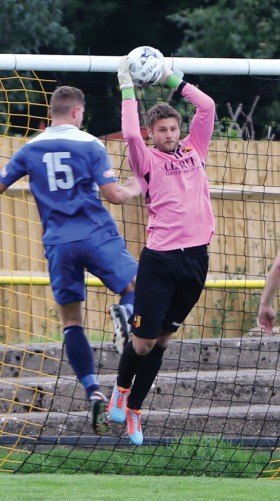
Goalkeeper Paul Evans (pictured above) is also leaving the club, having been a stalwart in the Alvechurch line-up over the past two seasons and instrumental in the recent success of the club.

Such is his popularity at Lye Meadow that he was awarded the supporters’ Player of the Year last season.

With a young family, Paul felt that he couldn’t commit his time to both the football club and home life. Everyone wishes Paul the very best for the future and thanks him for contributing so much to the club.

Bekir Halal and Javia Roberts, both recently signed from AFC Hinckley, have now left Lye Meadow as they could not be guaranteed first-team football.

Bekir has returned to Hinckley, while Javia has joined Market Drayton Town, where his former Hinckley manager is now at the helm.

FIXTURES
League games unless stated

Sat Dec 2   3pm Spalding United (A)

Sat Dec 9   3pm Kidsgrove Athletic (H)

Sat Dec 16   3pm Leek Town (A)

Sat Dec 23   3pm Gresley FC (H)

Tues Dec 26   1pm Bedworth (A)

Mon Jan 1 3pm Romulus (H)

Sat Jan 6 3pm Chasetown (A)

* For more info or sponsorship enquiries, please contact Trevor Ball at .(JavaScript must be enabled to view this email address) or visit https://www.pitchero.com/clubs/alvechurch

Being bold in the garden

Flowers

Hannah Genders helps clients ‘go for it’ with a new design.

When drawing up a garden design for clients, one of the most helpful things for them is the chance to develop the garden in stages and not all at once.

It enables a client to implement the design over time, when the funds are available, and means whatever work is carried out will work as part of a whole scheme.

I would estimate that at least half of the projects I undertake are built like this and there is also the issue of planting at the right time.

For instance, at this time of year we are re-visiting projects to add bulbs, followed by trees that are rootball (field-grown) and not container-grown as they are cheaper and can be planted anytime between the end of November and February.

Sometimes, on the other hand, a client will plan to do the work in stages but become so enthusiastic when we’ve completed the design stage they just go for the whole lot! This was the case on a recent project in Barnt Green, a garden design and rebuild for Jan and John Blackhall.

At the initial meeting Jan and John gave me quite a challenging brief. Jan was very direct (and I liked her immediately for it), telling me they had three very lively dogs that needed to run in the garden, but that equally she wanted a vegetable garden, and beautifully-planted borders.

In truth, the garden had been fairly wrecked by the dogs running around it, the lawn was very bare, and they had destroyed any plants that were low enough for them to get hold of.

Jan and John also had an existing swimming pool that they had ordered a cover for, so it could be used for a longer time throughout the year – so this needed to be in the design as well.

In the initial sketch ideas, I proposed an area for the dogs that was fenced off to contain them, and to make this look attractive using cleft chestnut and gates to match.

This gave the dogs just a little under half the garden, a lawn area and a few trees planted large enough for them not to reach the branches!

The swimming pool cover was allowed for and this meant redoing all the paving around the pool. To the left of the pool was an area that was sunny and secluded; the ideal place to have an extended patio.

As it was part of my brief to have well-planted cottage garden borders, I designed these in at the back of this sitting area, where there was plenty of sunshine and enough depth to make a really good display.

Both Jan and John love the heavily-scented old English style roses, so these were incorporated into the planting scheme.

The soil in the garden contains quite a lot of clay, so while Jan was very keen on having lavender, we created the same effect along the front edge of this border with a low-growing catmint called Nepeta racemosa ‘Walkers Low.’

It flowers from May to September and has silvery leaves and light purple flowers in abundance, so it does look like lavender from a distance.

It is called catmint because cats love it – they can lie on it and chew the leaves – although in this case the dogs are likely to keep them out of the garden.

Along with the catmint we planned to have plenty of colour from cottage garden perennials, like Salvia nemorosa Caradonna with its stunning dark blue flower, a brightly-coloured, tall geum called ‘Mrs Bradshaw’, and a little pink dianthus which I found in an organic nursery near me.

There is quite a lot of height in this border and it’s deep enough front to back to take it, but as Jan and John also wanted to have a summerhouse (they chose a breezehouse) at the top of this border we planted some mature shrubs to half-hide the breezehouse and give the garden depth.

The bulbs we planted sweep through this border to give it long-lasting movement and colour: drifts of the very dark purple tulip ‘Queen of the Night’ and a bright red tulip to contrast called ‘High Scarlet’.

As I can buy bulbs at wholesale prices we tend to plant several hundred at a time, adding some real drama to existing planting.

The other great thing about the transformation of this garden was being able to recycle old garden ornaments that Jan and John had collected over the years.

We stood some wonderful old sandstone millwheels in the perennial border and planted around them; we also built a water feature out of two of these larger sandstone ornaments and the water bubbles up through it on the patio near the house.

Along with exuberantly-planted borders, Jan was keen to have a greenhouse and grow some food in raised beds. The greenhouse sits towards the rear of the garden in its own fenced-off area, again to keep the dogs out, and we built a raised bed from new oak sleepers.

The brick path runs from the back door to the greenhouse and it now looks like it’s been there forever.

Jan has also proved to be an excellent veg grower – I’m really impressed with all she can grow in a relatively small space. Her mangetout looked amazing this summer; she grew both the green and purple podded varieties (I had to admit they looked better than mine).

We did manage to get some lavender in, to hide the new swimming pool cover. We designed in and built a rendered wall which had space for planting in the top, and I planted this up with one of the taller English lavenders called Lavendula x intermedia to add height to the wall.

This is an idea you can try if your soil is not suitable for lavender – just create the right conditions in a pot or raised border.

The garden is now pretty much put to bed for the winter; it’s been mulched well and I’m sure it will pop up next year and look better than ever.

Wishing all Village readers a very Happy Christmas and good gardening in 2018.

The holly bears a berry

Holly and ivy

Mary Green looks at the role of wildlife in our songs and carols.

We certainly had a St Luke’s summer in October; very warm and with many leaves still green. I was eating ripe wild strawberries at the start of November.

The combination of mild weather, no frosts but high winds meant that the leaf colour wasn’t great this year – the leaves fell before having a chance to show the yellow and orange colours which are there when the green chlorophyll is withdrawn.

Also, the red colours appear in autumn after the chlorophyll has gone, more so in cold sunny weather – which is not what we had.

However, in November the oaks were still turning golden, and by then it was cooler and less windy, so the colours burned bright.

And, as I suspected, there was an amazing crop of acorns this year, covering the ground near any oak trees and delighting the squirrels, mice and jays. 

After the greys and browns of November, December often seems to offer splashes of colour. Red and green are the ones that come to mind, especially with Christmas coming.

It’s no coincidence that these colours are at the heart of our winter celebrations. Red is the colour of fire, blood and life. To have it in the middle of winter is a mark of hope for the return of spring.

This is literally true about the berries of December, especially the traditional holly but also the plentiful hawthorn haws and wild rose hips. They carry the seeds for next year, and the red is a colour recognised by birds, signalling a good feed.

The birds spread the berries around and allow new growth away from the parent tree. They can even eat the red yew berries, poisonous to us, because they pass the seeds, where the poison is, right through them.

To my mind it is a crime against nature to cut hedges at this time: wait till the berries have gone!

Green is also symbolic of life, the life of nature, of plants. The spirit of the wild is often symbolised by the Green Man, whose image is of a face surrounded by leaves, usually oak or ivy.

He often appears incongruously in carvings in churches, another example of how the Christian church absorbed pagan influences. Mistletoe, green in winter and growing mysteriously on other trees, is also accredited with magical powers and fertility.

A mixture of pagan and Christian marks this time of year. The solstice and the festival of Yule were chosen as the time to mark Christ’s birth, which wasn’t necessarily at this time of year, to capture the images of new life and rebirth already around the old fire festival.

The red and green holly and ivy became the key symbol of Christmas, along with the red-breasted robin and later the green Christmas tree.

The robin was the king of the birds, who in the old stories defeated the wren at Christmas. Again, the literal truth matches the myth, in that the robin is one of the few birds that sings through the winter.

He shows up strongly among the bare branches, whereas the little brown wren will be hidden in the low hedges.

Mind you, he is just as likely to be a she, as both sexes of robin sing – and fight! The bird wasn’t always called the robin: it was the redbreast or ruddock. It took the name Robin from Robin Goodfellow, the spirit of the greenwood – a mischievous version of the Green Man!

At Christmas we have traditionally sung songs about the plants and birds of this time. We all know one or other of the songs about the holly and the ivy. Some of these go into details about the berries, blossom and leaves (red, white and green).

They all have something about the holly being the king of trees (the holly bears the crown) or the “first tree in the greenwood.” It was one of the trees in the Celtic tree calendar, though of course it should be the queen not the king, as the ones with berries are female trees.

It’s an easy transition from the king of the woods to the “new king born today”, so the holly became a symbol of Christ.

The wren and robin also appear in songs. We probably remember “Who killed cock robin? I, said the sparrow/wren” but not many of us these days know the old song The Cutty Wren, still occasionally sung on the Celtic fringes of Britain.

The wren was hunted and killed on St Stephen’s Day, the day after Christmas (originally for real, later symbolically) and paraded to the song, which details how the wren will be dismembered and cooked.

As the song develops the wren becomes enormous, with the leftovers being used to feed the poor.

Both of these are strange old songs, but remnants of an ancient world-wide myth about the king who has to fight his opposite, is killed and comes back to life again.

You can see another version of this in the mummer’s plays performed around Christmas, where St George is the hero who dies and comes back to life.

The greenwoods and trees generally feature a lot in old songs. There is a strange old carol called Down in Yon Forest; it includes Jesus, Mary, thorns, stones, blood, water, purple and red, bells and the moon – like a jumble of all the symbols from the pagan and Christian worlds.

Another one is The Bitter Withy, which deals with an incident in Christ’s childhood when he was naughty, was smacked by Mary with a willow twig, and cursed the willow (withy) to perish at the heart before other trees.

The song reminds me of those old Mystery plays, where Christ’s birth happens in an English stable with comic sheep-robbers hiding a lamb in a cradle.

It was much more usual centuries ago to set songs and stories from religion in a background of normal life, not treat them as history.

The Cherry Tree Carol is a lovely example of this. It features Joseph as a normal bloke, getting cross when Mary asks him to reach some cherries for her as she has a craving, and he says that the father of her baby should reach them for her.

Whereupon the baby in the womb commands the cherry tree to bow down and offer her the cherries, which it does.

Moving away from Christmas, you can find trees, plants, animals and birds all over old songs. Later ones are often nostalgic songs about people who have had to leave their homes and traditional lives to find work in towns or abroad.

“The oak and the ash and the bonny rowan tree” is a well-known example – they “bloom at my home in the North country”.

There are also the Galloway hills, which are “covered with broom, with heather bells in bonny bloom,” and in another song, we “pick wild mountain thyme. . . all around the blooming heather.” 

Then there are the “Verdant braes of Skreen”, where the singer “leaned my back against a mossy oak, to view the dew on a far country.”

Lots of songs have people leaning against an oak, as it symbolises strength, but sometimes they end up with the willow tree, meaning sorrow. Love songs make great use of plants, with each flower having a symbolic meaning.

One is Let No Man Steal your Thyme, thyme being the symbol of virginity. In another, The Seeds of Love, the singer rejects the offer of “the violet, the lily and the pink” – all chastity symbols – and chooses the “red red rosy tree”, or passionate love. She ends up with the willow tree, of course.

In happier songs, courtship happens on the “Banks of the sweet primroses”, and sheep shearing takes place when there is “A rosebud in June, and violets in full bloom.”

Love often takes place in the greenwoods: there is a lovely old song with a double meaning about three maids who go to the greenwoods with a young man and he finds “The bird in the bush” for them!

If a song itself doesn’t have wildlife in it, the chorus will – “parsley, sage, rosemary and thyme,” for example.

Many of the animals in old songs are either hunters or hunted. Mr Fox appears a lot, cunning and often outwitting humans. Deer are hunted, but often represent human beings, especially women. The “running of the deer” even comes in one version of the Holly and the Ivy carol.

Two crows (“Twa corbies”) discuss eating a new-slain knight who has been abandoned by his “hawk and his hounds and his lady fair”. However, “small birds sing” where lovers are, so are less threatening.

Lovers with magical powers turn themselves into animals – a hare, a bird – to challenge each other.

The cock crows to let ghosts of dead lovers know that dawn is coming and they must return to their graves. In one ancient Christmas carol a cooked cockerel rises up from its plate and crows “Christ is born!”

Life and death and life after death appear in our old songs, all tied in with the growth of plants and the seasons passing, winter giving way to spring. No wonder December is such a great month for songs and singing.

We used to sing carols all the year round, but now only at Christmas, when the old traditions still burn away in the background. I hope you get to sing some this year.

This is a poem I wrote about this time last year.

Advent Calendar
Three days of frost and glittering grass
It feels like Advent now. I like this time
Perpetual kid, I suppose, looking forward
Though I no longer know to what.
I read that someone has designed
A cheese Advent calendar, for those
Who don’t think Christmas is about chocolate
And even a craft beer Advent calendar.
Mine would have windows opening
On to signs of winter taking hold
Pink array of Christmas cactuses
And chandeliers of bilbergias,
The first Christmas card, from the Church,
Fairy Tale of New York on the radio,
Our choir singing every couple of days
Wearing red like a gardenful of robins,
Hawthorn trees suddenly stripped bare
By real blackbirds and redwings,
Days shortening, sunrises in my bedroom
And the first skin of ice on the canal.

Report reveals the real value of advice

0

ADVERTISEMENT FEATURE

You could save more money with the right guidance, writes Martin Pryor, of Pryor Portfolio.

An interesting report was produced recently by the International Longevity centre (ILC) into the “real value of financial advice”.

A robust statistical method was used to control a range of factors likely to determine demand for advice – including income, wealth and behavioural traits.

The results show that those who take advice are likely to accumulate more financial and pension wealth, supported by increased saving and investing in equity assets, while those in retirement are likely to have more income, particularly at older ages.

Financial planning is complex. Broadly defined as making decisions about money to help individuals meet certain goals and aspirations over their lifetime, planning is a continuing process of anticipating and adapting to changes in personal circumstances over the long term.

The human mind, however, is not programmed to think long-term, preferring rewards today over larger rewards tomorrow, and switching off in the face of complexity.

Given that our lives are so full of other activities, we are likely to need help with financial planning from those who are qualified to give it. Unfortunately, many do not seek financial advice – only 16.8% of people saw an adviser in the years 2012 to 2014.

In this context, this report brings new empirical evidence to bear on the value of expert financial advice.

The investigation quantifies the impact of advice on asset accumulation and retirement planning, and provides case studies to illustrate the roles of advisers in supporting their clients’ financial planning needs.

To address this challenge, the report uses an advanced statistical technique called “propensity score matching”, which identifies two similar groups of individuals within the data and then assesses the impact of advice on one group (the treatment group) versus the other (the control group), thereby mimicking a scientific experiment.

Using this technique, the analysis explores the impact of receiving advice during the period 2001 to 2007 on consumer outcomes in 2012 to 2014.

As well as exploring the overall impact of advice, the analysis also focuses on two specific consumer groups – the “Affluent” group (wealthier subset of the population) and the “Just Getting By” group (less wealthy subset).

Headline findings
The results strongly demonstrate the positive value of financial advice for consumers – both amongst those who are wealthy and those who are less wealthy:

* Those who took advice were significantly more likely to save more as well as to invest in the equity market.

* The “affluent but advised” group was 6.7% more likely to save and 9.7% more likely to invest in the equity market than the equivalent non-advised group.

* The “just getting by” group was 9.7% more likely to save and 10.8% more likely to invest in the equity market than the equivalent non-advised group.

Subsequently they ended up with more financial assets (£13,435) and pension wealth (£27,664) by 2012–14 than similar individuals who did not take advice.

* The “affluent but advised” group accumulated on average £12,363 (or 17%) more in liquid financial assets than the equivalent non-advised group, and £30,882 (or 16%) more in pension wealth.

* The “just getting by” but advised group accumulated on average £14,036 (or 39%) more in liquid financial assets than the equivalent non-advised group, and £25,859 (or 21%) more in pension wealth.

* Those who had received advice in the 2001–2007 period also had more pension income (+£773) than a similar group who did not.

This was the case at all ages but particularly for the oldest group (+£1,100 for people aged 65-79 and +£1,300 for those aged 80 and over).

* The “affluent but advised” group earn £880 (or 16%) more per year than the equivalent non-advised group.

* The “just getting by” group earn £713 (or 19%) more per year than the equivalent non-advised group.

These results strongly indicate that advice works, adding real value to consumers’ financial circumstances over the long run.

Evidence from this report also reveals that the experience of taking advice is highly satisfactory: 9 in 10 people are satisfied with the advice received, with the vast majority deciding to go with their adviser’s recommendation.

Since advice has clear benefits for customers, it is a shame that more people do not use it!

Read the full report at https://www.ilcuk.org.uk or contact PPM and we would be delighted to email you a copy.

Contact Pryor Portfolio for more information and advice.
Tel: 07961 162818
.(JavaScript must be enabled to view this email address)
https://www.ppm-ifa.co.uk

Colours of Africa

0

Satvinder

Sally Oldaker meets an artist whose work reflects his roots.

He may have made his home in the Midlands, but Satvinder Gill’s artwork recalls the joy of his childhood in rural Africa as well as reflecting his great love for its wildlife and landscapes.

Satvinder was born in Dar-es-Salaam in Tanzania. His uncles were hunters and his dad worked on the railways, meaning the family got to travel all around Africa.

They then moved to Kenya, where Satvinder enjoyed what he describes as a “Born Free lifestyle”. While exploring his surroundings, he started sketching, and it slowly evolved from a habit to a hobby.

“We moved to England in 1975 and I started looking into the possibility of doing something with my art, and finally I went to art college in Kensington.”

However, he fell out with his tutors, who he says wanted to “put a full stop” on his work. “They wanted to categorise me and tell me what I could and couldn’t do – this is a big problem in the art world. They should help you use and improve your talent, not package you into a neat little box. That is not art.”

Therefore, Satvinder is largely self-taught. His hero is the late wildlife artist and conservationist David Shepherd: “As a kid, I would spend hours looking at his artwork and figuring out how it was achieved.”

One of his proudest moments was receiving a young artists’ award from Shepherd in 1996.

He exhibited in London, Birmingham and Northern Ireland, and started to get his work recognised.

He realises that sales of his art are not going to be enough for him to give up the day job (as a fabricator for the MoD in the aviation sector) but says his love for his work is more than enough to keep him going.

Satvinder has lived in Tardebigge for a couple of years now, moving from Webheath to be closer to his mum.

He originally came to the Midlands from London because his brother had a house in Walkwood, and then met his wife, Caroline – they’ve now been together for 30 years.

“I couldn’t go back to London now. This is home, and it’s much more peaceful. Most of my family live up here now.”

However, he goes back to visit his uncles in Africa every couple of years. “I go off in a Land Cruiser, do some sketches and take photos, as well as having a holiday. Then I come home and start putting my paintings together.”

He works largely from photos: “Lots of artists claim they painted their wildlife pictures on the spot, but that’s just not possible – there’s no way an elephant is going to stand there for four hours while you paint it! It has to be done with photos as well as preliminary sketches.

“Some more famous artists do get sponsorship so that they can go on longer trips to see wildlife, whereas people like me just go when we can.

“I do it because I love it, and it’s a way of celebrating Africa and also putting something back – I pay for two rangers who look after elephants in Kenya.

“It’s terrible what’s happening to the wildlife there now. I’d love my grandkids to be able to see a bull elephant one day, but it’s unlikely that will happen.”

Satvinder is not afraid to get close to his subjects – for instance, he came within 20 to 30 feet of the gorilla in the picture opposite – but usually has to use a long-range camera lens.

He says he can spend up to 40 hours on one painting, depending on his mood. “I tend to half-finish a piece and then leave it for a while, to come back at it with fresh eyes later.”

He used to use watercolours but now sticks mainly to pastels and oils, as they can be manipulated more than watercolour.

“Pastels are one of the nicest things to depict Africa with, because they give that dusty African look even without really intending to! Dust falls on the page and sits there; you just have to seal it.

“With oils you have to layer them more. The results are beautiful but you need longer drying times in between layers.

“I really enjoy building up a picture – when it starts to come together you can see that it will all be worth it when it’s finished.”

Satvinder used to have a gallery at Tardebigge Court, but now does most sales via his website; his work is particularly popular in China, Japan and Saudi Arabia.

You can view and buy it at https://www.rangiyaafrica.com – the name means “Colours of Africa”.