Home Blog Page 131

Once in a blue moon

Looking southeast

Amateur astronomer Brian Watkiss peers into the Village night sky.

Happy New Year – and we start 2018 with a bit of a conundrum. It’s the Moon. It starts the new year at perigee; that is, it is at its closest to Earth. Then early on the 2nd, it is full (a bit like I have been for the last week!).

Whether this closeness makes a difference to its appearance I will leave you to decide. As it takes just over 29 days to circle the Earth, it is full again on the 31st and in some circles this would be seen as a Blue Moon, although it will turn red for people on the other side of the world as it is eclipsed!

Astronomers, being a serious lot, take a Blue Moon to mean the third full moon of a season which has four. That would still make this one a Blue Moon, except that astronomical winter runs from the Winter Solstice to the Vernal or Spring Equinox.

So, there being no full moon in February, they have no Blue Moons this winter, making me glad I’m not an astronomer. What’s more, we get another one in March.

Incidentally, the Earth also has an offset, elliptical orbit so its distance from the Sun varies throughout the year and in January it is at its nearest, or perihelion, at 05:30 on the 3rd – but it won’t make any difference.

Now, where are all the bright planets? Well, they are all lined up to the right of the Sun, which means they are only visible in the mornings, a little before sunrise. It all starts at around six in the morning, which may be a little difficult on the 1st of the month!

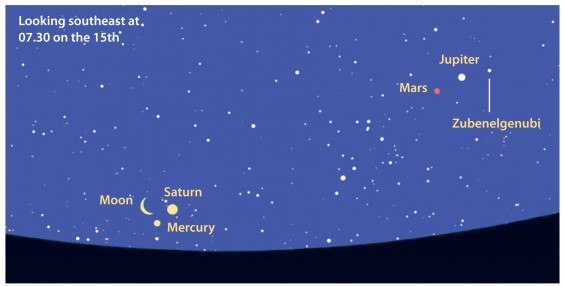
Low in the southeast, you can find Mars, Jupiter and the brightest star in Libra clustered tightly together. This star is nowhere near as bright as the two planets but I had to mention it because it’s the star with my favourite name, Zubenelgenubi!

As the days pass, Mars, orbiting the Sun more quickly, will appear to move closer to Jupiter until the morning of the 7th when they are really close together or in conjunction. After that, Mars sinks lower in the sky each day.

For the first few days of the month, you might just catch Mercury in the brightening sky lower down but it is usually tricky to spot. It, too, sinks lower each day and passes close to Saturn on the 13th.

Being so much bigger, Saturn should be easier to find, especially during the second half of the month. Look for a thin crescent moon close by the pair of them on the 15th.

“But what can we see in the evenings?” I hear you shout. Well, the 3rd sees the peak of the Quadrantid meteor shower, although that pesky Moon will be making the sky rather bright. Always worth looking though, especially a day or two after.

Then we start to see the great constellations of winter. With their Nebulae and star forming regions and giant stars, we’ll have to come back to them next month!

Trio of new garden entries

0

Birmingham Road

The bi-annual Alvechurch Open Gardens event will take place again in 2018, with a group of interesting gardens open to the public over the weekend of June 23 and 24.

This year there will be nine gardens to visit, including three new additions: Mike and Tracy at The Moat House, Anna and Andy at Birmingham Road (right) and Joanne and Mark on Bear Hill will join six of the regulars.

The Moat House still has a large portion of its original moat, while the garden at Bear Hill includes Joanne’s art studio.

Philip Aubury is still organising the event, although he and wife Elisabeth will not be opening their garden at Hill Cottage this time.

“If any readers of The Village wish to join us by opening their garden this year, I would be pleased to hear from them,” says Philip.

To find out more, call him on 0121 455 3895.

Wintry end to the year

Snow

Alvechurch amateur weatherman Phil Thomas records the changes.

The first seven days of December followed the bland November trend – but following an Atlantic blocking anticyclone on the 7th, very cold air was brought across the UK.

There was snowfall on the 9th, and heavy continuous snow on the 10th. I recorded 20–21cm of level snow by the end of the 10th.

This depth was second only to the record fall on the 22nd December 2010 (26cm).

December 2017 (to the 14th)
Mean Max 5.9C   1.2 below average
Mean Min   0.7C   0.8 below average
Mean     3.3C   1.0 below average
Rainfall     38.0mm   55% of average
Sunshine 29.6 hrs 61% of average

November was an unremarkable month with weather much as we would expect, making a pleasant change from recent wet and windy Novembers.

After a warm wet start to the month it became colder and drier, with only 4.2mm of rainfall in the last 10 days.

There were colder daytime maximum temperatures, staying in single figures for the last eight days of the month.

November 2017
Mean Max 10.0C 0.2 above average
Mean Min   3.6C   equal to average
Mean     6.8C   0.1 above average
Rainfall   44.5mm 57% of average
Sunshine 96.3 hrs 151% of average

Outlook
Computer models were correct for the cold start to December. This report is from the middle of December so forecasting January’s weather is near impossible.

There may be some further frosty nights if the blocking anticyclone becomes established at any time. The long-term trend is for a colder winter than of late.

More information at https://www.alvechurchweather.metsite.com 
You can see an improved HD weather-cam, updated at one-minute intervals, at: https://www.alvechurchweather.metsite.com/webcam_alvechurch.php

Looking forward

0

Oak Tree House

Dave Morgan, county organiser for the National Gardens Scheme (NGS), suggests ways to plan for the warmer weather.

I used to have one of those “page a day” desk calendars that had a different saying for each day – and one that I read about 20 years ago has always stuck in my mind. It was “We look forward, hoping; backward, regretting, whilst the present stands offering us flowers”.

It’s the same sentiment as the shorter saying “Live for today” – and really, both make a lot of sense. But despite that, it shouldn’t stop us planning for the future – and nothing is more sensible when it comes to gardening!

Clearly gardeners have to plan for the future – spring bulbs should have been planted in the autumn or very early winter if you want early spring flowers, while tender plants and exotics should have been removed to greenhouses or warmer places, or generally protected, if you want them to come back to life in the summer.

Clearly, also, in gardening terms, gardeners do look forward hoping – hoping that the spring bulbs grow and that the mice don’t eat them – and hoping that the winter weather isn’t too severe.

But there are some jobs you can still do now – assuming there isn’t several inches of snow on the ground. For instance, you can check the condition of all stakes, supports and ties for trees, looking for signs that indicate that if it becomes very windy the support may not hold the tree, and replace stakes and renew ties if necessary.

You should also continue to check for pests like snails in sheltered places, such as empty pots in the cold frame or greenhouse. Most pests will be inactive in cold spells, but it’s still worth checking!

And there are still plants that can be planted (assuming the soil isn’t frozen solid), like garlic and seeds, which can be sown in seed trays and left in protected areas like a greenhouse or windowsills to germinate ready to be planted out in the spring.

If it’s too cold or wet to actually work in the garden, then just pop out and feed the birds with fat balls and seed.

As well as being a delight to watch, these birds will repay you by eating up a lot of insect pests that lurk out of our sight and reach, under buds and on stems.

When it gets dark, start planning for warmer days in the garden. Try to have something in flower all year-round, which is essential for the wildlife that plays such an important role in keeping gardens healthy.

But perhaps even more exciting is to get hold of the new Worcestershire National Garden Scheme county leaflet (due out at the end of January, and available from most good garden centres and libraries) and start planning for some visits to gardens open as part of the scheme.

The National Garden Scheme (or NGS) has been operational for more than 90 years and raises much-needed funds for various charities like Macmillan Nurses, Marie Curie and Parkinson’s UK, and last year gave £3 million to these and a few other organisations.

In fact for many, like Macmillan and Marie Curie, the NGS is their biggest single annual donor, so the NGS plays a vital role in ensuring these charities can do the work they do.

And what could be more enjoyable than spending time in a delightful garden, admiring the colours and scents of the plants, perhaps gaining a tip or idea for your own garden, with a cup of tea or coffee and a piece of delicious home-made cake, knowing that your visit is also helping someone in need through one of the beneficiary charities?

In Worcestershire, the first garden open is in early February, near Malvern, and the first in the Village catchment area is our own garden (Oak Tree House, Marlbrook) for an evening opening on May 12 when there will be a free glass of wine or soft drink for all visitors (well, I had to get a plug in for our own garden, didn’t I?).

Perhaps, on reflection, that old saying I remembered from 20 years ago should be updated for gardeners to state, “We look forward, planning; backward, having learnt from mistakes; whilst the present stands offering us plenty to do!”

Marlbrook Gardens, which comprises Oak Tree House and Round Hill Garden, will be opening in August only this year – you will find more details on https://www.ngs.org.uk

Villagers on screen

Nigel and Dave

A short film involving plenty of local talent is now in production in the Village area.

Produced by Cofton Hackett film maker Nigel Davey and Hopwood directors Ian and Dominic Higgins, Seven Days is the story of Midland hero “Blind Dave” Heeley, who has raised more than £1 million for charity with his endurance events.

It will tell how Dave ran seven marathons on seven continents in seven days, with flashbacks to his childhood and diagnosis of the condition that led to him becoming completely blind at the age of 20.

Playing the role of 11-year old Dave is Charlie Boswell from Blackwell. Barnt Green actress Sarah Manners plays Dave’s wife Debbie, while Dave himself is played by theatre and television actor Jack Lane.

Also in the film is Harry Potter actor Oliver Phelps as Dave’s doctor.

“I have known Dave for a number of years, but spending time training with him last year and watching his determination, humour and encouragement to others, I thought it would be great to make a film about his life,” says Nigel.

During filming, the team is based at Hillscourt, the hotel and conference centre at the foot of the Lickey Hills, with support from manager Matthew Baker, while other locations include Alvechurch FC.

The 30-minute film, which has Sir Ranulph Fiennes as its patron, is due out in May and will be shown at festivals worldwide.

It’s not too late to get involved with the project as an extra – or if you are a business and would like to support the film, please email daveyfilms@aol.com  

More information can be found at https://www.pixelrevolutionfilms.com/7days

Right: Nigel Davey with the real Blind Dave.

Shining lights

Choir

Villagers in Alvechurch, Barnt Green, Lickey and Blackwell embraced the spirit of Christmas with a host of sparkling celebrations.

In Alvechurch, the new lights were switched on by BBC presenter Joanne Malin, with music by Alvechurch Community Choir (above) – who then processed to The Lawns care home to sing at their Christmas Bazaar.

Shops and businesses in Alvechurch entered a Best-Dressed Window competition, judged by the Rev Fiona Lee from the Baptist Church – the winner was newcomer Gin & Pickles.

Barnt Green’s big switch-on included music from Blackwell Concert Band and the Cats’ Chorus choir, plus the unveiling of a new light designed by a pupil at St Andrew’s First School.

There was also a Best-Dressed Window competition, which was won by Oulsnam Lettings.

Blackwell’s celebrations began with the tree light switch-on outside The Wheel, before a procession to Blackwell First School’s Christmas Fayre, complete with Santa’s grotto.

In Lickey there was a Christmas concert and tree lighting at Holy Trinity Church, as well as a Christmas Fair at Lickey Hills Primary School.

Santa was also on hand as The Midland Sinfonia performed their annual Candlelight Concert at St Laurence Church, Alvechurch.

For more pictures, visit our Facebook page.

The trees of life

Gorse

Mary Green starts a new series on trees in the Celtic calendar.

I have been contributing these articles (and poems) for ten years now. Sometimes people ask me if I ever run out of material. Actually, I don’t, because the cycle of nature is endlessly fascinating and slightly different each year, and because I keep finding out new things I didn’t know about!

The photos are all mine, though of course they’re usually from previous years. I write the articles a month or so before they are published, and sometimes get caught out by the effect of unusual weather on plants and animals in that year!

I certainly didn’t expect the autumn colour to go on as late as it did last year, but it did go out in a blaze of glory.

This year I will base each of my monthly features on one or more trees from the Celtic tree calendar. I have mentioned this list of trees before, as it shows how trees were a vital part of life in previous centuries, and how this tradition can still be found around us now.

The Celtic people lived in Britain and continental Europe, though they had originally migrated from further east.

In mainland Britain they were pushed west and north by the Romans, Anglo-Saxons, Vikings and Normans who settled here, so their traditions survive best in Scotland, Wales and especially Ireland. There are also some vestiges in Cornwall and the Isle of Man.

However, because of intermarriage and the temporary nature of some invasions, Celtic influences remained in England too. They are our oldest traditions, and many of them predate Christianity.

The Celts used the trees as a calendar for the year, as their alphabet, and as a guide to the character of people. Their beliefs treated trees as very close to human beings, influenced by them, and influencing them.

They understood the natural world intimately, but also thought it could be used in ways we would now think of as supernatural.

I don’t think they saw it that way. They didn’t “worship” trees, they just didn’t see a clear distinction between the tangible world which we think of as the material of science, and the intangible world of unseen forces within nature, the earth and the planets.

Recent scientific research has begun to show how trees communicate with each other in subtle ways, so perhaps we are rediscovering some of these forces.

The use of trees as a calendar is fairly straightforward. There are thirteen months (because they used a lunar calendar), each of which has a tree assigned to it.

This tree draws its nature from that time of year but also influences that month and the people born in it. It’s a bit like the Zodiac we took from the Greeks and Romans.

There are in total 20 trees: the other seven are seen as influencing broader parts of the year. As the tradition has been handed down, there are slightly different versions of it.

You may have seen these trees made by a wood craftsman at the Jinney Ring, who produces a different “birthday tree” for each month. You can get greeting cards with them on too.

Each of these has a slightly different allocation of trees to months from the one I use.

Each tree also made a letter of the alphabet. The letter was named from the tree. The letters were known as runes. Two of these, ash and thorn, were even carried over into the Anglo-Saxon (Old English) alphabet.

Probably the others were too, but ash and thorn represent letters not in the Roman alphabet, which was later used to name letters in Anglo-Saxon.

Ash represented a short “a” sound later represented as æ, found in the Anglo-Saxon word “æsc” for the ash tree, and thorn was the soft “th” at the start of “thorn”.

The tree for the New Year was the rowan or mountain ash. It has an important place in Celtic folklore, not least because it grows readily in the western and northern parts of Britain.

It’s the kind of tree that finds a crack among rocks by the side of a stream and survives wild weather. It likes lots of light and air.

Round here it is commonly planted alongside new roads. There are plenty on the Rowney Green bypass and the Redditch ring road. It is a favourite of planters because it grows quite quickly and starts to flower and fruit after a few years.

It’s often used as a “nurse tree” to protect other, slower-growing species. When they are fully grown and in leaf, the rowan may not survive under their cover.

Rowan (Sorbus Aucuparia) is in the same family as the rose, hawthorn and apple, and has nothing to do with ash, except the leaves have a similar shape.

Its family gives a clue to its uses: the berries are edible and in ancient times were even ground to make a flour.

The flowers are heavily sweet-scented like hawthorn, creamy-white, and often covered with insects after the nectar. The berries are more orange than hawthorn. There are garden varieties with different coloured berries, white or even pink.

Rowan is known in some places as the “Witchen Tree” and was planted outside houses to keep evil spirits away. At one time every graveyard in Wales had one, to make sure that the spirits of the dead did not rise and cause trouble. These are remnants of its old importance.

It was seen as a tree of protection. The wood was powerful and used for divination and more practical things like stirring cream!

On the Isle of Man, rowan crosses were made and put up for May Day, this being a fusion of the old magic belief and Christianity. It was thought unlucky to cut a rowan down.

Other close relatives of the rowan, also called Sorbus, are the whitebeam and the wild service tree. The former grows in more chalky soils so is not native in this area.

The latter is quite common here, though relatively rare nationwide. Sometimes a little of the magic of the rowan attaches to these too. Wild service berries were eaten like sweets by children!

Rowan berries are loved by birds. They ripen early in the autumn so are a good place to see blackbirds and thrushes feeding in September. And they make a lovely jelly with crab-apple!

One of the other “trees” in the Celtic calendar, though not attached to a month, is gorse. We would probably not call this a tree, but it has a woody stem and grows like a small thorn bush.

(There isn’t actually a clear definition between a tree and a herbaceous plant – it’s a matter of degree.)

Gorse is a good plant to look out for in January. It’s one of the few plants that flowers now. In fact, different kinds of gorse flower all the year round.

This gives rise to an old saying that “when the gorse is out of bloom, kissing’s out of fashion” – in other words, never!

Gorse, known as “furze” in some parts of England, grows on open heathland and quite likes roadsides and the edges of woods. It used to be used a lot for burning, giving a fierce heat and being used in bakers’ ovens.

It was also used to make brooms, along with its cousin, the plant called broom.

Broom and gorse were not always differentiated, so you get places in Scotland with broom names which seem to have always had gorse growing there. Broom has similar flowers, but is not prickly.

It is often planted along roadsides and there is some along our canal banks. The broom used for sweeping was originally called a besom, then it took the name broom from the plants mostly used.

Gorse was an important food for horses, being very nutritious despite the prickles. The flowers are bright yellow, pea-flower-like, and in the sunshine smell of coconut. They were used to make wine, and also as a yellow food dye.

Gorse was so useful that it was much prized, and people’s rights to it on common land strictly controlled. Now it’s often seen as a nuisance. But it can play host to early insects and makes a very cheerful splash of colour in winter.

There are other trees to look out for in January. The hazel will have its catkins, really the first mass flowering of the year.

Horse chestnut buds start to get sticky, and other tree buds start to swell, a little at first but quicker in a mild winter. The life of trees never stops.

Here’s a little New Year poem I wrote last year.

New Year
In the before dawn light I see the trees
Become alive again on the hill. A frosty start
And the sun suddenly reddens the sky
Wonderful, as bright as love, warm as wine
I try to hold it in my grasp, but it goes
Can my new year be as bright as this
Vivid and defining behind the familiar trees?
Barnt Green ups stakes over lifts

Barnt Green Parish Council called an emergency meeting last month to raise its protest over the disabled lifts U-turn at the village station.

After telling residents for years that they were committed to installing lifts on the new station footbridge, Network Rail now says the cost has more than trebled from £900,000 to at least £3 million and cannot be afforded.

This has caused dismay among villagers, with the chairman of the parish council, Robert Cholmondeley, saying they had been “hoodwinked”.

Coun Cholmondeley told the extraordinary parish meeting in December they were still awaiting a response from Network Rail to their request for a meeting.

“We should write to [Network Rail chief executive] Mark Carne saying it is six weeks since we asked Network Rail for a meeting and they have not even given us a date.

“I think it is appalling,” Coun Cholmondeley added. “We have been very patient in taking the commitment from Network Rail and confirmation that the budget was in place since the summer of 2015. 

“Those commitments need to be honoured in line with the letter and spirit of the law.

“Without lifts at Barnt Green, Network Rail cannot claim that the Bromsgrove Electrification Project has been completed.”

The meeting heard that local MP Sajid Javid was also writing to Mr Carne “to demand an explanation and ask him to have the decision reviewed”.

Councillors delegated authority to the chairman, vice-chairman and executive officer “to do whatever is necessary to progress this matter”.

The hidden Budget buy-to-let headline

0

ADVERTISEMENT FEATURE

Have the scales now tilted too far against BTL? asks Martin Pryor, of Pryor Portfolio.

The Autumn Budget contained more bad news for many buy-to-let investors which went largely unnoticed. 

April 2018 will see the next step down in mortgage interest relief for investors in buy-to-let (BTL) residential properties.

The amount of interest that can be offset against rental income drops from 75% to 50%, with a corresponding increase to 50% in the element that qualifies for a 20% tax credit.

If you pay tax at more than basic rate, that means more interest on which you effectively receive only 20% relief rather than 40% or 45%.

It could also mean an increase in your gross income, which might trigger other undesirable tax consequences, such as a phasing down or out of your personal allowance.

The mortgage interest changes have encouraged BTL investors to buy new properties via specially-established companies, sometimes also transferring existing properties into the same company.

Using a company can create a double capital gains tax charge – once in the company and a second time on the shareholder.

So far, however, the impact of this has been abated by the fact that corporate capital gains still benefit from indexation relief. That relief means only gains above inflation (measured on the more favourable Retail Prices Index – RPI) suffer corporation tax (currently 19%).

As the example below shows, even when inflation is relatively low, indexation can provide a real tax advantage.

The benefit of indexation relief

In February 2010, the Graham Property Company Ltd bought a flat for £200,000, including costs.

Seven and a half years later the company sold the property for £257,000 (net of expenses) – a rise roughly in line with the performance of the Nationwide House Price Index.

The RPI increase over the period was 25.3%, meaning the company had to pay corporation tax on a net gain of only: £257, 000 – £200,000 x 1.253 = £6,400

From January 2018, indexation will be frozen at the December 2017 level, exposing all future gains to tax.

HMRC said in the policy paper on the change that “This measure has no impact on individuals or households as it only affects companies”, but clearly individuals who have been driven to use companies for their BTL investment will be affected.

As if that were not enough, the proposed Stamp Duty Land Tax (SDLT) exemption for most first-time buyers outside Scotland will also hit BTL investors competing to purchase lower-priced property.

On a typical £250,000 purchase, the first-time buyer will pay no SDLT, while the BTL investor faces an SDLT bill of £10,000, whether buying personally or via their company.

If you have the sense that the Government is tilting the scales ever more against your BTL investment, then why not talk to us about other investments that are less heavily taxed?

* Contact Pryor Portfolio for more information and advice:
Tel: 07961 162818
.(JavaScript must be enabled to view this email address)
https://www.ppm-ifa.co.uk

The value of your investment can go down as well as up and you may not get back the full amount you invested. Past performance is not a reliable indicator of future performance. 

Investing in shares should be regarded as a long-term investment and should fit in with your overall attitude to risk and financial circumstances.

The value of tax reliefs depends on your individual circumstances. Tax laws can change. The Financial Conduct Authority does not regulate tax advice.