Barnt Green Parish Council has voted to keep its precept – the part of the council tax that goes to the parish – the same as the previous year.
A winter celebration

The annual Barnt Green Community Walk between Christmas and New Year had an extra twist this time – as well as taking a gentle stroll in the countryside surrounding the village, participants also stopped for a spot of wassailing.
Fifty local residents joined the event, led by the Parish Footpaths Officer, Simon Richards, despite the snow that had fallen the previous night.
Held in a local orchard on a very cold hillside just above the reservoirs that look out on to the Lickey Hills, the traditional wassail included singing, dancing and hanging toast in the apple trees to encourage a good harvest in the coming year.
The group brought along pots, pans and drums to bang – making a loud noise is thought to awaken the trees and drive off evil spirits – and enjoyed a warming drink of mulled cider.
The event was deemed such a success that there are already plans to repeat it this December.
Meanwhile, Barnt Green Parish Council is also discussing plans for other village events in 2018, including an expanded repeat of the Busking Festival (likely to take place in June this time), the usual September Community Walk, and possibly a “Billion Step Challenge”.
Photos by Sian Hunt
Congestion continues
Bromsgrove District Council has asked Worcestershire County Council’s Highways Department to explain the congestion problems on the roads in Bromsgrove, Barnt Green Parish Council heard.
County, district and parish councillor Charlie Hotham reported that WCC has discovered the roads are 7.5 per cent fuller than they thought.
Speeding still a concern
A report from the Safer Roads Partnership into the A441 through Hopwood states that the average speed is 47mph (in a 40mph zone), similar to previous years.
Alvechurch parish chairman Andy Humphries told colleagues that the report says the road still does not meet the criteria for a fixed speed camera.
The Safer Roads Partnership has been invited to a future parish council meeting to discuss the matter.
Alex meets Vinny

Four-year-old Alex Wells, of The Oakalls & Parklands in Bromsgrove, was the latest winner of a Mini Vinny in our monthly competition (and he’s kindly sharing his prize with big sister Poppy).
If you would like to win one for yourself, you’ll need to locate the little hedgehog hiding somewhere in your February magazine (the one above is just a guide).
Just tell us where he’s hiding via phone, email, post or Facebook – please include your contact details, especially if leaving a voicemail message – and we’ll draw a winner at random.
The closing date is midnight on the 18th of every month. We’ll let you know if you’ve won and you can collect your Mini Vinny from our office – and pose for a photo with your prize!
Scouts prepare for Jamboree

Bromsgrove Scouts are looking forward to a big adventure when they attend the World Scout Jamboree in the USA next year.
The quadrennial event brings Scouts from all over the world together for fun and friendship. The 2019 Jamboree in West Virginia is jointly organised by the Scouting Associations of Mexico, Canada and the USA.
Among the 4,000 attendees from the UK will be eleven youngsters from Bromsgrove, as part of a unit of 36 from Herefordshire and Worcestershire.
The unit is now working to raise the £4,000 ticket price through joint and individual fundraising projects as well as applying for local grants and sponsorship. Recent events have included cake sales, a car boot sale and a race night, while team-building activities took place at a snowy Blackwell Adventure.
Details of fundraising events will be published on the Bromsgrove Scouts Facebook, Twitter and Instagram pages. For donations or sponsorship, please email .(JavaScript must be enabled to view this email address)
Willow weaving

Mary Green continues her series on trees in the Celtic calendar.
We have certainly had a “proper winter” this year, with cold weather and snow. Generally, this is beneficial to our trees and plants, unless it goes on too long into the spring.
Native plants quite like a bit of cold: some even benefit from being frozen or under snow. It’s not quite the same for non-native garden plants, of course, which may have suffered if the frost goes on too long.
Some of the birds and mammals suffer too, if they can’t get at their food because of snow and ice.
Oddly enough, so far plants don’t seem to have been held back, and the native snowdrops in my garden were showing white quite early in January.
My tree for February is the willow. It was the Celtic tree for this time of year. It was associated with women, and was the tree of the female spirit of Celtic mythology, often called Brigid.
She existed in three forms: the maiden, the mature woman and the old crone or wise woman.
Willow is often associated with the last of these, so is linked with female wisdom. Women traditionally knew the secrets of nature and could use plants to heal and help people.
So, the willow carries all these female associations, but also a link with age and sadness.
February holds the Celtic festival of Imbolc, which became incorporated into the Christian Candlemas.
Imbolc is halfway between the winter solstice and spring equinox, so it traditionally marks the very beginning of spring. The willow is the tree of Imbolc, and the snowdrop the flower.
In other mythologies, the willow was associated with grief. There are biblical references to exiles sitting under willow trees weeping, or “hanging up the harp on a weeping willow.”
The fact that the willow exists in a beautiful “weeping” form may have added to this meaning. In many folk songs the willow is a symbol of sadness or lost love: “All around my hat/ I will wear the green willow.”
I live in Withybed, and a “withy” is a young willow. There are plenty of willows in the Village area, and at one time they were a very useful plant, so there was probably more than one Withybed!
However, there won’t be any old willows dating back to those times. Willows grow fast and have a relatively short life. They like low-lying wet land, growing along rivers and canals and on flood-plains.
We still have them at the back of our gardens here near the stream, though several have fallen over the years. They don’t grow from seed easily either.
Like poplars, they need just the right boggy conditions for the seeds to germinate, which they have to do quickly.
There are a lot of different strains of willows, but three main ones here: crack willow, osier and goat willow. Crack willow grows by water, and makes quite a big tree with its familiar long thin leaves.
However, it becomes hollow and cracks, as its name suggests. Branches fall off or the tree falls or is cut down for safety. The two tree falls we had near Alvechurch across the canal last year were willows.
The old English carol The Bitter Withy describes how the young Jesus cursed the willow to “perish at the heart” because his mother had smacked him with a willow switch for being naughty!
Osiers are the ones usually grown in withy beds – kept small for cutting. They were used for weaving, making baskets and small furniture items, fencing and brooms – and canes for schoolteachers.
Willow is very pliable and weaves well. You can even weave it while still growing, or make something from cut willow which will then take root again and grow.
This ability of willow twigs to root and grow makes up for their difficulties in seeding. They have been bred to have different natural colours, too, so are very attractive.
There has been a revival in willow weaving in recent years. One famous one is on the M5 on Sedgemoor in Somerset, a giant human figure arising from the wet plains.
But we have our own here too – the wonderful deer sculptures at the old brickyard site in Alvechurch.
Larger willow trees were harvested for their supple twigs too, by “pollarding”. This means cutting the trees off a few feet up and letting the new thin branches grow, which can then be harvested for use – a bit like coppicing but further above the ground.
Pollarding was useful because the new growth came above the heads of grazing animals!
Pollard willows are a familiar sight along rivers and streams and there are some lovely ones along the canal near Aqueduct Lane.
And of course when the willow is allowed to grow thicker, it is the wood used for cricket bats. Willows are truly part of the English country scene.
Most people know the goat willow or sallow as the pussy willow. This is the one with shorter leaves and lovely fluffy male flowers or catkins. Most catkins (the familiar hazel ones for example) are wind-pollinated, but pussy willows are insect pollinated.
The catkins start off grey, then become covered with yellow stamens which are really important to attract the early bees. Sometimes on a warm spring day you can stand under a pussy willow and hear the hum of bees!
Pussy willow has long been associated in Britain with the season of Lent, and especially with Palm Sunday. Lent begins in February. The branches were often carried into church as “palm.” In a mild year the catkins begin to show in late February.
Many willow leaves start to show quite early too, and weeping willows get a golden glow in the twigs even before the leaves come out. There is a beautiful one by the portal of the Tardebigge tunnel.
Willows even have their own birds, the willow tit and the willow warbler. The willow tit is relatively rare, but the willow warbler can be heard round here in spring and summer with its distinctive descending scale of warbling notes.
I have hard it particularly in the field by the dead arm of the canal, and in Mick’s Wood. It doesn’t seem to actually need willows!
The other celebrated native flower of February, the snowdrop, should be out by now. Most of the ones around us are garden-planted, but there are vestiges of native woodland ones too, often in hedge-bottoms.
Snowdrops contain a chemical called galanthine, which is being trialled as a treatment for dementia. One of their country names is Fair Maids of February, and they are the flower of Brigid at Imbolc or Candlemas.
They aren’t the only flower that may be out this month. Celandines sometimes appear this early, as does coltsfoot, but it all depends on the weather. And white deadnettle thrives even in this cold season.
If it gets milder, the cherry-plum blossom will start whitening the hedges.
You may see the first leaves appear in the hawthorn, often the earliest tree, and once called “bread and cheese” as children ate the leaves.
And beside the paths will be new leaves of cow parsley, goose grass, garlic mustard, wild garlic, bittercress, dead-nettle and other highly edible plants.
In the hard winters of earlier times, the sight of new greens to eat must have been really uplifting.
This poem describes the kind of cold day you sometimes get in an otherwise mild February.
East
You can see the east wind. It’s grey.
It strokes a veil across the hopeful blossom
Of cherry plum and pissard plum
Along the grey roadside, and the wild green
Of hawthorn, dusting it all with ash.
The market traders hug themselves
And everything I buy turns in my mind
To hot soup, cheese on toast, baked potatoes.
Only the wood smoke as I cross the canal
Brings a warm grey, a blanket, a fur
Keeping the east wind out of my soul.
Later I walk the towpath, and I see
Sky and canal not grey but blue-wash-brown
The background for a water-colour
Then a kingfisher takes off
Sparking along the far bank, outflying me
Bright as a flame: air, fire, water, earth.
There is new graffiti on the bridge
And the fishermen are all out today
Wrapped thick and black against the cold
Concentrated and isolated like crows.
Just as I am thinking of the right, the best,
The exact words to describe his flight
Back comes the kingfisher. He darts
Before me and then streams away –
I could swear he is teasing me.
No-one else sees him. They are all
Talking, or listening to iPod music,
Controlling their dogs, or timing their runs.
Perhaps you need a desire in your eye
And room in your full heart to see a kingfisher.
The east wind doesn’t blow through you
If you keep moving. I am warm and
I am carrying a kingfisher in my heart.
Knitting kindness
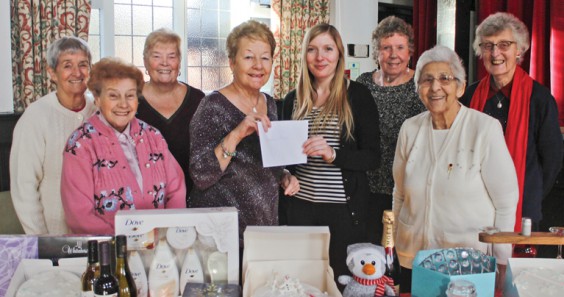
Members of the Alvechurch Knit & Natter group raised £1,300 for the Alzheimer’s Society via a raffle with prizes donated by local businesses and a Christmas craft fair at which they sold their knitted goods.
Organiser Cynthia Lawton presented a cheque to Emily Styles, regional fundraising support officer for the charity, at the raffle draw.

Village Archive: 10 years ago…
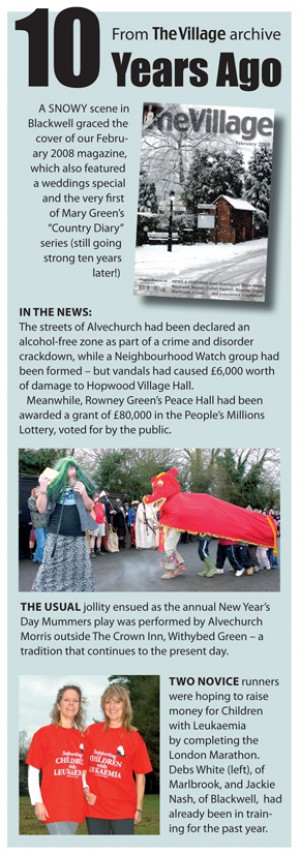
A look back at what was happening around here in February 2008.