Home Blog Page 123

Ready for village fun run

Barnt Green Chuggers running group have once again teamed up with the parish council to put on a Sport Relief 5k Fun Run, taking place on Sunday March 18.

Sport Relief this year aims to get people moving by counting their steps – the ultimate aim being for the nation to do one billion steps per day.

The Fun Run is not a timed race but a fun family event with the chance to have a go at completing a 5k walk, run or jog around the village.

The Fun Run (sponsored by Provest Wealth Management) starts at 12.30pm in Millennium Park, where there will be refreshments and medals later.

Entry fees are £2.50 for under-16s; £5 for adults, or £10 for a family (one adult plus up to three children/ two adults plus up to two children).

It’s an extra £2.50 for any additional child, and under-10s must be accompanied by an adult.

Registration for the run opens on Monday March 5 at Barnt Green Post Office (normal opening hours) and St Andrews First School (school hours). 

If you are keen to be part of the fun but are not able to do the run, you can volunteer to support the event. You do not need previous experience but you must be 16 or over. To volunteer please email Andy Scarle on .(JavaScript must be enabled to view this email address)

* The Chuggers have also launched a women’s “Up and Running” programme, perfect for beginners to jogging and running who want to get more active in the company of others.

The aim is to form a group of no more than 20 women, all new to running.

The seven-week programme of one-hour sessions begins on Sunday March 25 at 10am, starting at Barnt Green Sports Club, Margesson Drive, Barnt Green. The cost is £12.

For more information and to register, email Emma Fordham on .(JavaScript must be enabled to view this email address)

Much colder than normal

Icy lock

Alvechurch amateur weatherman Phil Thomas records the changes.

As we went to press, February had been very much colder than the 30-year mean for this area. We had a few days with snow, though not prolonged or cold enough to lie for any period – but only two nights with no ground frost.

February 2018 (to the 16th)
Mean Max 5.9C   1.2 below average
Mean Min   0.1C   1.0 below average
Mean     3.0C   1.1 below average
Rainfall     25.6mm   49% of average
Sunshine 51.2 hrs 84% of average

January was bland and slightly milder than average, without any extremes of cold or mildness.

There were a few windy periods, including gusts of 51mph on the 3rd and 52mph overnight on the 17/18th. A little snow on a few days, but none that caused any disruption.

January 2018
Mean Max 7.6C 0.9 above average
Mean Min   2.2C   1.0 above average
Mean     4.9C   0.9 above average
Rainfall   86.2mm 126% of average
Sunshine 61.4 hrs 122% of average

Outlook
Writing this on February 16th, forecasters were anticipating a fairly dramatic event in the atmosphere over the Arctic, with the possibility of a fundamental effect on our weather at the end of February and perhaps early March.

Occurring way up in the stratosphere, the event is known as a Sudden Stratospheric Warning, which causes changes to the Jet Stream flow and introduces an east or north-easterly flow of very cold air over western Europe.

However, trying to forecast with any confidence is very difficult. We could yet return to wet and windy conditions – but at least in March the days are getting longer and the sunshine is more powerful.

More information at https://www.alvechurchweather.metsite.com 
You can see an improved HD weather-cam, updated at one-minute intervals, at: https://www.alvechurchweather.metsite.com/webcam_alvechurch.php

Visual activity centre

Church and Orion

Amateur astronomer Brian Watkiss peers into the Village night sky.

March, the month we’ve all been looking forward to since Christmas. Why?

Well, for a start it’s only ten months to next Christmas, but mainly it’s the Vernal Equinox on the 20th (at 16:50 to be precise), and the clocks go forward on the 25th, which means that the Sun doesn’t set until half past seven and we can all start wearing shorts again.

Right from the start, we can see the brightest of planets, Venus, over in the west, chasing the Sun into the glow of sunset.

In fact, it sets just an hour after the Sun so you will have to be pretty quick to spot it and you will need a good view of the western horizon, although it gets better as the days go by.

Mercury is nearby too, so see if you can join the small, select band of people who have spotted this tiny planet. Your best chance is on the 4th when it is conjunction with (very close to) Venus.

Again, Mercury gets better later in the month and you simply must look on the 18th when Venus, Mercury and a very thin crescent Moon are all close together.

Speaking of the Moon, there was no full Moon in February, so we get two of them this month, on the 2nd and the 31st, although neither of them are with the Moon at perigee or looking blue.

It does do something rather special on the 22nd when it passes in front of a bright star.

Unfortunately, it happens rather late in the evening and when they are very close to the western horizon, but you’ve already found a good view of that when you were looking for Venus.

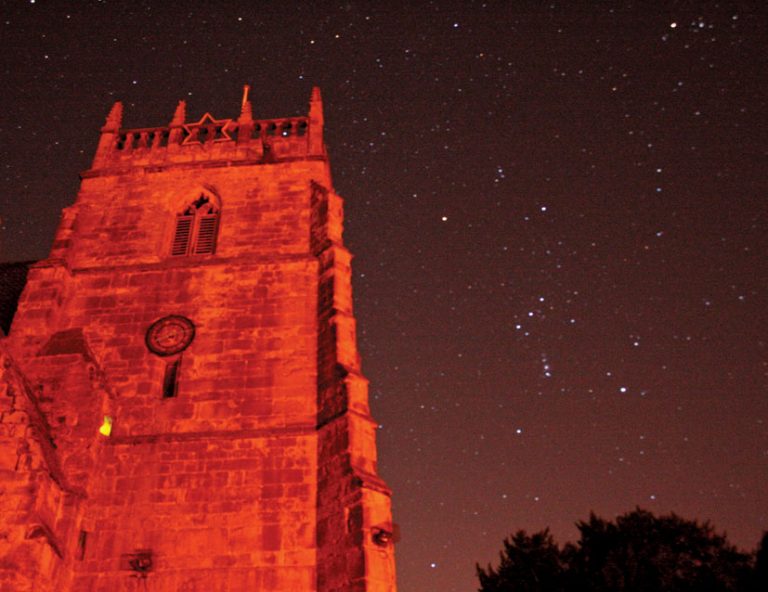
Looking out as soon as it gets dark, somewhere west of south, you can easily spot Orion. This is a huge constellation, half the height of Alvechurch’s church tower.

Up and to the right is the vee of stars that form Taurus, dominated by the bright red star, Aldebaran. This is the star that the Moon occludes on the 22nd, a little after eleven thirty when it should just pop out of sight.

The Moon is a chubby crescent so its leading edge is dark, adding to the effect.

While you’re waiting, take time to have a good look at Orion. At the top left is the red supergiant star Betelgeuse, the largest star in the sky. At the opposite corner of Orion, bottom right, is Rigel.

This is a blue supergiant, its difference in colour to Betelgeuse being quite striking. In the middle of Orion, hanging from his belt, is his sword, and the middle star of his sword is a bit indistinct.

This is because it is a little bunch of hot, bright stars that have recently formed (relatively) from the cloud of gas that surrounds them. Try using averted vision (last month) to see it.

Plenty to see then – the sky is a veritable visual activity centre!

Making a woodland

In the den

Hannah Genders suggests ways to create a wild garden area.

Looking out from my studio, there is an area to the left-hand side of my garden that I call the woodland, which makes it sound much grander than it is really.

But it is more of a wild area – when we moved into the house, there were a number of large trees including a Scots pine that had been really badly pruned and a eucalyptus which, I’m glad to say, died, as I then felt less guilty about removing it.

I wanted to keep this area more natural in choosing what was planted, and to introduce smaller trees that would fit in better with the scale of a garden.

Most of the trees were too large; they cast a lot of shade and had to be pruned every year due to some power lines running over the boundary.

We took the plunge last autumn and had most of them removed, apart from a lovely copper beech that shades my studio in the summer months and another large beech that is in good condition.

I can’t believe how much light it has let in to both my studio and the rest of the garden.

I replanted the area with smaller trees like hawthorn (Crataegus ‘Paul’s Scarlet’), which makes a lovely tree and has a double pink flower.

It does need some trimming up the trunk in the first few years to encourage it to be a tree and not a shrub, but as with a hedging hawthorn it flowers in the spring and has red berries for the birds in the autumn.

I’ve also planted a white cherry (Prunus avium plena) which has double white flowers and grows to a lovely shape – it’s a slightly larger tree but ideal for most gardens.

For underplanting I have used a mixture of hazels and Acers that give some dappled shade throughout the summer.

All the leaves from the rest of the garden and off the lawn are blown onto this area so it gets plenty of mulch.

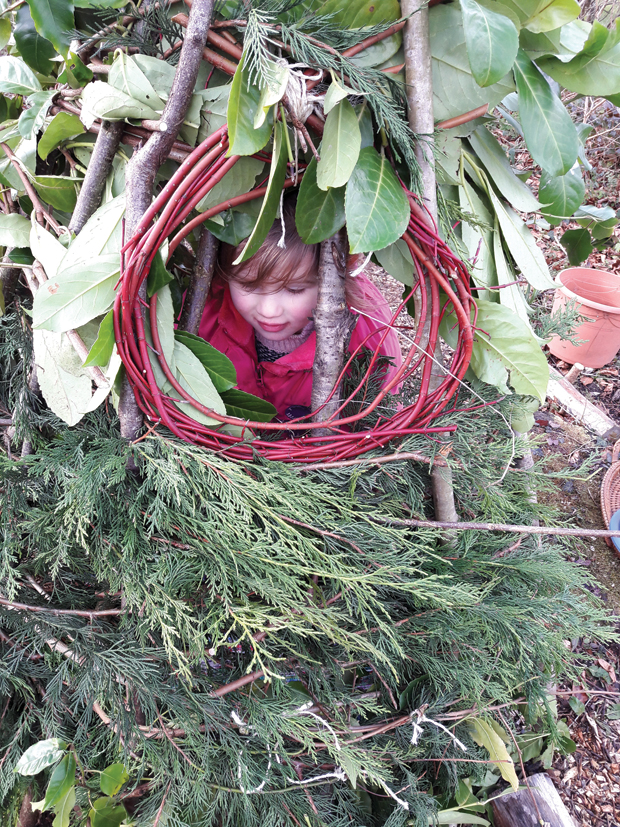
We have added a woodchip path through the planting to give more interest and allow you to walk through and enjoy it, and recently we built a den with our little granddaughter, all made from natural materials, which was great fun.

Creating an area like this in your garden can be a haven for wildlife. I’m making log piles with anything that won’t burn in the woodstove and these also become great bug hunting areas when you have kids round.

We are just planting up the area that backs on to the field with a native hedge. There are some plants already in but I’m filling the gaps to make the hedge more substantial.

I’ve gone for a mixed hedge of hawthorn, dog roses (Rosa canina) and, for autumn colour, viburnum opulus.

There is quite a lot of wild honeysuckle already in the hedge which will now take off since removal of the larger trees, but I’m adding more native honeysuckle (Lonicera periclymenum) to the hedge so that when walking along the path you will get that wonderful scent in the summer months.

The whole hedge has been planted as bare-rooted whips so it was inexpensive.

As this area is copying a native woodland structure, I want to copy the woodland flora on the floor, so I’ve added some foxgloves – and often move them from other areas of the garden where I don’t want them.

You could go for the common pink flowered one (Digitalis purpurea), but there are also lots of cultivars with flowers ranging from pure white to soft apricot or yellow, and all of them are good for bees.

Do be aware that they will revert to a pink shade when the bees do their work of pollination, but if you are just planting a small area, try one colour.

I have also put in some other semi-native plants; that is, plants that are like the ones you would find on a woodland floor but maybe have something different in the leaf or flower colour.

The arum lily (Arum italicum), which has naturalised in a lot of our woodlands now, has a marbled leaf – it can be invasive but if you are happy to let it ramble away it’s a wonderful plant in a shady setting, especially planted with bulbs.

It has other common names like “Italian Lords and Ladies”, the origin of which I understand is too rude to write in a Village article! It is also very poisonous. I’m not particularly keen on the flower or seeds but I love the leaves which give interest in the winter months.

Alongside the lily flowers I’ve planted plenty of hellebores; again, like the foxgloves, these will revert, but I’ve moved lots from other areas of the garden and I let them find their feet in this situation, which they seem to love and faithfully pop up every year through the leaves.

The bulbs I’ve planted in drifts and these are left to naturalise. The small daffodil (Narcissus cyclamineus ‘February Gold’) which, as the name suggests, comes up each February, only grows to a height of 10cm but is a great plant to herald the spring.

For autumn colour I’ve planted the ivy-leaved cyclamen (Cyclamen Hederifolium) and these are really starting to take off this year and spread. Like the Arum lily, the leaves are beautiful just on their own too.

One of my other favourite bulbs that I have seen grown in a naturalised setting is Camassia, so this autumn I’ve put in plenty of the blue-flowered one, Camassia quamash.

The flowers are formed on spikes in May and June and will sit well above most of the foliage at around 60cm – they won’t tolerate full shade but in semi-shade or sunny areas they should multiply well.

I’m really looking forward to seeing how this area develops during the year once the plants fill out and the trees get going, and of course, den-building and bug-hunting too!

The tree of balance

Alders

Mary Green continues her series on trees in the Celtic calendar.

The spring snowdrops came early in January, celandines came in February, ducks were mating on the canal and the lone barnacle goose suddenly re-appeared.

I still don’t know where this goose comes from – they are winter visitors to western Scotland and Ireland – but it comes back here for a time every winter.

Candlemas Day on February 2 (also known as Groundhog Day and Imbolc) was “fair and bright”, though cold.

According to tradition, this means “winter will have another flight”, and sure enough it did. The Alvechurch Wassail on the day after brought well-needed warmth to a cold wet night.

My tree for this month, the one that appears in the Celtic Calendar for this time of year, is the alder. It is very common around here, yet people rarely notice it or even recognise it.

But it was obviously important enough at one time to name one of the months of the year and a letter of the alphabet.

It represents the balance between male and female elements in nature, unlike the willow which was perceived as female.

Alder, or Fearn in the Celtic languages, was associated with the great hero Bran, and was said to be powerful in battle and sometimes the king of trees.

But it also had a link with water and the goddess Brigid, giving it healing and comforting “female” qualities.

In Greek, Norse and Italian traditions as well as Celtic ones it is especially associated with spring, its new green leaves marking the coming of spring proper.

These leaves were thought to have healing properties and were sometimes worn in shoes on long journeys to protect the feet.

Like willow, alder grows by and even in water. It needs wet or boggy ground and won’t survive well if it dries out. Here it grows along the canal in many places.

It can survive in wet and poor soil because it has a special relationship with specific bacteria which allow it to fix nitrogen.

Spare nitrogen and phosphorus can collect around the roots of a mature tree, and it shares these with other alder trees, helping them to grow, and also with lichen, fungi and insects, some of which are specific to the alder.

It needs plenty of light for seedlings to grow, so is a plant of open country, waterside and forest edges. It is a “pioneer tree”, taking over new ground and allowing other trees to establish later, when it dies down.

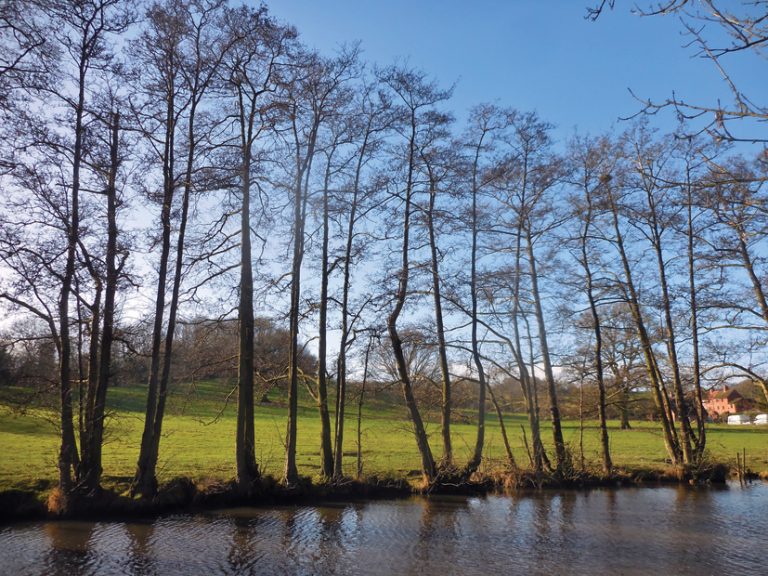
There is an interesting stretch from Withybed to Alvechurch which has alders on the field side, with ash, holly, hazel, willow and other trees on the towpath side.

The towpath side was cut along an old hedge: some of the trees probably pre-dated the canal and the hedge-bottom flowers are those of old woodland.

The side with the alders, however, would have been cut through a field and the trees came later, on to open ground. In other places they sprout out of the canalside water by the towpath, from where they are often trimmed to stop them growing into trees. You can also find alders along the river Arrow and by Bittell reservoirs.

Alders, because of their habits, are very water-resistant. So, the wood used to be used for canal piling, wharves and bridges. The world-famous Rialto Bridge in Venice is built on huge alder piles.

Early boats were often made from alder wood. Where an alder has been cut along the canal, you can easily spot it.

The wood is white when first cut but soon turns orange when exposed to the air. This added to the magic of the tree, which was thought to bleed like human beings.

Two key uses for alder were for making clogs and gunpowder. They are perfect for clogs which will be worn to walk through wet and mud. I can remember wearing trendy clogs in the 1970s and wonder if they were alder wood.

It was the charcoal from alder that was used for gunpowder, and the trees were often grown near gunpowder factories – I guess this might have been the case in Birmingham.

This is especially apt as the ancient Celts used alder charcoal to forge metal for their weapons for hunting.

The wood was also popular for brush handles and other tools. So, it was one of the trees encouraged in the outer parts of the many woodlands planted round here in the past by the Harris brush company, such as Shortwood.

It is relatively quick growing but more robust than willow, so it lives a bit longer. However, alders don’t grow to real old age like oaks and beeches.

Alder is a catkin-bearing tree like hazel and birch. It has far more prominent female flowers, though. These are like small green pine-cones, turning brown later in the year as they ripen.

The dangling male catkins are a bit like hazel but a lovely reddish-purple colour. As these become covered with pollen, the female cones open their scales and receive the wind-blown pollen. There are no insects involved.

Having prominent male and female flowers on the same tree may be one reason for the mythological status of this tree as balancing male and female.

Alder was a dye-plant. The female flowers were used to make green dye, associated with the fairies, foresters and outlaws! The bark makes a red dye, possibly used anciently as a face paint, and the twigs brown.

Alders are attractively-shaped trees, quite tall, with dark green rather leathery leaves. They are particularly good to see in the late winter and early spring when they glow red with catkins: the bare trees have lovely shapes.

The roots are often partly exposed by subsidence in the banks and they help to hold the banks together. Geese love to nest among these roots: a pair of Canada geese returns to nest under an alder in Withybed every year.

One of the other Celtic trees, not representing a month, is the aspen, related to the black poplar and white poplar. Aspen is more common in cooler places and grows well in the uplands and in Scotland and Ireland.

All the poplars are catkin-bearing trees and like damp or wet ground, like the alder and willow.

The aspen differs from the other poplars by having male and female catkins on the same tree, like alder. This makes it more successful at spreading by seed. It is also a great sucker-producer and colonises large stretches of land this way.

The defining characteristic of the aspen is the way the leaves shake in the wind. They are delicate leaves on very fine stalks, and the least breeze sets them off chattering and rustling.

I wrote about black poplar a few years ago when our mighty tree fell in The Meadows here in Alvechurch. There are still some there and elsewhere round here, though getting rarer each year.

White poplars (also known as abeles) are very similar in tree-shape and leaf-shape, but the back of the leaf has a distinctive fine white down, so as the wind blows the tree looks silvery-white. The trunk has diamond-shaped dark marks on its light-coloured bark.

There are some lovely ones around Tardebigge, and a line planted alongside the footpath south of Foxhill near Alvechurch.

You will also see Lombardy poplars around here. These are the tall narrow ones, not native but often planted distinctively on ridge-lines and to mark boundaries.

We are lucky around here to have sufficient wet areas to host all these water-loving trees, with the two-hundred-year-old canal greatly enhancing this as farm land has been drained.

I wrote this poem in March a couple of years ago.

St Patrick’s Day
Sun breaks open the blackthorn blossoms
Fragile stars on these cold nights
But thick and close now like fur
Warming the branches, unquenchable.
Then marsh marigold, bold by the water
And white violets, half-hidden, downcast
I have to taste one, that forbidden perfume
Of Parma violet, sweetening the mouth.
Hawthorn shines bright green, green as your hat
On Paddy’s day, and the blackbird
Sings an air of love and longing for home.

Verge parking plea

Damage caused by vehicles parking on grass verges was discussed by Lickey & Blackwell parish councillors after a resident asked them to discourage the practice via their newsletter.

Yellow lines plan for station

Double yellow lines are likely to be painted at the junction of Station Road and Latimer Road as parking problems around Alvechurch railway stations spill into the streets.

The “no-waiting at any time” plans have been proposed by Worcestershire county highways and sparked a fiery debate at the monthly parish council meeting.

A resident from further down Station Road objected strongly on the grounds that it would cause “chaos” outside his house, while a villager living in the current problem spot welcomed the plan because parked cars were making it very dangerous to get in and out of his drive.

Coun John Cypher said it was foreseen in 2013 that improvements to rail timetables would bring more cars, adding: “We need to open up a serious discussion about the problem.

“Who knows how many people from the new Weights Lane development think there’s a free car park here in Alvechurch and they will be using it?”

The council agreed there was general support for the yellow lines, but the consequences further down the roads should be considered.

Hopwood homes objection

An application to build up to 21 new homes on a Green Belt field at Hopwood has been shown the red light in a lengthy objection by Alvechurch Parish Council.

The plan for the site behind Smedley Crooke Place, with access from the main roundabout, is similar to one for the same site in 2013 which was turned down.

Members of Alvechurch parish planning committee agreed unanimously to object on the grounds that it is a Green Belt site and there are no very special circumstances to outweigh this protection.

Hannah’s Everest trek

Hannah and kids

A former Alvechurch Middle School pupil will add to her fundraising for a school in South Africa by trekking to Everest Base Camp.

Hannah Peters, aged 24, first volunteered at Amasango Career School two years ago and has since returned for a two-month stint, as well as helping to raise the profile of the school through the charity Friends of Amasango UK.

She also recently become the charity’s treasurer, in between working full time and studying for her accounting chartership.

Hannah is no stranger to travelling, having spent two weeks exploring Sudan over Christmas – putting her total number of countries visited to 46. The journey to Everest Base Camp will involve a 13-day trek, climbing 5,400m above sea level, starting on March 1.

“It will be worth the struggle as any money raised will be directly helping the children at Amasango gain an education, which many of us take for granted,” says Hannah.

“I was very fortunate to go to great schools in Alvechurch and Bromsgrove, so now it is my time to give something back!”

Amasango Career School is in a township on the Eastern Cape, with more than 70 per cent unemployment.

Friends of Amasango UK currently supports pupils by providing two hot meals a day, school uniform and additional learning equipment, and is hoping to raise money to build a new school in the future.

For more information or to make a donation, visit https://www.mydonate.bt.com/fundraisers/hannahppeters

Ready for ISA and pensions season

ADVERTISEMENT FEATURE

Investors should start to turn their focus to the end of the tax year on April 5, writes Martin Pryor.

ISA contributions have historically always been focused on the end of the tax year. This is the case even though it would make more sense to invest at the start of the tax year, to maximise the period of tax shelter.

This time of year, the personal finance pages start to fill with stories about ISAs, often including tales of ISA millionaires. For all the coverage, these remain a rare breed, but they serve as a reminder that regular saving over a long term can create meaningful amounts of capital.

The past couple of years have seen total ISA contributions falling primarily due to a sharp drop in the popularity of cash ISAs. These have seen contributions fall by over a third between 2014/15 and 2016/17 for two good reasons:

* Ultra-low interest rates and limited competition between banks have made prospective returns look miserable, particularly as inflation has picked up; and

* The introduction of the personal savings allowance in 2016/17 has meant many depositors no longer need an ISA to escape tax on their deposit interest.

Stocks and shares ISA contributions have reached a new high, probably helped by some ISA investors abandoning the cash version. This tax year there are a few points to remember when making your stocks and shares ISA investment:

* The contribution limit (in total to all ISAs) is now £20,000, up from £15,240 in 2016/17. It will be held at £20,000 in 2018/19.

* Dividends within an ISA are free of UK tax. With the dividend allowance falling from £5,000 in 2017/18 to £2,000 in 2018/19, you may find you have to pay tax on shares held outside of an ISA.

* It is important to get your money into an ISA shelter. Whilst your annual limit can’t be carried forward to the next year, you do not have to invest it all in funds by 5 April – once you hold cash in your ISA you can drip feed investment into funds, if you wish.

March is also a popular time for reviewing and making pension contributions. By this stage you should have a good idea of what your income for the tax year will be and how much you may be able to contribute as a one-off payment before 6 April arrives.

In this tax year, there are several changes to note:

* Thursday 5 April will be the last day on which you can make a contribution to mop up any unused annual allowance from 2014/15. To do so you will need to first use up your annual allowance for the current tax year.

* The money purchase annual allowance was reduced from £10,000 to £4,000 at the start of this tax year, although the legislation achieving this did not arrive until November.

If you have used the new pensions flexibility to draw benefits this may limit the amount you can contribute.

* From 6 April 2018, the lifetime allowance rises by 3% to £1,030,000. At the margin that modest increase may permit more benefits to be taken without triggering tax charges.

* From 6 April 2018, automatic enrolment contribution levels increase, with the total of employee and employer payments rising by about 150%.  There will be another increase of around 60% the following year.

If you want to maximise contributions into either your ISA or Pension before the April deadline, contact us as soon as possible. The calculations involved can be complex and miscalculations can lead to lost tax relief.

* Contact Pryor Portfolio for more information and advice:
Tel: 07961 162818
.(JavaScript must be enabled to view this email address)
https://www.ppm-ifa.co.uk

The value of your investment can go down as well as up and you may not get back the full amount you invested. Past performance is not a reliable indicator of future performance.

Investing in shares should be regarded as a long-term investment and should fit in with your overall attitude to risk and financial circumstances.

The value of tax reliefs depends on your individual circumstances. Tax laws can change. The Financial Conduct Authority does not regulate tax advice.