In our occasional recipe series, keen baker Jen Morris, of Rowney Green, creates a fruity cake to bring back memories.
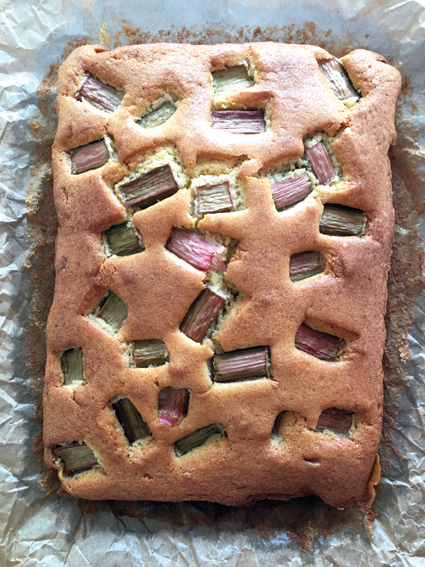
One of my lovely neighbours has a glut of rhubarb and I am a delighted recipient. There’s nothing wrong with a rhubarb crumble or pie, and they are brilliant for using lots of fruit. But if you’re in the mood for a cake, then this is a classic rhubarb and custard combination, reminiscent of childhood sweets.
Ingredients:
250g unsalted, softened butter
250g golden caster sugar
4 large eggs
250g self-raising flour
¼ tsp bicarbonate of soda
¼ tsp salt
1 tsp vanilla extract
75g ready-made, thick custard
300g rhubarb, half chopped into small pieces, half chopped into 3cm lengths
1) Heat your oven to 180C / 160C fan / Gas 4, and line a 20×30 cm cake tin.
2) In a large bowl, mix the butter and sugar using an electric hand mixer, until pale and fluffy.
3) One at a time, beat in the eggs, with a spoon of the flour added with each one.
4) Fold in the remainder of the flour, bicarbonate of soda and the salt. Then fold in the vanilla extract, custard and the rhubarb chopped into small pieces.
5) Pour the mixture into the tin and bake in the preheated oven for 25 mins.
6) Remove from the oven and scatter the larger rhubarb over the top. Return to the oven and bake for 40 mins, until golden and springy to the touch.
7) Leave in the tin for 10 mins, before transferring to a wire rack. Serve with custard or cream.
The 58th Bromsgrove Festival will once again bring a wide-ranging programme of arts and cultural activity to the area, with extra emphasis this year on free community events.
During the four-week Festival period, there is an arts or cultural event happening virtually every day at venues right across the Bromsgrove district. These include theatre productions (indoor and outdoor), opera, folk and blues concerts, plus classical orchestral and choral performances.
There are also dance events, art exhibitions, comedy and the spoken word. Many of these events are designed for children and younger people, with participation encouraged.
The programme kicks off on the evening of Thursday June 21 with Jazz Sirens – a high-profile concert at Artrix featuring one of Britain’s finest jazz singers, Jacqui Dankworth (the daughter of Johnny Dankworth and Cleo Lane) and her band – and ends with the final MusicFest gala concert on Sunday July 22, given by the Orchestra of St John.
As last year, there will be a range of free community events on Saturdays on Bromsgrove High Street and New Road in Rubery.
The Festival is grateful for financial support from Bromsgrove District Council for these events, which also include a Day of Dance, Family Fun on the High Street and a Fusion event on Saturday July 21, plus a Summer Jam and skateboarding competition in Rubery Park on the afternoon of Saturday June 23.
Further free events include the EnjoyRubery programme, expanded to a full weekend from Friday June 22 to Sunday June 24, and more Free Bite Sized Classics concerts in Catshill and Rubery.
The Trustees hope that this will encourage greater participation in Festival activities.
For the full programme and details of tickets, visit https://www.bromsgrovefestival.co.uk, or pick up a free programme brochures at Bromsgrove Library, community centres, and many churches and shops.
Amateur astronomer Brian Watkiss peers into the Village night sky.
June, and we are well into the Formula 1 racing season – and there’s also a bit of a race going on in our Solar System.
We have Mercury racing ahead as ever, with Saturn leading the rest of the pack. Then Mars – but the Earth is gaining rapidly, having just overtaken Jupiter.
Finally, Venus is on fresh tyres and rapidly reducing the lead we have. Uranus, Neptune and Pluto are, as ever, plodding around the circuit as lap markers.
What does all this mean as regards what we can see in the night sky? Well, basically, anything that is in front of us is a morning object and anything behind is an evening object.
As we overtake a planet, it can be seen all night. We never overtake Mercury or Venus.
So, starting with Saturn, it rises early, just before midnight, and can be seen till the Sun obliterates it at about four in the morning.
Mars pops up about an hour later, both being low in the south-eastern sky. This is also where Jupiter appears but as we have just passed it on the home straight, it rises a little before sunset and is in the sky all night.
As for that sneaky Venus, it too appears as the Sun goes down but in the south-west, and is visible until it sets a couple of hours later.
Mercury starts to lap Venus towards the end of the month and can just about be seen between Venus and the Sun during the last half of June.
The Moon appears to rather crazily travel against the flow, passing each planet in turn. So, on the 16th it is just to the left of Venus. At this time it is a very thin crescent as it is just three days old.
Now, for simple-minded folk who might think “Three days old? I’m sure I saw it last week!”, I must point out that this just means it is three days since the new moon – which itself just means when the Moon is between the Earth and the Sun.
Then on the 23rd, it is above Jupiter, which is sitting next to the brightest star in Libra and my favourite, Zuben Elgenubi.
Incidentally, the most famous feature on Jupiter’s disc, the Great Red Spot, appears to be shrinking. It is, in fact, a giant storm in the planet’s turbulent atmosphere and has been around for hundreds of years but may only last a few more.
It is visible with a good telescope, or look for some great pictures of it from the newly-arrived Juno spacecraft.
Finally, the Moon visits Saturn on the 27th, the day we overtake it – and as the Moon is full on the next day, Saturn will be almost lost in the glare.
There are a lot of launches due this month including from India, China and Japan. The ones of interest to us are the Soyuz launch on the 6th and especially the SpaceX Dragon on the 28th.
Look for them on https://www.heavens-above.com to see if they become visible here in Alvechurch.
Philip Aubury, organiser of Alvechurch Open Gardens, offers advice on getting your garden ready for summer.
Well, it was a long hard winter and at Easter we were at least two weeks behind normal – but as the sun came out in May, Mother Nature began to catch up.
By the start of June we should be past the risk of any late frost, so you can safely plant out all those tender bedding plants and lots of young vegetables.
So often there are tender bedding plants on sale in April, which is great if you want to plant up tubs and baskets and you have a porch, conservatory or cold greenhouse to protect them from frost.
It can be very tempting to plant out too soon, only to see your time and money wiped out.
Tubs and baskets will require watering, feeding and dead-heading throughout the summer, but they can be very colourful so make sure they are in the most prominent positions. It is worth noting a few important points to get the best from your containers.
For tubs and troughs, do ensure there are good drainage holes in the bottom. Some containers for use in conservatories don’t have holes and if used outside, your plants can drown.
Traditionally the holes in the bottom have been covered in “crocks” but few people now have broken clay pots, so break up some polystyrene packaging to cover the bottom.
Use a good-quality all-purpose potting compost. For permanent plants like bay trees or shrubs I use John Innes, but for bedding plants this can be too heavy.
I always mix some slow release fertiliser into the compost as this reduces the need for liquid feeding in the summer. Don’t just use garden soil as you will be very disappointed with the results.
There is a very wide range of summer bedding plants to choose from these days, but do select strong healthy plants. Avoid lanky, pale or wilted ones. Water and allow to drain before planting.
Choose a range of plants – perhaps a tall one placed centrally if the tub will be seen from all sides but towards the back if it is going to be against a wall.
Surround this with smaller plants but leave space for some trailing plants at the edge. Do be careful to ensure the spaces between the roots are well filled with no air spaces and the finished level is an inch or so below the rim to allow for watering.
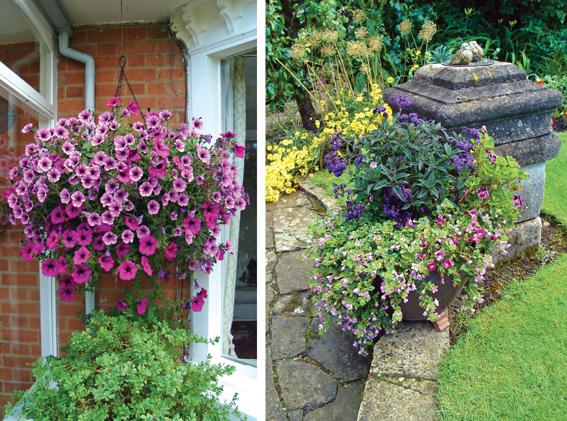
Colour schemes are a matter of personal taste. The hanging basket pictured above uses two closely-matched petunias, while in the mixed tub the beautifully-scented heliotrope takes centre stage.
Note the feet under the tub to make sure it drains well. Don’t forget that there are automatic irrigation systems which can save you hours with a hose or watering can. The baskets on the outside of Alvechurch Village Hall have just such a system.
Keen gardeners often spend far too long working in their gardens. OK, it is great exercise and saves on the gym subscription, plus it is very good for mental wellbeing. However, we all need to take time out to sit and enjoy our gardens.
There are two things that can make gardening so much easier. Stainless steel tools have been around for many years, but the newer aids are the modern lithium ion rechargeable power tools.
I’ve had my stainless steel trowel since I was a teenager, and my spade was a 21st birthday present. Although a little worn after fifty years it is still going strong. I’m always amazed when I see gardeners struggling with old rusty tools.
Still on stainless steel tools, a good hoe can save you hours. They are self-sharpening and if run over the soil just as weed seeds are germinating, you don’t have to clear up the weeds as they will dry up very quickly.
The development of tools with rechargeable batteries can save you loads of time and effort. No smelly and noisy petrol engines, no more extension cables with the risks they can pose.
There are rechargeable hedge trimmers, strimmers, mowers and now even sprayers and fertiliser spreaders – but the pièce de résistance has to be the automatic mower.
I first saw one of these many years ago in Scandinavia. It was programmed to come out each evening and wander round the lawn before retuning to its ”cabin” where it plugged itself in to recharge!
A guide wire buried under the edge of the lawn ensures that it does not stray into your borders. These are now readily available in the UK.
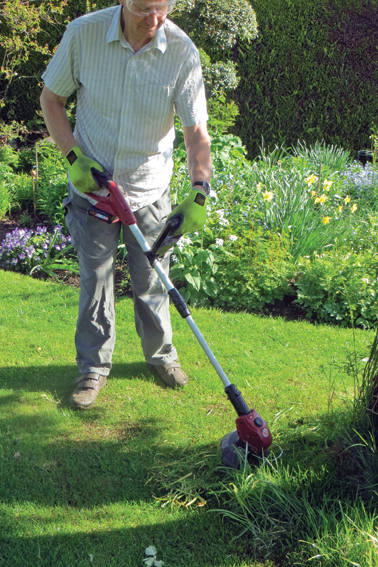
The strimmer pictured right has a wire guard to protect trees from having their bark shredded at ground level and the small hand trimmer is great for shaping bushes.
Enjoy your garden this summer.
Visit Alvechurch gardens
Alvechurch Open Gardens takes place on Saturday June 23 and Sunday June 24. This year many of the regular gardens are opening again for the National Gardens Scheme, from 1pm to 6pm on both days.
New this year are 18 Bear Hill; 69 Birmingham Road, and The Moat House (pictured above) in Radford Road. Also, although not listed in the NGS book, The Shrubbery in Bear Hill will again be joining in.
Over the past year their new house, Wychwood House, has been built in the garden. Some trees have already been planted here and a wild flower meadow sown.
Philip Aubury, M. Hort., retired director of Birmingham Botanical Gardens.
Mary Green continues her series on trees in the Celtic calendar.
What an odd year we’ve been having. Late April brought sudden warmth and sun, and plants grew and bloomed faster than I’ve ever seen them.
I walked the canal every day and saw cow parsley and garlic mustard grow from small rosettes of leaves to flowering plants in a few days.
The insects followed – the orange tip butterflies that feed on garlic mustard; the brimstones, a pale yellow that gave us the name of butterfly.
Then ducklings suddenly appeared and a moorhen’s nest with eggs came nearby. The local swans have a successful brood.
The natural world is very clever at timings. Great-tits and blue-tits can adjust the way they brood their eggs to delay or speed up hatching, so they catch the right weather and therefore the coming of the right insects.
Tree blossom – plum, damson, blackthorn, cherry – all came out in one week. I said last month that the hawthorn would bloom very late this year. It was still late, because it soon went cold again!
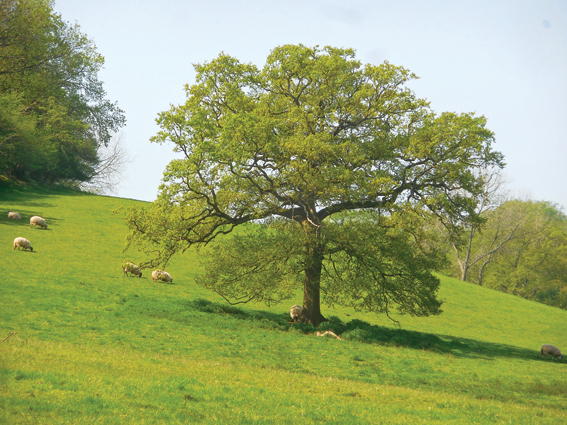
My tree for June, the oak, was rather late coming into leaf this year. It is very much influenced by warmth so was delayed by the cold. It’s hard to know where to start with the oak.
It’s such an iconic tree of the English countryside, especially here in the Midlands.
It’s a symbol of England, associated with St George’s Day, with the ships of the Royal Navy, with Charles the Second hiding up an oak tree – even the symbol of the National Trust and many long-distance footpaths is an acorn.
The oak figured importantly in other cultures too – it was a sacred tree in ancient Greece and in Norse myths, and there are examples collected from all over the world.
The seminal book on folklore, Fraser’s The Golden Bough, is mostly about the oak and its accompanying mistletoe. This book was one of the first to show the relatedness of myth and religion in all cultures.
The oak is so often the king of the trees, being the strongest and longest-lived, that it inevitably gets associated with gods. It’s a very male tree mythologically but the rounded form often looks female, ironically.
In our pagan traditions the oak is associated with the very spirit of nature, the Green Man, who is usually shown with a garland of oak leaves.
Oddly enough, the traditional link with mistletoe is a bit of a false trail, as it rarely hosts this parasite which grows more readily on apple or lime.
But it does host a lot of other things, being an ecosystem all on its own with thousands of species of beetles, moths and other insects, fungi, birds and mammals depending on it.
Oaks can live to over a thousand years old. They are very slow growing, not producing any fruit for at least twenty years of their lives. They can grow to enormous sizes.
You can estimate their age by linking arms around a tree. For each person, count 100 years.
There are several in Alvechurch at least 500 years old. One stands at the back of the Meadows, a bit butchered by unsympathetic cutting but going strong still.
One is on the old Salt Way by Scarfield Dingle aqueduct. This one shows marks of being burnt, but is a beautiful shape and structure. The famous Calling Oak at Rowney Green is accompanied by others round the boundary of the old Alvechurch Park.
Oaks are often boundary markers and there are several around the Parish Bounds in Alvechurch. When I lived in Leeds there was a county boundary oak which gave its name to two pubs, the Original Oak and the oddly-named Skyrack.
This name came from an Anglo-Saxon phrase Scir Ac, meaning Shire Oak.
The shape of an oak is very characteristic. It doesn’t have many straight lines. It’s curvy and rounded, growing in a fractal shape – in other words, each small part of the tree is a similar shape to the whole tree (a bit like a cauliflower).
Many older ones have lost branches over the years, so this shape is rarely perfect.
Being so huge, they have to have enormous roots. These stretch for yards all around the tree and are crucial to its health, being linked in to fungi and other micro-organisms.
Unfortunately, people sometimes damage these outlying areas even when trying to protect an old oak.
Oak wood is hard and highly prized. It was used for building, especially for ships, and the wood lasts for centuries.
The bark was once used for tannin in leather treatment, and also to make ink, and it’s probable that Shakespeare wrote in oak ink. It’s amazing to think that the trees he used may still be here!
Oaks, of course, grow from little acorns. These start as catkin flowers, beautiful golden tassels coming soon after the leaves in May.
They ripen into acorns for the autumn, providing food for birds, squirrels and mice among others, which all help to spread the acorns away from the tree too, especially the squirrels who bury them and then forget!
Oaks are very clever. In some years, they all locally produce masses of acorns. There are so many that even if the squirrels and jays take a lot away there will still be plenty left to grow. Then they will all rest for a year.
There is clear evidence that trees can communicate with each other in the behaviour of oak trees.
People are often misled by other apparent fruits on an oak. These are called oak apples or oak galls, and are round cases of a gall wasp which feeds on the oak.
The oak lives in a fine balance, with insects living in it which sometimes cause it harm but at other times simply provide food for the other species that depend on it.
One of the insects currently damaging trees in the south-east is the oak processionary moth. As with ash dieback, this came in from abroad with imported trees.
Most native insects can live sympathetically with trees – they don’t really want to destroy them so will only cause marginal damage. I wish we could learn not to bring in plants, but to concentrate more on raising and replanting our own.
Some oaks are so old and hollow that you can crawl inside, and there are old photos of people having picnics in them. There are famous individual trees, as well as extensive woodlands with oaks as their base.
They have also survived well in hedgerows, even horribly flailed ones where people tend to leave oaks alone, and many lanes around here have them every few yards.
They grow along the canal too, often predating it so you know the cut was made along an old hedge or wood. There are lovely knobbly ones along the stretch between Alvechurch and Scarfield.
Oaks don’t only grow in these soft regions, but sometimes on uplands too. There is a wonderful ancient oak wood called Wistman’s Wood on Dartmoor, with small stunted gnarled old oaks, covered with moss and ferns.
It’s very magical and worth a visit if you’re down that way. People love oaks for their strength and beauty and their amazing age.
Right: Here’s a poem I wrote last year, based on the ten-year anniversary of the Withybed Poets.
In our tenth year
My first ten years I learnt through school and farm.
I hated school: pets and injustices,
Though I was good at it. I loved the farm
The smell of cowshit on your hands, hedges
Strewn with primroses or rising above snow
Swallowful barns and the sea’s soft lullaby.
The next ten I loved school and university
Friends, books, poetry, music, love, and beer
I learnt about injustice too, violence and want,
How to carve out my views against the grain.
I wrote and marched and sang, as all around
The world released itself from some old chains.
My twenties saw me change: marriage and work
Moving and setting up an adult life
I fell by chance into a job I loved
Discovered Scotland and the lovely wild
Cut my hair then let it grow again
Walked with the young and tried to set them free.
The next ten brought strange fractures. I felt bound
To march again and stand up for my views
Walking to Greenham, meeting miners’ wives
And working my way up to have some power
Trying to change things. But a failure of love,
Breaking apart and moving, moving again.
Forties were good. I found new loves and came
To live in Withybed, my own true home
My work expanded in my native city
I loved the dirty streets and clean houses
The students learning to transform their lives
I travelled, found a new place in the world
Fifties began with flying a small plane
Riding an air balloon and motor bikes
Moved on to challenges at work, the hard
Strain of people who resisted change
Or wanted their own glory, trying to hold
The line of common good and make things whole.
At sixty, I retired. I found my home
Had birds and flowers and trees and families
Which had been close around me all the years
Warming and freeing and challenging me
And now accepting me into new life
Friends, plum-blossom, music, love, and poetry.
Sarah Rees reports from the Oakalls and Parklands.
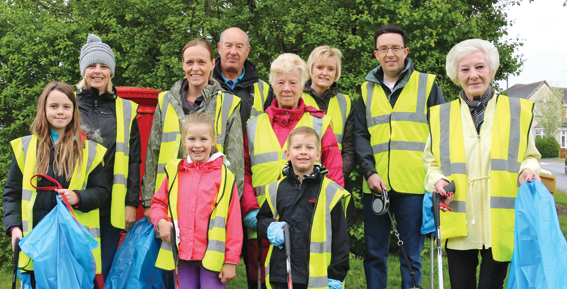
There was a much better turnout than in previous years for the annual Oakalls litter pick, with ten residents and two dogs joining district councillor Caroline Spencer for the “Great British Spring Clean”.
While it was agreed there was less litter than last year, a particular blackspot was identified along the footpath from Samsara Road on to Penshurst Road.
Litter pickers were also astounded to find a dumped carrier bag full of cereal bowls and an abandoned satellite dish!
A large number of black doggy bags were also discovered thrown into bushes, despite the fact there are plenty of special bins across the estate, emptied on a weekly basis.
SPEED CHECK
Following concerns voiced by several residents over recent months, the local policing team carried out a speed check on May 10.
They were positioned with cameras on the corner of Royal Worcester Crescent and Regents Park Road. The result of this speed check should be available next month.
FUN ON THE CANAL
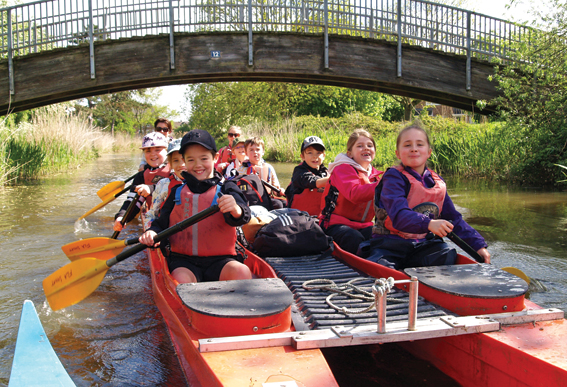
Year 4 children from Finstall First School enjoyed an extra-curricular fun day in the sun when they took part in a Bell Boat journey on the canal from Droitwich to Worcester.
The aim was to help the young students build confidence and develop new skills as they learned basic paddling techniques and were fascinated to discover how canal locks work. They also gained an understanding of the history of British canals.
Matthew Mason, deputy head, said: “Children particularly enjoy activities which take them beyond the boundaries of the school.
“We were fortunate to have a warm, sunny day for the trip and everyone benefited from the wonderful experience.”
Emily Tennant, aged nine, said: “I enjoyed learning new skills such as how to hold a paddle. My favourite bit was going through the locks and watching the water level drop down around us.”
Six-year-old Samuel Westwood-Tams, of Cofton Hackett, was the latest winner of a Mini Vinny in our monthly competition.
If you want to win one for yourself, you’ll need to try to locate the little hedgehog hiding somewhere in your June magazine.
Just tell us where he’s hiding via phone, email or post – please include your contact details, especially if leaving a voicemail message – and we’ll draw a winner at random.
The closing date is midnight on the 18th of every month. We’ll let you know if you’ve won and you can collect your Mini Vinny from our office – and pose for a photo with your prize!
An Oakalls youngster represented Great Britain in archery in her first international competition.
Nicole Burdett, aged 16 and a pupil at South Bromsgrove High School, has been a keen archer since taking part in a “have a go” session at Alvechurch Middle School in 2012.
After achieving her selection shoot scores and competing at the first selection shoot of the year, Nicole was selected to represent her country at the European Youth Cup in Rovereto, Italy.
With a score of 581 out of 720 in qualification, Nicole was up against a Russian athlete in the head-to-head, and was beaten in a close match.
She thoroughly enjoyed the experience and says it has given her an appetite for more international competitions.
Nicole shoots for Bowflights Archery Club in Longbridge, as well as attending the Archery GB National Age Group Academy.






 FUN ON THE CANAL