
The article “Rail history for sale” (The Village, February 2006) is like the curate’s egg – good in parts.
In the 1930s, I and my family often travelled to Worcester and back via the Lickey Incline. During the War I visited friends in Blackwell and both had houses adjoining the station, one each side of station road, so I have personal experience!
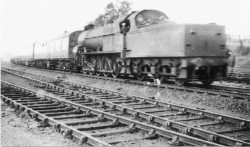
It was not just the incline that brought people to watch, but a really huge banker, Big Bertha, famous all over the country for both size and power.
There was no change of engines. Your train stopped at the bottom of the incline at Bromsgrove and a banker came up behind it.
The slight bump as it touched the last carriage – normally the guard’s van – coincided with the train’s own engine starting, and up you went.
On very long, heavy trains, usually two ordinary bankers were used: one behind the other to push the train up the incline. Big Bertha normally did it alone.
At Blackwell (a passenger station then much used by commuters to Birmingham) it stopped to allow passengers to get on or off, then continued to Birmingham.
The bankers then moved via the points to the loop line taking them back to the bottom of the incline, Bromsgrove, ready to change lines and push the next train up.
The long drive at the side of Blackwell station led to what was once the convalescent hospital for patients from Birmingham hospitals who needed time to recover, but not nursing care.
Their visitors came by train; no regular bus service in the area then.
In wartime, wounded soldiers were sent there, via hospital trains, to recover, too.
Goods trains, which also needed bankers, stopped to deliver coal and possibly other goods to a coal merchant who also handled hay, corn and wine. He had a yard right against the rail lines.
In wartime, tremendously long heavy ammunication of weapons trains needed extra help as even Big Bertha could not always manage alone. So in addition to the bankers which pushed, one might be linked in front of the train’s own engine.
To allow this one to return on the loop line, the train had to stop just before the points, then the front banker left, the train moved on again and the other bankers peeled off as usual.
Whether the loop line still exists, I don’t know. It may have gone the same way as the cattle sidings at Barnt Green when the markets finished.
But if, as the article says, Saltley sends 66 locomotives for heavy trains, presumably it may? Or would they send one engine to Bromsgrove to push the train up and then follow it back to Birmingham?
V Greaves
Barnt Green
Do you remember Big Bertha or, better still, have any memorabilia related to her? Read more here.
Pictured: Big Bertha at work on the Lickey Incline – snapped by Geoff Chandler in the summer of 1955.
