
This is the time of year when all the trees and hedges are in full bloom and the pastures are at their most productive.
Grass abounds and we need to make the most of this crop and “harvest” as much as we can for our winter feed store for the cows.
The saying “make hay while the sun shines” is as true for farmers today as it always has been. Even though we make silage (fermented, preserved moist grass) rather than hay (preserved dried grass) nowadays, good silage can still only be made in dry, warm weather – a whole winter’s feed can be ruined by wet weather at silage time.
The cows yield plenty of milk when at spring pasture, the grasses and herbs being very high in energy, protein and nutrient value.
Rabbits, pheasant and song birds can be seen and heard all over the farm in June, along with a plethora of wild flowers in the hedgerows. A pair of ducks are resident on a small pond by the farm buildings this year, and it never ceases to amaze me how they manage to take off from the water over such a short distance, being quite heavy birds.
Calving is continuing apace here at Groveley, with up to ten cows a week giving birth. Come July there will be no more calves born until the beginning of September when hopefully the busy harvest period will have finished.
By my next report we will know how the harvest has gone and how the wildlife has fared over the summer.
Mark farms at Groveley Farm, Hopwood, home of Grovewood Farm Dairy, which delivers milk direct to homes in this area.
Tel: 0121 445 6670.
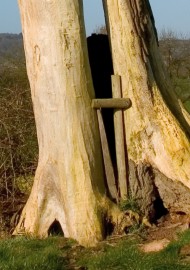
* Readers who looked closely at the cover picture on last month’s issue of The Village – of a dead ash tree at Groveley Farm (right) – may have wondered what the wooden frame was for at the bottom of the trunk.
The answer is that is was nailed in place after an unfortunate and inquisitive cow stuck her head into the hollow trunk and got stuck.
It took more than an hour to free her as three men pulled from behind while Mark Elliott attempted to calm the frightened animal and ease her head free.
