
Mary Green watches nature begin to wake up.
January was exceptionally mild this year, but February started cold. Candlemas day was ice-cold, bright and sunny. As I write, it is beautifully sunny and warm, but with night frosts.
Plants have not come into flower especially early: this may be due to the cold spell before Christmas or even last year’s odd summer. The cherry-plum and blackthorn blossom are a week or so behind last year, but should be spectacularly white over the hedges now.
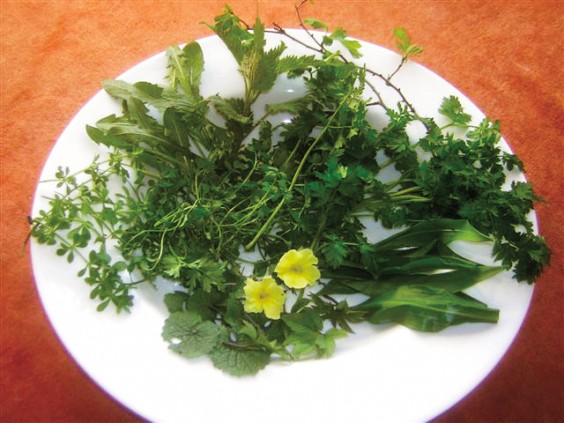
The banks and fields are rapidly greening, and the extra light makes it feel like spring. One of the pleasures of this time of year is the new growth of edible plants in the hedgerows.
While the local vegetables in the shops are still wintry, there is wild bounty. The new leaves of hawthorn were traditionally eaten, especially by children, to the extent that they were commonly called “bread and cheese”.
Cow parsley leaves have been coming up since January, and are delicious, tasting not surprisingly like parsley. Of course, you should be careful and only pick if you are sure what they are: in this case a few other members of the parsley family are poisonous.
Knowing plants, though, is often a matter of knowing when and where they grow. We all know cow parsley as the frothy white plant that will fill our hedges in April and May, so recognising its habitat will help recognise the earlier leaves.
In my spring salad I would also have leaves of jack-by-the hedge or garlic mustard. Many of you will know this as a garden weed, with its soft, rounded, toothed leaves that smell of garlic when crushed, and tiny white flowers later. Real wild garlic leaves are around in March, too.
You will find it in wooded patches, especially along the river Arrow. When it flowers in April, it can make a whole wood smell of garlic, but the leaves are quite mild and delicious raw or cooked.
You may also find the young leaves of sorrel, sharp and refreshing. And of course stinging nettles are perfect at this time of year, though not in a salad! Cooked, they are like spinach and make a lovely soup.
Nettles are a much maligned plant. Not only can you feast off them in spring, but they provide food for many of our favourite butterflies.
Other common weeds such as dandelion, bittercress (which tastes like rocket), goosegrass and even ground elder are delicious too.
This greenery was welcome Lenten fare in the days when food ran out in winter, and savoury puddings made of suet pastry with fresh greens were a staple for many people. In the north of England they were called “dock pudding” – not our common dock but a related plant called bistort being the main ingredient.
The flowers of spring are here now, and show how difficult it is to distinguish between wild flowers and non-native garden ones.
Primroses are one of the genuine natives. Though not as common here as further west where they lie in the hedges like dollops of clotted cream, there are well established patches, including some railway embankments and road hedges.
They’re edible too, and can be added to sweet and salad dishes, along with violets, another native flower of this time. Primroses are associated with Easter and Mothering Sunday, and I always used to pick my mother a big bunch from the wild.
When I first left home and was living in a cold northern city, she sent me a spring package, which I unwrapped to find a cool damp bunch of primroses wrapped in moss, smelling of the country.
However, daffodils and crocuses seen in the wild round here are unlikely to be native species. The little wild daffodil, with its paler petals and yellow trumpet, used to be very common (the “Lent lily” and the national flower of Wales) and is still prolific in some places, Cornwall, North Yorkshire and the Lake District being the best known.
Not so far from here they are common on the Herefordshire-Gloucestershire borders.
A century ago, wild daffodils and primroses growing near railways were picked, often by children, and rushed to London for the flower markets. Botanists don’t think all that picking contributed to their decline: that was due to modern farming changing their habitat.
The native spring crocus may be found sometimes in churchyards and parkland, but most of the crocuses that brighten up our verges are garden escapes.
As well as the Lent lily and the Easter primrose decking churches, the catkins of pussy willow are still used, this time in Palm Sunday celebrations. The familiar fluffy yellow catkins are often called “palm” because of this.
By the time you read this, the dawn chorus will be a full orchestra. The best ones to start to identify are the chaffinch, blackbird and thrush. The chaffinch doesn’t get its full song back till spring, but then it sings all the time.
I walked along the canal one day in February when all the chaffinches around suddenly seemed to have remembered how to do it. The bird is very recognisable by its pink breast, blue-grey head and white wing-bars.
If you don’t know the song, the best way to start is to get one of the RSPB’s fluffy toy birds with the song that you can squeeze for – the chaffinch is especially good!
Or there are websites such as https://www.garden-birds.co.uk and https://www.rspb.org.uk where you can get pictures and hear the song.
The blackbird has a long liquid golden song, especially at dusk where you can often see it sitting on a branch or fence post pouring it out from its golden beak.
The thrush is similar, rich and melodious, though with a song that repeats phrases twice over, often from a prominent tree.
Among the songs, you will probably hear the drumming of the spotted woodpecker. Even if you don’t see the bird, the sound it makes drumming on trees is a familiar part of early spring.
Skylarks are also singing their rolling song high up on the wing in March. They are not common in this area of pastureland, but if you find arable patches (such as between Alvechurch and Rowney Green) you’ll hear them.
Despite this feast for the senses, March is a treacherous month, and we often have a few days of cold and snow, threatening the blackthorn and plum blossom. Keep your fingers crossed!
March morning
I wake after a night of wild trees
Woodpeckers nail themselves to the masts
Chaffinches shout in the garden
The sun stuffs daffodils through my bedroom window.
Sky is high as a kite and flying
The canal lies quiet
With fat brown rabbits still on the impossibly green hill.
Cherry plum foams and spits behind
Mallards enamelled like narrowboats.
Celandines open themselves shamelessly
Holding the sun.
My washing spreads on the line like bunting
And is dry in a minute.
By noon I have forgotten winter.
