
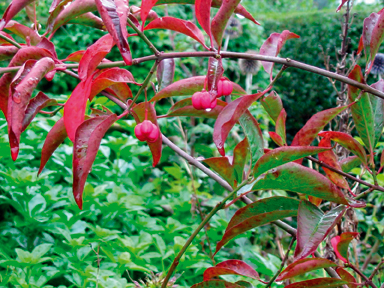
Hannah Genders brings a spot of autumn colour to the garden.
It’s a fantastic time of year when all the autumn colours are really starting to come to fruition – even though it means that winter is just around the corner, the wonderful fiery reds and bright yellows are a feast for our eyes.
The reason for these fabulous colours we enjoy is actually due to the trees and shrubs “shutting down” for winter. With deciduous plants, as the winter approaches and the leaves stop photosynthesising, they lose their green pigment.
Then the other underlying colours in the leaf show through; depending on the plant, this can be anything from vivid reds to yellows, oranges and purples. This is also an excellent time of year to be planting trees and shrubs so you still have time to plan some autumn hues in your garden for next year.
If you have a large garden, the Sweet Gum (Liquidamber styraciflua) is a wonderful tree with the leaves turning orange, red and even purple, but be warned that it does reach a mature height of 70 feet. Often only one tree with good colour is needed in a planting scheme, as a specimen on its own or in front of a small copse of trees.
For smaller gardens, the common but beautiful Rhus typhina or Sumach tree is a good choice; for further interest try Rhus typhina ‘Lacinata’ – as the name suggests, the leaves are very finely divided and with the changing of the leaves it does look great.
Another small tree that I often add into autumn planting schemes, but for some reason is not so well known, is the Persian Ironwood or Parrotia persica. Its slow growing makes for an amazing range of colour on each individual leaf and would give that “wow” factor to many smaller gardens. It will also enjoy quite a damp site.
Many of the Acers are good for autumn colour, but do check when you are buying as a few have spring interest only, like the pink-leaved Acer pseudoplatanus ‘Brilliantissimum’.
Small trees reach about ten feet in height and so there is a crossover in size between them and the category called a “large shrub”. Again many of these are great for autumn colour. The euonymous group of shrubs often give fine autumn shades, and Euonymous europaeus “Red Cascade” has the added treasure of little winged red fruits hanging from the branches. Just don’t expect it to do anything else for the rest of the year because it saves itself for the autumn display.
Sometimes a tree or shrub will give you a double display, with flowers in the spring and then dramatic leaf colour in the autumn. The shrub Amelanchier canadensis is a good example with its white blossom and young copper leaves in the spring and then another display of colour in the autumn as the leaves turn orange.
It also has bright red berries, which any book will tell you are edible, sweet and delicious. I have never tasted them as the shrub in my garden doesn’t keep them long – the blackbirds strip them in about two days. I always forgive them, though, as it seems to me such a privilege to have them just outside my window.
Do go out and enjoy the autumn displays in the garden and in local woodlands and let me encourage you to put some autumn stars in your plot ready for next year too.
